Category: Features (Page 13 of 37)

Robot Heart Stories Sends Kids on Cross-Country Trek Fueled by Imagination


Image by Mike Hedge and Tiffani Bearup

Lance Weiler’s most recent project began with a simple yet provocative question: can a robot reboot education? To answer that question, Weiler collaborated with fellow Workbook Project contributor Janine Saunders in creating Robot Heart Stories with a team of more than 50 creative professionals.

For the project, students in a Los Angeles elementary school class and a Montreal media workshop teamed up to send Laika, a small female robot scientist, from Canada to California. As a team of award-winning photographers drove the robot across country, the 42 students fueled Laika’s journey with stories, videos and letters. Photographers and other artists brought the children’s work to life and, in turn, uploaded their work to the website.

While this ambitious project focused on the two groups of students, aspects of the campaign were open to the world. Anyone could create a heartpack, origami robots that could be painted, colored or photographed in different settings. Those images were also uploaded to the Robot Heart Stories website. Other classes used the project for experiential learning projects. This collaboration had virtual and real world implications. The website notes that “everything you submit helps the robot’s heart meter reach full strength, AND it helps raise money for underpriveledged [sic] students.”

Continue reading

Dark Score Stories Hides King’s Secrets in Bag of Bones Photo Essay


Image courtesy of Campfire

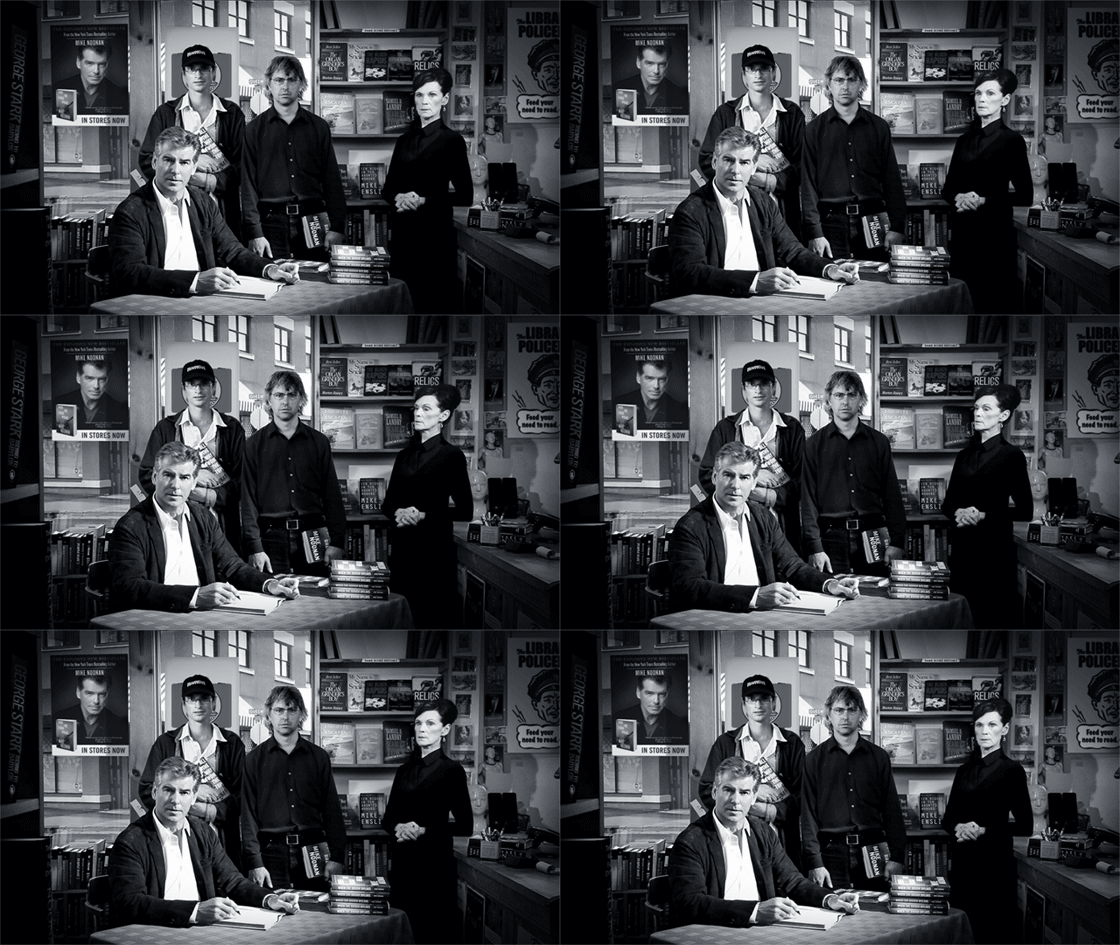
In anticipation of A&E’s upcoming adaptation of King’s novel Bag of Bones airing December 11th and 12th, Campfire created Dark Score Stories, a deceptively simplistic photo essay that provides a glimpse at life in the unincorporated township of TR-90. High fidelity black-and-white images shot by award-winning photojournalist Joachim Ladefoged provide artful glimpses into life at Dark Score Lake, complemented by audio interviews with the local townsfolk featured in seven separate sections of the site. Scratch the surface, however, and an entirely new experience inundated with King-themed puzzles and easter eggs emerges.

The first indication that something might be amiss with an otherwise straightforward photo essay comes from the headline images featured at the beginning of each of the seven sections. In her lighthouse studio, Jo Noonan’s smile is briefly wiped clean. Gerald Lean’s face is twisted by a grimacing smile at his shop of curios. And Lance Devore’s hands shift from a protective embrace of his daughter Kyra to a much more threatening grip. These changes are all the more startling for their subtlety, adding a new dimension to the audio commentaries.

Puzzles are integrated into the experience through messages hidden within each photo essay. Bold letters in the website’s introductory message instruct readers to “go down left side” for clues to seven increasingly difficult challenges. Solving each clue leads to a new exclusive preview of A&E’s upcoming miniseries as well as seven GetGlue stickers. The real challenge, however, lies in the photographs themselves.

Continue reading

2011 Year in Review: The Year in Three Quarters, Nickels, and Dimes

In the past three months, players have demonstrated their willingness to pay for alternate reality games.

Taken in isolation, players reaching into their pocketbooks to pay money for alternate reality games is not news. Ever since the genre’s inception, opportunities to pay money for ARGs have emerged. Majestic, Electronic Arts’ venture into the world of alternate reality games, reportedly convinced about 15,000 players to pay $9.95 a month (or $40 for the CD) for access to its content. Studio Cypher adopted a similar model for its month-long multiplayer novels, which offered custom content to “Wakeful Agents” willing to pay $9.99 for a more immersive experience. Games like Perplex City tied gameplay to collectible puzzle cards that collectively unlocked additional content for approximately $5 per pack, while local interactive experiences like those produced by Accomplice, 5-Wits, and Ravenchase Adventures charge admission to their real-world adventures and hunts.

Having said that, the past few months have seen a resurgence of campaigns seeking players willing to pay for their alternate reality games, with more options of game experiences to buy into than ever before. The past quarter has been a busy one for alternate reality games with experiments in new storytelling platforms and additional institutional assistance for developers. This article will offer a taste of some of the campaigns that have caught my attention since my last broad look at the industry in April.

Continue reading

Unlocking the Future at the New York Public Library

Growing up, my parents had me convinced that one of the local librarians lived the building’s basement. For years, Jim Caccamo was an archivist at the Hudson Library and Historical Society, and spent countless hours preserving the library’s collection of artifacts. He spent so much time there, it was a relatively simple matter for the librarians, with a little help from our parents, to convince many younger library patrons, myself included, that he never left the building. I suspect that one of the reasons we were so willing to believe this local urban legend was because the prospect of staying overnight at the library with all of its artifacts from history was such an exciting one. Sadly, Jim is no longer with us, but the legend he inspired stuck with me through the years. On May 20th, the New York Public Library invited five hundred people to stay overnight as part of the Centennial celebration. I was lucky enough to be one of the attendees at the launch of Find the Future, letting me live out the fantasy Jim planted in my head so many years ago.

Find the Future is a game developed by Jane McGonigal and her husband Kiyash Monsef along with Natron Baxter Applied Gaming and Playmatics, on behalf of the New York Public Library. The game itself involves a mobile scavenger hunt to discover one hundred artifacts including a fireproof copy of Ray Bradbury’s Farenheit 451, Malcolm X’s briefcase, the stuffed animals that inspired A.A. Milne’s stories of Winnie-the-Pooh, and Charles Dickins’ letter opener with a handle made from his cat’s paw. QR codes near each object can be scanned in using iPhone and Android apps to unlock writing prompts that ask players to think about their futures. The game provides individuals with a casual way of exploring many often overlooked details of the library along with prompts designed to make visitors think about how each artifact is relevant to their own lives. Interacting with the experience is a deeply personal, contemplative experience that plays out over time as players gradually return to the library and post their responses online. Players are rewarded with points for unlocking artifacts and submitting stories, allowing them to level up their writer level and receive achievement badges. Players can then assemble their favorite stories into an online Epic. Visitors to the public library can play the Find the Future game through the end of the year.

The Write All Night event invited 500 players to experience an intensely collaborative version of the Find the Future game. Players were selected from a pool of 5,000 entrants who explained what they would accomplish by the year 2021. The goal for the night was to create a 600-page book collecting player responses to each artifact prompt between 7PM on May 20th and 5AM on May 21st: in turn, the library promised to preserve and protect the book as long as New York City exists. Paper Dragon Books’ Gavin Dovey was on hand to bind the entries into a book before the night’s end, and editors made themselves available to help participants polish submissions. Before the event started, McGonigal assured players, “we have not rigged this game so you will win: it’s up to you.”

Continue reading

Current TV’s Participation Tango, Bar Karma

An old man stands behind a bar.  Half butler, half mad scientist, he sports a three-piece gray suit, an all-knowing smile, and the frayed messy grey hair of an aging genius.  He withdraws a deck of cards labeled with simplistic circles and lines, slowly shuffling the deck before placing a handful of cards in front of a patron at the bar going through a turning point in their life. Every time he touches a card, the card’s face is replaced by a glimpse into one of the patron’s many potential futures.

Welcome to the signature scene from Bar Karma, a science fiction themed television show on Current TV. This past Friday, Bar Karma ended its first season.  The show features characters from different times and places as they unknowingly enter a bar outside time and space when they have a tough decision to make.  The show repeatedly asks questions about fate and free will as the barkeep and his small but attractive staff attempts to help each new character while protecting their renegade consultation shop from a mysterious evil entity.  Each episode’s narrative is created in part by an active portion of the Bar Karma audience that proposes and votes for plots.

Co-produced by former Nickelodeon executive Albie Hect and Sims creator and game industry legend Will Wright, the show is experimental TV on the bleeding edge of interactive storytelling.   “The mission is to extend to the viewing audience an unprecedented amount of input and participation in the development of the series,” says David Cohn, General Manager for Current TV.  “To create the world’s first community-developed series.”

Continue reading

Discover History at NYPL and Find the Future

According to Jane McGonigal, gamers tend to read books more than they watch TV. Books give us big ideas and inform our imaginations, create new worlds and take us on amazing adventures. Oddly enough, the place where books are kept and made available, the library, does not usually fill us with the same sense of wonder. The New York Public Library wants to change that perception. The library’s goal is to “inspire people around the world to see libraries as a place where they can achieve their dreams and invent their own future” and “show off NYPL as a space for active creation and social collaboration.” To do this, the library has developed Find the Future, an interactive experience that guides visitors through the many artifacts housed at the New York Public Library. The game is directed by Jane McGonigal and her husband Kiyash Monsef, and designed and developed by Playmatics and Natron Baxter Applied Gaming.

Find the Future will initially be played by 500 participants who will be locked into the Stephen A. Schwarzman Building overnight on May 20, 2011. Once inside, players will go on real-world missions by following virtual clues on laptops and smartphones, collaborating online to discover 100 amazing and unique items from the collections of the New York Public Library, like Charles Dickens’ letter opener or a draft version of the Declaration of Independence. After finding each object, they will write a short piece based on the experience, inspiring the future with their personal contribution, which will later be bundled and published in a book. As McGonigal explained to CNN.com, “it really becomes clear that for every moment in history there was a person who set that moment in action — and you could be that person.”

Continue reading

« Older posts Newer posts »