Category: Features (Page 24 of 37)

Alert Vulcan, After the Fact

trekcore_vid_screencapThe most recent Star Trek movie has been a rousing success, earning $76.5 million on opening weekend. And like many projects involving JJ Abrams, Star Trek was promoted using an alternate reality game, Alert Vulcan. While the game has wrapped up, one fan has created a video summarizing the experience, and five lucky players are still receiving rewards for their contributions in the mail.

Back in April, Hollywood party blogger The Cobra Snake posted a series of Star Trek mixers in Hollywood and Paris. Hidden in the background of some pictures were barely discernable text strings that led players to a distorted video of the Narada, Captain Nero’s Romulan vessel in the film. Further code lead to a chat log of five Romulans conversing in English, French, Spanish, Japanese, and German.

One of them left an item in France, which was recovered by “Malako.” Following a series of clues, players uncovered a staged Romulan crash site with Romulan symbols visible from the air. They also gained the ability to manipulate a digital hologram of a starfield via webcam by going to johannbayer.eu, entering the code U04C5NMD413, and printing out the background image, using a system similar to the Experience the Enterprise viral.

Eventually, players received phone calls explaining the situation: two sets of Romulans crash landed on Earth, with one group attempting to help Captain Nero destroy Earth, and the other group attepting to prevent it. By recreating a transmission at AlertVulcan.comand reposting the file across the internet, players were able to prevent the end of the world.

Capping off the alternate reality game, Leonard Nimoy personally congratulated the participants on YouTube, five players in particular. Matt was selected to receive a replica of the USS Enterprise, while the other four top contributors received a collection of Star Trek related products pictured here and here.

Special thanks to ellisrico for putting together a great video summary of the game.
Skeleton Creek

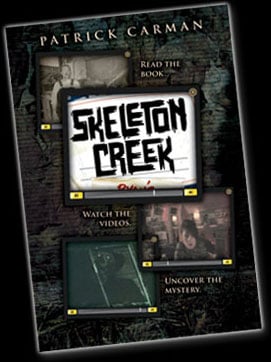
For those of you looking for a great cross-media spooky mystery comes Skeleton Creek, a half book, half movie experience by best selling author Patrick Carman. Published by Scholastic Press, the book serves as the doorway to the world of Sarah Fincher and Ryan McCray as they try to solve the mystery of Skeleton Creek. Their challenges come in the form of ghosts, mysterious park rangers, and other discoveries that set the path for their adventure — to which the reader, of course, has a front row seat. Ryan is hurt early on in the story, during one of his and Sarah’s first escapades, and so he resorts to writing down his thoughts in his journal (which is the book) and watching the videos that Sarah provides him via her password protected website (which is the movie element).

Due to the nature of this work, one could not just read the book or watch only the movies and get the entire story. Both media are intricately tied together and work to give the reader/viewer a sense of the story and the world of Skeleton Creek. However, even as the reader reaches the end of the book and has watched all of Sarah’s movies, the Skeleton Creek experience is not over.

Continue reading

IU’s “Skeleton Chase” Gives Students the Runaround

skeletonchase_logoA few months ago, I wrote about Indiana University’s exciting new alternate reality gaming research project, Skeleton Chase. The game was a collaboration between professors Anne Massey (Kelley School of Business), Jeanne Johnston (Kinesiology Department), and Lee Sheldon (Telecommunications Department). Now that the game is over, the three professors took the time to describe the game play and their research to me.

During the first week of the game, students in Indiana University’s Foundations of Fitness and Wellness class were greeted by Steven Cartwright, a public relations representative from the Source Corporation, a fictional company researching health and nutrition. The students would participate in a series of fitness challenges, and were handed a worksheet and free bottles of vitamin water. Through the worksheet, students discovered the Source Corporation’s “Internal Site” using clues from the presentation to access the site. Through the Internal Site, students discovered IU Security reports relating to Sarah Chase, a missing student. Her former associate instructor Sam Clemens was also missing.

Over the course of the next few weeks, the students engaged in a series of physical challenges from the Source Corporation while digging deeper into the disappearance of Sam and Sarah. According to Lee Sheldon, students

searched Sarah’s office (staged with planted assets including Sarah’s diplomas and research notebook); hacked into the IU Security internal website where they could access security camera footage from the night Sarah vanished; found Sam’s hiding place (but not Sam); and were able to uncover a wide-ranging conspiracy tied to a formula that may or may not retard aging. In the process they learned of a third person’s disappearance; were alerted to flying saucers sited near IU’s Cyclotron facility; and investigated appearances of a creature dubbed the “Blomington Bigfoot” in some campus woods.

Continue reading

CommanderVideo: We Barely Knew Ye

commandervideo_01Four days before Christmas, fans of alternate reality games got an early present. A member on the Unfiction forums noticed a strange new video and from there, it seemed that a new ARG had begun. The video, an eerie clip that showed a group of German explorers discovering and being attacked by a partially buried television, got the attention of the message board members who looked towards commandervideo.com for answers.

At the apparent trailhead web site, the rabbit hole wound further down as players began getting correspondence from a being named CommanderVideo, a professed alien life form approaching earth and in need of help. Just as it appeared that the puppet masters were prepared to reveal to gamers the reason for the viral campaign and the ARG that grew out of it, a player found a scan of a recently released Nintendo Power article that did the job for them.

While the Internet gives life to ARGs, it also has the power to take that life away, and the scanned article contributed to this game’s premature end. The Nintendo Power article killed the ARG as it exposed the game CommanderVideo was marketing, Bit.Trip: Beat, and this left players upset and frustrated. The players were not alone in their disappointment as Gaijin Games, the game’s creators, were also frustrated with the premature reveal. With the game effectively over, players questioned what went wrong.

Alex Neuse, the CEO of Gaijin Games, was kind enough to answer those questions and discus the promising ARG, its abrupt demise, and the upcoming release of Bit.Trip: Beat for ARGNet.

Continue reading

The Family That Games Together

robbie_swag_pa.jpg

“I got it Robbie! I got it,” My mother screamed into my ear. As she excitedly described her prize, my cell phone let out a monotone cry and the line went dead. Next came a knock on my cubicle wall. Looking up, I saw my boss standing in the doorway.

“Robbie, can I speak with you for a second?”

“Sure thing,” I said, stuffing my phone into my pocket, hanging up on my mother as she was calling back, “No problem.”

…..

My mom loves scavenger hunts. There always seemed to be a particular thrill in it for her–the chase, the race against time, the competitive nature of the event. Although she has always loved hunts, mom has always had one problem: her inability to win. Despite years of playing, she had never walked away as the victor, carrying the spoils of war in her triumphant hands.

Perhaps you now understand my hesitation to call her when I learned of Project Abraham‘s last hurrah. As 42 Entertainment wrapped up their immersive viral campaign for the Resistance 2 video game release, they had planned the ultimate ARG event–the coveted Dead Drop. All around the nation twenty satchels were hidden, their coordinates released over a five-day period to anxious players who then scrambled to be the first to reach them.

Continue reading

PICNIC ’08, part six: From Crowdsourcing to Collaborative Creation

argnetpicnic2008.jpgEditor’s Note: Daniël van Gool, an administrator at the Unfiction forums, was on the scene at PICNIC ’08 on behalf of ARGNet. We were impressed with Daniël’s work covering PICNIC ’07 and, as media partners of the annual cross-media festival, were invited to a number of special events in addition to the speaker sessions. This is the sixth and final part of Daniël’s comprehensive look at this year’s event in which he outlines the highlights of day three of PICNIC ’08. All pictures are courtesy of Daniël as well.

I arrived at PICNIC early on Friday the 26th. When I arrived, the main conference hall was mostly empty, but it was filled with the ambient noises one would expect at a picnic — crickets, a flowing creek, and the occasional buzzing fly. This is why I love PICNIC so much! The smell of fresh coffee slowly filled the building, even though PICNIC’s Espresso Factory was closed for the morning, and life was good.

The focus of day 3 of PICNIC ’08 was on the collaboration within the creative industry, which mean that there would be a ton of showcases by different entrepreneurs that are developing several innovative concepts that provide means for creativity and/or collaboration. Before this ‘parade’ of mostly very ingenious commercial concepts, Matt Costello gave a speech presenting his thoughts and ideas on creativity in games in a highly entertaining form. Costello is mostly known as a games-designer, having worked on The 7th Guest and Doom 3, and on several novels and games for TV (PBS, BCC, the SciFi channel). He introduced himself as somewhat of a cross media schizophrenic.

He started out by talking for a bit about the concept of Story, by telling a tale about a personal encounter with a shark that he had while diving. He then read a passage from a novel he co-wrote that used that personal experience to base the storyline upon and engaged the audience in a conversation about the differences.

He stated that the audience often knows something that the protagonist in a story doesn’t know, a point he illustrated by bringing two members of the audience on stage. His point was that a good story creates the illusion that something is going to happen, but then causes something else to happen, making the audience the surprised party instead of the protagonist. The unexpected and the unknown are two important factors in storytelling, interactivity and games.

Costello went on to demonstrate a lot of his other points by having members of the audience perform several tasks. Again, it is very hard to convey his points by merely describing what happened. During his address, I was chatting with people on IRC following along through PICNIC’s live feed, and I said the following:

<Gisk> yeah, Matt Costello is a fun guy
<Gisk> very good points he made about storytelling and gameplay
<Gisk> unfortunately, almost impossible to write up… you need to see his interaction with the audience and the creation of illusion to convey what he was talking about
<Gisk> which is exactly his point
<Gisk> so, figures 🙂

I guess this is the best summary I can give, so I’m afraid it’ll have to do.

Continue reading

« Older posts Newer posts »