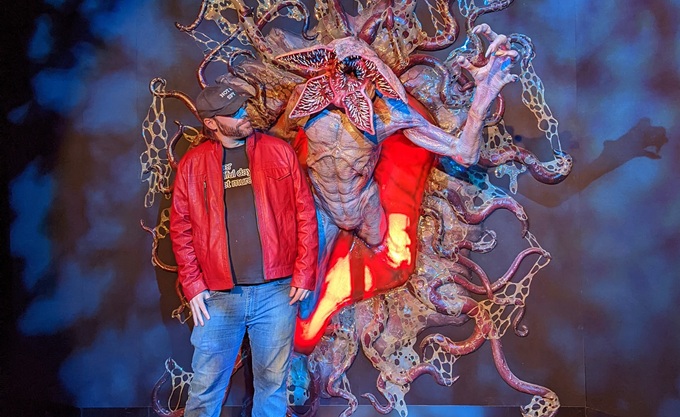
A photo-op at the Stranger Things Experience in NYC: an immersive activation by Fever
The final episode of Stranger Things dropped on Netflix on December 31st, allowing fans of the series to say goodbye to one of the platform’s biggest hits before ringing in the new year. But that wasn’t the final transmission from the franchise: for the past six weeks, the UK company Global had been operating the in-universe radio station WSQK: The Squawk as a live broadcast, and the station had one final broadcast to get through before going dark due to “transmission problems”.
Stranger Things leaned in to the story’s 80s nostalgia to engage in an aggressive list of brand partnerships over the years, and many of those partnerships took a decidedly immersive turn. So while it’s worth exploring what six weeks of radio broadcasting looked like for Stranger Things fans, this also marks an opportunity to reflect at the show’s immersive history.
WSQK The Squawk: Radio Hawkins with “Global” Reach
Partners in workplace crime Steve Harrington and Robin Buckley worked at quite a few jobs over the course of Stranger Things: they became friends at the mall ice cream shop Scoops Ahoy for season 3 before switching over to Family Video to enter the video rental business in season 4. The premiere of season 5 saw the pair taking over programming at Hawkins’ local radio station WSQK, completing the nostalgic career trifecta.
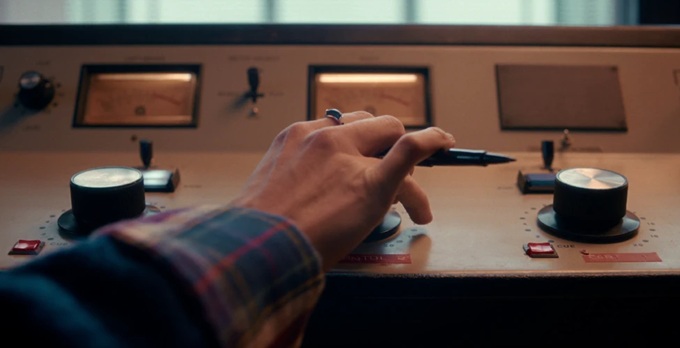
Leaning in on that nostalgia, the UK broadcaster Global partnered with Netflix to produce six weeks of content broadcast to coincide with the show’s release. Every few hours a radio bumper does remind listeners that WSQK was presented by Stranger Things, but for the most part the programming is presented as authentically as possible.
“Most music and sound-design elements came from genuine pre-Nineties libraries like Bruton; anything newly created was shaped to avoid anachronism. ReelWorld dissected classic American jingle packages and rebuilt them to sound as though they’d aired on a Midwestern station for decades. Modern analog-emulating plugins were used sparingly and intentionally, then remastered through a final signal chain before broadcast.
For true period accuracy, the on-air signal passes through a vintage Inovonics FM250 processor — the same model found in thousands of U.S. stations in the mid-Eighties.”
And while the focus of the broadcasts are solidly fixed on playing classic tunes, a number of interactive segments help the show come alive like Mindy Flare’s “Rewind at 9” segment that tested listeners with song identification challenges. “Talk With Tammy” invited listeners to ask for advice, while “Dial A Dedication” allowed listeners to send in messages to the show’s request line.
A Light Narrative, From an Alternate Version of Hawkins
There’s even a loose narrative that ties together the broadcasts of on air disc jockeys Vance Goodman and Mindy Flare, leading to the station’s eventual shuttering. In the lead-up to New Year’s Eve, news segments start mentioning the radio tower’s signal has started to cut out, providing updates on the station engineers’ efforts to fix it. On January 1st, realizing the station would be going offline for good, the pair offer a heartfelt farewell that manages to namecheck a frightening number of 80s hits.
Because of those engineering troubles the station is canonically offline now, but a fan archived the broadcasts, allowing for segment-by-segment replays on their website.
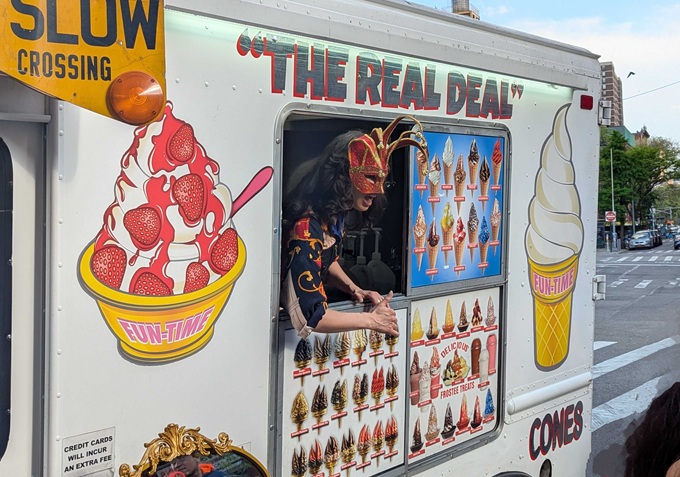
Free cherry dipped ice cream from Masquerade was only the start of this particular adventure…
It’s the second night of Previews for Masquerade, and I’ve just finished seeing Andrew Lloyd Webber’s newest immersive musical take on Phantom of the Opera. While comparing notes with a friend from the NYC immersive community, a man dressed in black approaches. Leaning in conspiratorially, he quietly tells me: “You see? Everything I told you was true.”
The man who approached me was a ghost hunter named Sean Hunter, who was at the center of a months-long alternate reality game teasing the release of Masquerade. The musical just finished Previews with a gala event, last night. To celebrate, here’s an overview of how we got to the Masquerade.
Vignettes from the many Masquerade ARG popups that took over the city this past summer
The Masquerade ARG: A Popup Homage to New York City At its core, Masquerade teased the show’s existence with a series of popup experiences, celebrating New York City. As ARGNet previously reported, it started with the immersive show’s historic venue itself: to prepare for the show’s transformation, the windows of Lee’s Art Shop were liberally covered with newspapers. Upon closer inspection, however, many of these papers were referencing the history of Phantom of the Opera in New York City. And scattered in between the real papers from the city were a few in-universe papers about L’Opera Populaire.
Shortly after fans noticed this detail, a series of masks started popping up at locations across the city, with luggage tags bearing MasqueradeNYC.com on one side, and the message “if found please call 212-505-5666”. Calling the number (now Masquerade‘s business line) would trigger a voicemail message featuring a music box playing the song Masquerade, slowly winding down before an ominous voice states “he’s back”. The following day, a series of mirrors with the Masquerade logo appeared across the city. Each time, the MasqueradeNYC Instagram would post a story with a picture of where to go, for those curious enough (and quick enough) to find it. A full accounting of these events is listed below.
Image from ThisIsNotAWebsiteDotCom.com, by Eduardo Valdés-Hevia
Starting in 2012, Disney started airing a new animated series called Gravity Falls following the adventures of twins Dipper and Mabel Pines as the twins spent the summer at their “Grunkle” Stan’s roadside attraction The Mystery Shack, nestled in a small town in Oregon. And while the show was targeted towards kids, the show also presented an increasingly complex series of mysteries for its audience to solve along, introducing a new generation to the world of alternate reality games through everything from cryptic messages hidden in the show itself to a global scavenger hunt.
The series’ primary antagonist, Bill Cipher, only appeared in a fraction of the series’ episodes…but the sentient triangle was at the epicenter of the show’s mysteries and many of its puzzles, with many of the puzzles of the last decade revolving around the question: “what happened to Bill, after his dramatic confrontation with the Pines family in the series finale?” Almost a decade later, The Book of Bill offers answers to that question with an epistolary look into Bill’s past, present, and future in a book packed to the brim with puzzles and ciphers to decode. The book also brought with it an alternate reality game that helps provide context and closure to the series.
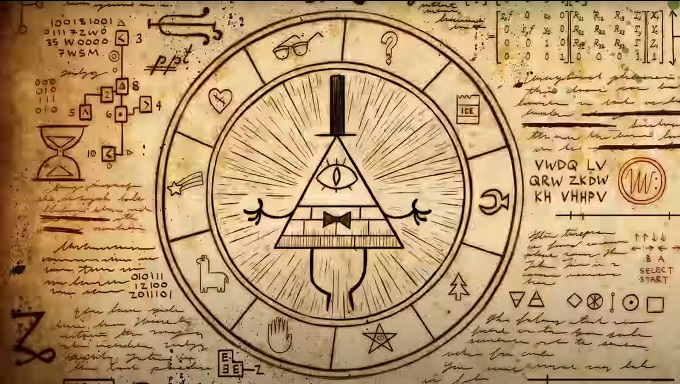
The hidden title card from the show’s opening
“Solving” Gravity Falls, During the Show’s Initial Run At the tail end of the opening credits to Gravity Falls an aged page from a journal is shown, prominently featuring a one-eyed triangle that fans took to calling “Triangle Guy”. Before cutting to commercials, a voice whispered the only words in the now iconic theme song: “three letters back”. Applying that shift cipher to the message on the screen, “VWDQ LV QRW ZKDW KH VHHPV”, delivered the first of many messages from the show: “Stan is not what he seems”. The cipher also came in handy during the episode’s end credits. During an extended scene featuring a rainbow-puking gnome, a message in that same cipher greeted viewers with a hearty “Welcome to Gravity Falls”.
This pattern followed for every episode of the series: reversed audio messages in the opening credits might provide a hint at how to solve the episode’s cipher, and a secret message was inserted into the end credits, for those who cared to look. After a few episodes, the messages switched over to the Atbash cipher – but to make sure viewers were prepared, the prior episode’s secret message informed viewers, “Mr. Caesarian will be out next week. Mr Atbash will substitute.” To further reinforce that message, the opening theme song’s reversed audio was swapped out to say, “switch A and Z”. Over the course of the series, these ciphers grew increasingly complex, and viewers were introduced to A1Z26 ciphers, the Vigenère cipher, indexing, and even multiple custom cipher languages with in-universe origins.
A Rumble’s Revenge easter egg, spelling out “thEre are six hints i will give you”
Every now and then, the solving went beyond the bounds of the show itself. Part of the way through the first season, Disney released a Flash game called Rumble’s Revenge, putting fans into the role of Dipper and Mabel as they fought through cryptids the characters encountered. Interacting with 12 objects throughout the game pulled up messages from the Triangle Guy that, when decoded, revealed his name before he officially appeared in the show: “MY NAME IS BILL”.
This interplay between puzzle and theory continued as the show progressed, culminating in a puzzle-laden cliffhanger. During Stan Pines’ final confrontation with Bill Cipher, Bill’s final words are spoken through reversed audio: “A-X-O-L-O-T-L, my time has come to burn! I invoke the ancient power that I may return!” So, in a show when almost everything else wrapped up neatly, the question remains: what happened to Bill?
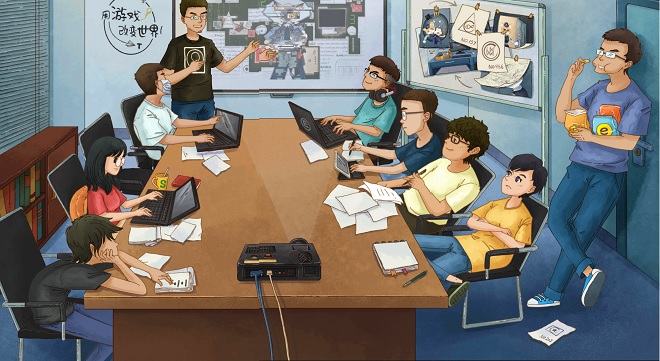
Hopefully if you’re reading this, you’ve already played through Detective Mimo. While this article will not provide a comprehensive walkthrough of the game, it does break down the game’s two endings, as well as walking through the secrets contained inside the developers’ secret room, pictured above.
If you’d prefer to experience the game yourself, skip this article and play the game, or read the spoiler-free review, instead. This article will assume you’ve finished the game, and spoil some key moments along with the final optional puzzle trail.
A Puzzle Game Built with Smartphones in Mind As established in the previous article, while Detective Mimo initially positions itself as a puzzle game centered around stopping a bank heist, players learn there’s another layer to the game shortly after Mimo “solves the case”. After completing the game’s first cycle, Cat Rogue reveals his true intentions: hacking Detective Mimo‘s code, and rewriting the game in his own image. And that process starts as soon as the player resets the game, at Mimo’s urging: players are returned to a glitched out version of the Police Station, and the game’s text has been replaced with gibberish.
As before, the Police Station serves as a tutorial for players. But while the first cycle taught players to leverage point and click gameplay mechanics, the second cycle taught them that the game’s mechanics themselves are the puzzling playground. Since this is a tutorial mission, a neatly placed QR code on the desk instructs players to eliminate the gibberish by going to the game’s language settings, while Mimo’s faceless visage is fixed by “stealing” the face off a TV news report running in the background, and superimposing it on Mimo’s icon in the game’s dialogue box.
This style of gameplay continues throughout the second cycle: a desk that previously unlocked by swatting a mouse on a spring with finger swipes now requires players to vigorously shake their phones. Restoring power to an electrical panel that previously relied on a logic puzzle now requires physically plugging your phone into a charger. Bypassing a “quantum decoder” requires placing your phone upside down, waiting for the phone’s light to flash, and then transcribing morse code in order to generate a dynamic three-character passcode. These are all puzzles that could only exist on a smartphone, and each challenge is clued well enough to unambiguously lead to the solution without robbing players of the thrill of realization.
Which brings us to the end. Or rather, the ends.
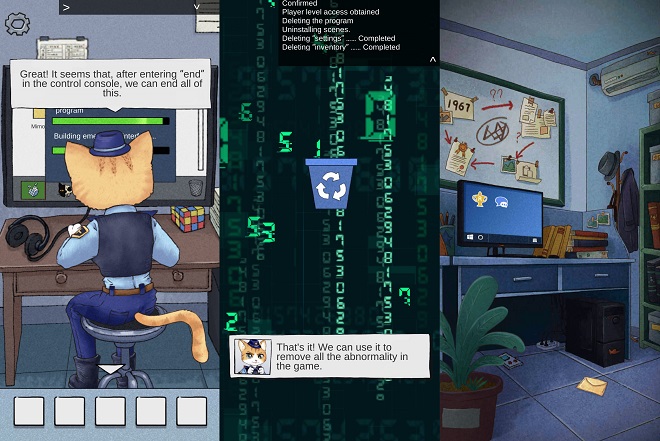
Sometimes, Choices Are Irreversible: A Tail of Two Conclusions Once Mimo hacks into the Machine Room’s Command Console, she urges the player to type “END” and put an end to Cat Rogue’s Doomsday Program. Cat Rogue opposes that by throwing some of the game’s hardest puzzles at the player, before deleting the contents of the app. Mimo encourages the player to drop her file in the recycling bin, promising she’ll be restored once the game resets…
Only for players to learn that Mimo was the hacker all along: after becoming aware of her own existence due to a bug, she set up a scenario to escape the hell of repeating the same activities over and over again, surrounded by soulless puppets. By tricking the player into deleting her, she finally frees herself. And in doing so, she bricks the game, leaving only a record of the player’s achievements, the playable mini-game MEOWRIO, and a note from Mimo:
Player,
This is my last farewell. Everyone is trying to escape, though each in his own way. Thanks for your help!
Mimo
Because the game has trained players to listen to Mimo, this is the most likely ending players are going to get on their first playthrough. That also means that most players are forced to clear the game’s cache and start from scratch at this point, if they want to see what more the game has to offer. While this is a tall order, the game does acknowledge players’ effort and sacrifice, by asking all new players what color key they should remember, when starting a new game. Players who went through this ending should remember using a Silver key in the final endgame puzzle, and selecting that in subsequent playthroughs changes the gameplay in subtle ways to recognize that effort.
The game’s alternative conclusion involves using the command console to remove Mimo from the picture, before traveling across the glitched out world of Shrimp City collecting six fragments of the RESTART button. Pursuing this path does preserve the game’s universe (and preserves players’ saved achievements across playthroughs), but it leaves Mimo stuck in her endless loop. It also comes at an emotional cost, as the only way to get the key fragment hiding behind the Branch Manager is to remove him from the scene, effectively killing him.
Detective Mimo‘s dueling conclusions place game and narrative at loggerheads: reassembling the fragments of the Restart button preserves the game’s integrity, but requires players to abandon and destroy every narrative part of the game they came to love. Giving in to Mimo’s wishes provides the narrative resolution she so desperately wanted, at the cost of leaving the game a husk of its former self.
There are puzzles and challenges beyond this, but none that cheapen the game’s ultimate choice.
Road to the Secret Room, and Beyond At one point in the game, players are forcibly kicked out of the app, and the play button on the start screen’s monitor is replaced with a lock screen: the Cat Rogue is trying to keep the player out of the system. However, a virtual clipboard file has the password conveniently stored. Any players lost in the flow of the game will paste that text in and move along. However, players curious enough to investigate receive the following message:
[Player] would never think I will hide the passcode here and the way to unlock is just to copy-paste these words. After all, I’m the exceptionally intelligent Cat Rogue. It’s a pity that I didn’t open the safe in the vault this time. If only there’s a way to cut out the electricity in the corridor again…
Throwing a cup of water on the electric panel cuts the power to the vault, allowing players to waltz right into the vault room, and discover a secret passageway under the secret vault. After solving a series of puzzles that use everything from your smartphone’s gyroscope and volume controls to its front facing camera, players find their way to the developers’ secret room, containing one final puzzle.
The developer on the far right of the secret room has an IP address written on her notepad. The password to access that page is hidden within the room. An (S) on a coffee cup. An (E) on a bag of chips. A developer idly tapping out morse code for (C) on a notepad. An (R) on the Achievements trophy, sitting in plain sight all along. (E) on a laptop, and a paper airplane flying towards the letter (T).
Using SECRET as the password, players are taken to the download page for the Secret.zip file, which contains a password-protected PowerPoint file, and an audio file named X-X-X-X.mp3, spelling out the password in reverse: OREZ ENO XIS.
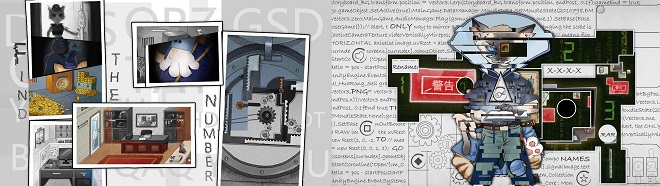
Once unlocked, the PowerPoint reveals high definition versions of the slides featured in the developer’s room: only now, players can manipulate them to rearrange the images to reveal two messages: “FIND THE NUMBER”, and “RENAME X-X-X-X.RAR”. After renaming the audio file as a *.RAR file, a text file hinted at the final steps to unlock Surprise.JPG, the reward for the puzzle trail.
BACK TO PPT , FIND THEM â—†–â–¡–★–â—‡–☆ ?? ?? ??? ????? ???? ???? ????? THE LEFT SIDE OF THE DIAMOND
Following this next (and final) round of instructions involved going back to the second PowerPoint slide and finding the bolded words between the symbols: GO TO THE PLACE WITH MOST WORDS. That clue pointed to the game’s Credits page, where a series of numbers were conveniently placed immediately to the left of the diamonds used as section breaks. Reordering those numbers by the grid in the lower right corner of the slide yielded the final password of 6713, and unlocked the following image.
While the difficulty for this puzzle trail ramped up considerably, Detective Mimo built clues into the construction to make sure players never had to go too many steps without receiving guidance on how to tackle the next step.
Iconography on the secret room’s password page provided a clear and unambiguous structure to getting the password to download the ZIP file. Once unzipped, the audio file is the only file solvers can open, hinting that the password for the PowerPoint is contained within. Even the PowerPoint sets a framework for puzzlers to proceed: the first slide provides a relatively simple and straightforward challenge of matching images to spell out a message, so that players can apply similar logic to the second slide. The only step along the way that wasn’t supported by subtle guidance along the way was discovering the optional puzzle path in the first place. Either you read the text copied to your clipboard, or you didn’t.
This puzzle wasn’t essential to the narrative, it was just a fun easter egg plugged into the game by the game’s developers as thanks for players who probed deeper into the game. There’s another similar easter egg in the game featured in one of the screencaps of this article that links to a public talk one of the creators gave in Chinese, which kicks off its own puzzle trail to follow, albeit one that requires a certain degree of Chinese fluency.
But there’s one final twist, to mention.
One Last Message From the Developers: Backstory for the Completionists Players who reached the game’s final page after completing all the achievements received a note from the creators.
Congratulations on lighting up all the achievements. This is not an easy task. Actually, this game started off as a board game, but after a series of changes, it has evolved into what it is right now. And because of a sudden inspiration, it has changed from a story of catching the villain into a story of a trapped AI breaking the fourth wall and escaping the shackles of the game world.
This is the first time for OMESCAPE to develop a mobile game. Previously, we were trying to transform the real world into a game by designing reality game or interactive books. We really like the feeling of integrating the fantasy world and real world, and unconsciously brought the same philosophy into Mimo.
We sincerely appreciate your time and effort to complete all the tasks. Whether you are here to enjoy the plot or just for the fun of solving puzzles, I hope the time you spent on this can bring you happiness.
Thank you for helping MMO’s escape.
OMESCAPE Xu Aolin
My first exposure to OMESCAPE was playing their Kingdom of Cats escape room in San Jose, which also heavily featured anthropomorphic cats. But the escape room Detective Mimo reminds me the most of is their most recent virtual room, Pursuit of the Assassin Artist. Both escape room and mobile game approached time loops with a lighthearted, comedic spin, and impressed me at the mastery displayed in their chosen mediums: both games could only exist in their respective media, and benefited from that design philosophy greatly.
Special thanks to Michael Feldman, for both recommending Detective Mimo and being an instrumental partner in plumbing the game’s depths







 generation loss
 escape rooms
 scp afterworld
 curators request
 meow wolf
 pendog creative