In 2048, Wikipedia was taken down by a series of spurious copyright claims. Within a year, a successor to the world’s largest crowdsourced collection of knowledge was replaced by Omnipedia, a more centralized online encyclopedia that relies on a select community of human and artificial intelligence contributors, with the backing of Chinese technology conglomerate Zhupao. On September 30th, 2049, Zhupao founder Xu Shaoyong’s helicopter was shot down by a missle fired from one of the airport’s security drones, killing the world’s wealthiest person, along with everyone else aboard. This is the central mystery of Neurocracy, a political thriller that plays out across edits to an online wiki from the future.
Neurocracy is a single-player, interactive narrative game created by Playthroughline, released serially on the Omnipedia.app website. The first chapter of the story (covering Omnipedia updates from September 28, 2049 – October 1, 2049) is freely available, with nine additional chapters released weekly for paid subscribers, with each week’s installment covering a single day of wiki edits and additions expanding the sci-fi universe’s footprint.
And while the assassination of Xu Shaoyong is the primary narrative skein to untangle, there are a number of fascinating side plots buried within the ever-expanding web of Omnipedia entries. Who was really responsible for the murder on season two of Are You For Real, a dating elimination show with a Turing test twist? Who is Adira, and what is their connection to the hacktivist collective Five of Swords? And why are peoples’ neural colloid implants glitching?
The Omnipedia Main Page, circa October 1, 2049
Wiki-Wrangling as Gameplay Neurocracy‘s gameplay is deceptively simple. With every new episode, the Omnipedia Main Page is updated to highlight a featured article, along with a series of breaking news updates. Using these as a jumping off point, players can learn more about the world by hovering over tooltips, searching for key words or phrases in Omnipedia’s search bar, or clicking on in-line links within articles. Players can also dive deeper into individual articles by using Revision History navigation to see how articles have changed over time, with revisions conveniently highlighted.
By leveraging those features, players can dive into the central mysteries of the narrative, and try to assemble disparate pieces of evidence to figure out what really happened to Xu Shaoyong. Neurocracy is a game of theory-crafting, piecing together clues left behind in online breadcrumbs. Somewhat ironically, Neurocracy‘s gameplay is almost identical to the process of trying to piece together the events of an alternate reality game, after the fact.
Interested in piecing together the events of the Dungeons & Dragons ARG No Stone Unturned, leading up to the release of the Waterdeep: Dragon Heist module? Pore through the game’s wiki, and navigate through a series of pages to piece together the narrative. Interested in how a vampire dating site Tender led to a major Vampire: The Masquerade announcement? Another fan wiki will help guide you through the process. Parsing through wiki entries remains one of the primary way player communities track and document the often sprawling nature of alternate reality games: Neurocracy cuts through the middle-man and makes that navigational exercise a story in its own right.
It’s tempting to compare Neurocracy to other wiki-based storytelling projects like the SCP Foundation. But while the SCP foundation is an exercise in collective storytelling populated by largely stand-alone stories where multiple truths can coexist and contradict each other, Neurocracy is a more singular vision, unfolding in a non-traditional format.
Similarly, Neurocracyis also slightly distinct from alternate reality games, as the experience doesn’t even allow for the illusion of agency in gameplay. Players aren’t interacting with the story because they believe doing so might influence events. They’re interacting to try and piece together the narrative puzzle. That’s one of the reasons why the process of playing Neurocracy is so similar to that of consuming ARGs after they concluded: it’s ARGs, stripped of agency. This form of storytelling is often referred to under the umbrella term of ergodic literature, and focuses on the amount of effort taken to engage in the process of reading as its defining trait.
In the mobile puzzle game Detective Mimo, the titular protagnoist is an anthropomorphic cat detective, sent to put a stop to the nefarious Cat Rogue’s crime spree at the Purrfect Bank. By solving a series of increasingly challenging challenges in the game’s point-and-click interface players get closer and closer to the bank’s vault, figuring out Cat Rogue’s true identity and motivation along the way. At least, that’s how the game starts. Before the game is over, Detective Mimo will have players practicing their command line coding skills, cracking open password-protected PowerPoint presentations, and deconstructing practically every playable element of the game to complete the narrative.
The First Round: A Point and Click Puzzle Adventure Detective Mimo starts out as a relatively simple point-and-click adventure game, albeit one that leans heavily on puzzle tropes. At the Shrimp City police station, Mimo is briefed on her assignment, which doubles as a player tutorial on the game’s core mechanics. Clicking on certain objects of the game allows Mimo to interact with them: clicking on a computer monitor might prompt players to enter a password, while clicking on other objects might transfer them into the player’s inventory, where they can be used by dragging and dropping them onto other objects.
Early challenges in the game are structured around breaking through a series of locks. Find the key to unlock the drawer, then figure out the password to unlock the computer. Find the missing pieces to access the Purrfect Bank’s interior, and then peel back layer after layer of security before finally reaching the inner vault. Practically every lock works on different principles so the process stays fresh, but a comfortable formula is established. Along the way, Mimo will stumble across more narrative clues essential to solving the broader mystery, allowing a successful identification of the Cat Rogue. All the while, the game maintains a lighthearted, comedic tone. Security Guard Mr. Purr Job is obsessed with the pop idol Meowna, while the bank’s Branch Manager keeps a secret stash of catnip locked away in his office.
Second Time’s the Charm: An Evolving Playthrough Experience It’s only after solving the game’s primary mission that things start to get weird. The game loops back and has players retread familiar ground…but things are different this time. The difficulty of puzzles ramps up considerably, and not all challenges can be resolved through the now-familiar point and click mechanics. In the game’s first cycle, players provided support to cat detective Mimo in her investigation. For the second cycle, you as the player take on a more active role. And this round of gameplay is where Detective Mimo excels, both in its narrative and puzzle design.
From the puzzling perspective, challenges take full advantage of the fact that this is a smartphone exclusive game to force players into thinking outside the box, providing creative solutions to familiar tasks. The narrative complexity also expands, as players have a choice of how to proceed resulting in two drastically different endings. There’s even a secret room in the game available in this stage, containing the most challenging puzzle trail of the game.
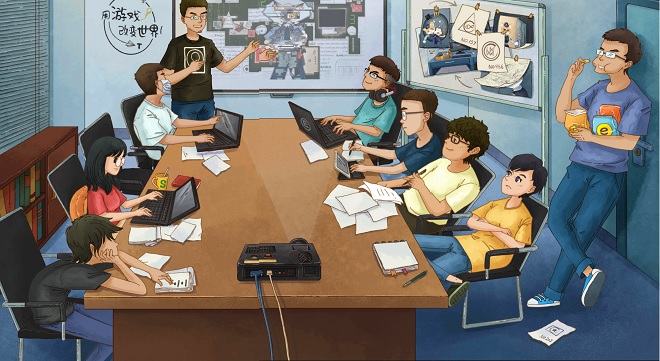
Hopefully if you’re reading this, you’ve already played through Detective Mimo. While this article will not provide a comprehensive walkthrough of the game, it does break down the game’s two endings, as well as walking through the secrets contained inside the developers’ secret room, pictured above.
If you’d prefer to experience the game yourself, skip this article and play the game, or read the spoiler-free review, instead. This article will assume you’ve finished the game, and spoil some key moments along with the final optional puzzle trail.
A Puzzle Game Built with Smartphones in Mind As established in the previous article, while Detective Mimo initially positions itself as a puzzle game centered around stopping a bank heist, players learn there’s another layer to the game shortly after Mimo “solves the case”. After completing the game’s first cycle, Cat Rogue reveals his true intentions: hacking Detective Mimo‘s code, and rewriting the game in his own image. And that process starts as soon as the player resets the game, at Mimo’s urging: players are returned to a glitched out version of the Police Station, and the game’s text has been replaced with gibberish.
As before, the Police Station serves as a tutorial for players. But while the first cycle taught players to leverage point and click gameplay mechanics, the second cycle taught them that the game’s mechanics themselves are the puzzling playground. Since this is a tutorial mission, a neatly placed QR code on the desk instructs players to eliminate the gibberish by going to the game’s language settings, while Mimo’s faceless visage is fixed by “stealing” the face off a TV news report running in the background, and superimposing it on Mimo’s icon in the game’s dialogue box.
This style of gameplay continues throughout the second cycle: a desk that previously unlocked by swatting a mouse on a spring with finger swipes now requires players to vigorously shake their phones. Restoring power to an electrical panel that previously relied on a logic puzzle now requires physically plugging your phone into a charger. Bypassing a “quantum decoder” requires placing your phone upside down, waiting for the phone’s light to flash, and then transcribing morse code in order to generate a dynamic three-character passcode. These are all puzzles that could only exist on a smartphone, and each challenge is clued well enough to unambiguously lead to the solution without robbing players of the thrill of realization.
Which brings us to the end. Or rather, the ends.
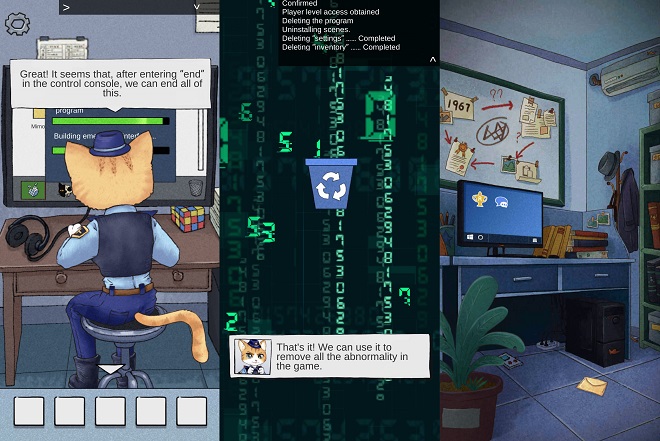
Sometimes, Choices Are Irreversible: A Tail of Two Conclusions Once Mimo hacks into the Machine Room’s Command Console, she urges the player to type “END” and put an end to Cat Rogue’s Doomsday Program. Cat Rogue opposes that by throwing some of the game’s hardest puzzles at the player, before deleting the contents of the app. Mimo encourages the player to drop her file in the recycling bin, promising she’ll be restored once the game resets…
Only for players to learn that Mimo was the hacker all along: after becoming aware of her own existence due to a bug, she set up a scenario to escape the hell of repeating the same activities over and over again, surrounded by soulless puppets. By tricking the player into deleting her, she finally frees herself. And in doing so, she bricks the game, leaving only a record of the player’s achievements, the playable mini-game MEOWRIO, and a note from Mimo:
Player,
This is my last farewell. Everyone is trying to escape, though each in his own way. Thanks for your help!
Mimo
Because the game has trained players to listen to Mimo, this is the most likely ending players are going to get on their first playthrough. That also means that most players are forced to clear the game’s cache and start from scratch at this point, if they want to see what more the game has to offer. While this is a tall order, the game does acknowledge players’ effort and sacrifice, by asking all new players what color key they should remember, when starting a new game. Players who went through this ending should remember using a Silver key in the final endgame puzzle, and selecting that in subsequent playthroughs changes the gameplay in subtle ways to recognize that effort.
The game’s alternative conclusion involves using the command console to remove Mimo from the picture, before traveling across the glitched out world of Shrimp City collecting six fragments of the RESTART button. Pursuing this path does preserve the game’s universe (and preserves players’ saved achievements across playthroughs), but it leaves Mimo stuck in her endless loop. It also comes at an emotional cost, as the only way to get the key fragment hiding behind the Branch Manager is to remove him from the scene, effectively killing him.
Detective Mimo‘s dueling conclusions place game and narrative at loggerheads: reassembling the fragments of the Restart button preserves the game’s integrity, but requires players to abandon and destroy every narrative part of the game they came to love. Giving in to Mimo’s wishes provides the narrative resolution she so desperately wanted, at the cost of leaving the game a husk of its former self.
There are puzzles and challenges beyond this, but none that cheapen the game’s ultimate choice.
Road to the Secret Room, and Beyond At one point in the game, players are forcibly kicked out of the app, and the play button on the start screen’s monitor is replaced with a lock screen: the Cat Rogue is trying to keep the player out of the system. However, a virtual clipboard file has the password conveniently stored. Any players lost in the flow of the game will paste that text in and move along. However, players curious enough to investigate receive the following message:
[Player] would never think I will hide the passcode here and the way to unlock is just to copy-paste these words. After all, I’m the exceptionally intelligent Cat Rogue. It’s a pity that I didn’t open the safe in the vault this time. If only there’s a way to cut out the electricity in the corridor again…
Throwing a cup of water on the electric panel cuts the power to the vault, allowing players to waltz right into the vault room, and discover a secret passageway under the secret vault. After solving a series of puzzles that use everything from your smartphone’s gyroscope and volume controls to its front facing camera, players find their way to the developers’ secret room, containing one final puzzle.
The developer on the far right of the secret room has an IP address written on her notepad. The password to access that page is hidden within the room. An (S) on a coffee cup. An (E) on a bag of chips. A developer idly tapping out morse code for (C) on a notepad. An (R) on the Achievements trophy, sitting in plain sight all along. (E) on a laptop, and a paper airplane flying towards the letter (T).
Using SECRET as the password, players are taken to the download page for the Secret.zip file, which contains a password-protected PowerPoint file, and an audio file named X-X-X-X.mp3, spelling out the password in reverse: OREZ ENO XIS.
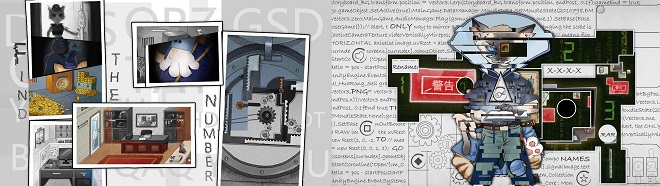
Once unlocked, the PowerPoint reveals high definition versions of the slides featured in the developer’s room: only now, players can manipulate them to rearrange the images to reveal two messages: “FIND THE NUMBER”, and “RENAME X-X-X-X.RAR”. After renaming the audio file as a *.RAR file, a text file hinted at the final steps to unlock Surprise.JPG, the reward for the puzzle trail.
BACK TO PPT , FIND THEM â—†–â–¡–★–â—‡–☆ ?? ?? ??? ????? ???? ???? ????? THE LEFT SIDE OF THE DIAMOND
Following this next (and final) round of instructions involved going back to the second PowerPoint slide and finding the bolded words between the symbols: GO TO THE PLACE WITH MOST WORDS. That clue pointed to the game’s Credits page, where a series of numbers were conveniently placed immediately to the left of the diamonds used as section breaks. Reordering those numbers by the grid in the lower right corner of the slide yielded the final password of 6713, and unlocked the following image.
While the difficulty for this puzzle trail ramped up considerably, Detective Mimo built clues into the construction to make sure players never had to go too many steps without receiving guidance on how to tackle the next step.
Iconography on the secret room’s password page provided a clear and unambiguous structure to getting the password to download the ZIP file. Once unzipped, the audio file is the only file solvers can open, hinting that the password for the PowerPoint is contained within. Even the PowerPoint sets a framework for puzzlers to proceed: the first slide provides a relatively simple and straightforward challenge of matching images to spell out a message, so that players can apply similar logic to the second slide. The only step along the way that wasn’t supported by subtle guidance along the way was discovering the optional puzzle path in the first place. Either you read the text copied to your clipboard, or you didn’t.
This puzzle wasn’t essential to the narrative, it was just a fun easter egg plugged into the game by the game’s developers as thanks for players who probed deeper into the game. There’s another similar easter egg in the game featured in one of the screencaps of this article that links to a public talk one of the creators gave in Chinese, which kicks off its own puzzle trail to follow, albeit one that requires a certain degree of Chinese fluency.
But there’s one final twist, to mention.
One Last Message From the Developers: Backstory for the Completionists Players who reached the game’s final page after completing all the achievements received a note from the creators.
Congratulations on lighting up all the achievements. This is not an easy task. Actually, this game started off as a board game, but after a series of changes, it has evolved into what it is right now. And because of a sudden inspiration, it has changed from a story of catching the villain into a story of a trapped AI breaking the fourth wall and escaping the shackles of the game world.
This is the first time for OMESCAPE to develop a mobile game. Previously, we were trying to transform the real world into a game by designing reality game or interactive books. We really like the feeling of integrating the fantasy world and real world, and unconsciously brought the same philosophy into Mimo.
We sincerely appreciate your time and effort to complete all the tasks. Whether you are here to enjoy the plot or just for the fun of solving puzzles, I hope the time you spent on this can bring you happiness.
Thank you for helping MMO’s escape.
OMESCAPE Xu Aolin
My first exposure to OMESCAPE was playing their Kingdom of Cats escape room in San Jose, which also heavily featured anthropomorphic cats. But the escape room Detective Mimo reminds me the most of is their most recent virtual room, Pursuit of the Assassin Artist. Both escape room and mobile game approached time loops with a lighthearted, comedic spin, and impressed me at the mastery displayed in their chosen mediums: both games could only exist in their respective media, and benefited from that design philosophy greatly.
Special thanks to Michael Feldman, for both recommending Detective Mimo and being an instrumental partner in plumbing the game’s depths
“They’re coming. The Angels are coming for you. But listen. Your life could depend on this. Don’t blink. Don’t even blink. Blink, and you’re dead. They are fast. Faster than you could believe. Don’t turn your back, don’t look away, and DON’T BLINK.”
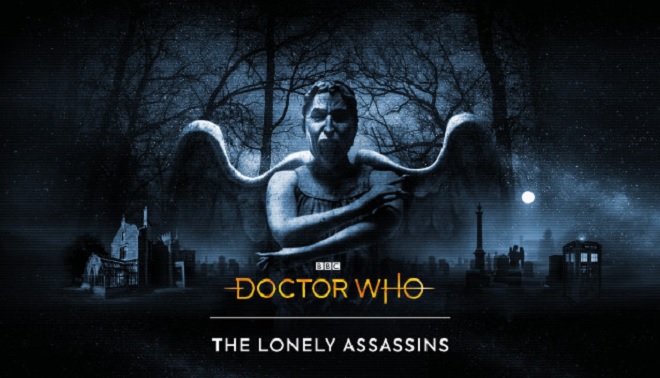
The Weeping Angels are one of the most iconic villains introduced in the BBC’s Doctor Who. As long as someone is observing the quantum-locked creatures known as “Lonely Assassins”, they look like perfectly normal statues. But look away for even a moment, and they’ll come for you. Not to kill…but to send you into the past, stealing away any future you might have had. The Weeping Angels literally feast on your potential, leaving you behind as an inevitability.
It’s telling that the Weeping Angels weren’t introduced in an episode pitting The Doctor and his then-companion Martha Jones against the creatures during their debut episode, Blink. Instead, the plot revolved around two ordinary brits: Sally Sparrow and Larry Nightingale. The pair do receive a series of cryptic messages spliced into a series of DVDs as easter eggs, but it’s not The Doctor’s adventure viewers are following: it’s theirs. Therefore, it’s fitting that the BBC turned back to Blink as inspiration for its first foray into the “found-phone” genre of games, making Doctor Who: The Lonely Assassinsact as the official sequel to one of the most beloved fan favorite episodes.
More than a decade has passed since Sally and Larry (now Lawrence) faced off against the Weeping Angels. In the intervening years, Sally moved to the United States, and Larry fell in love and settled down. But something went terribly wrong, and The Lonely Assassins opens with you, the player, finding Larry Nightingale’s missing phone. Can you pore through the evidence contained within and find out what happened to Larry, and stop it from happening to anyone else?
Gwenhwyfar Thomas is a second-year university student studying Fine Arts, who landed the offer of a lifetime: a chance to work at Asterith International as a Graphic Designer. All she needs to do? Drop out of university, move to the city of Torstoy, and complete a probationary period over the next few months. Gwen created the Instagram account Pictures of Gwen, to document snapshots of her new life through sketches and watercolor art, celebrating highly aesthetic moments such as befriending a local magpie, exploring the local farmer’s market, and wandering through local parks. She even started working on a zine. In short: if Gwen Thomas didn’t move to a city, she’d probably be living the cottagecore dream.
However, dig a little deeper and something seems slightly off about this particular dream. Why would a major marketing firm reach out to an unproven university student, and ask her to join the company before she even applied to work there? Why is the city littered with tarot-themed graffiti, in what one commenter described as a “Torstow version of Banksy”? And why does the city of Torstow’s tourist website have a secret message hidden in the website, telling visitors to “seek her in the room marked with a spade”?
Learning More About Torstow: Zine Subscriptions Optional Many mysteries remain unanswered, but one thing is clear: Pictures of Gwen is an alternate reality game, created by the team at Rogue Beacon, best known for their work on Boomtown Fair’s alternate reality game, featured on Night Mind’s channel. According to Pictures of Gwen‘s out-of-game website, while the game has started out as a simple story of a naive art student moving to the city to make a name for herself in the wonderful world of marketing, the story will soon take a turn towards magical realism, as Gwen “travels on the ley lines where mythology, art, and modernity meet…in the not-quite-shadow of a cyclopean tower that can only be seen through the corner of the eye.”
Mechanically, Gwen’s Instagram is the central hub for the story. From that central point, the narrative sprawls across a variety of websites, radio broadcasts, and even physical artifacts that breathe life into Gwen’s adventure and the fictional city of Torstow through monthly episodes. And while the game is free to play, invested players can sign up for monthly mailings that add a tactile element to the experience. The first mailing included everything from the first edition of Gwen’s zine and prints of some of her Instagram watercolor paintings to her welcome letter from Asterith International. And since players are meticulously documenting their packages once they’re delivered, the subscription element of the game remains a purely optional choice for prospective players.
Last week, a series of flyers started popping up around Nashville, featuring an image of a door, alongside the suitably vague message: “ARE YOU LOOKING FOR SOMETHING? Perhaps it’s this.” The bottom of the flyer was filled with tear-off strips, all bearing the same GPS coordinates. The handful of brave and curious passerby who followed the trail were rewarded with a business card introducing them to the organization behind the experience: Mysterious Nashville.
Around the same time, Ashley Locke received an Instagram DM from MysteriousNashville, linking her to the same GPS coordinates after opening up the conversation with two wide open eye emojis – “ðŸ‘ï¸ðŸ‘︔. She made the trek out with her boyfriend, and claimed another one of the cards before posting a video of the experience. Over the next few days, more people made the trip out to a random drainage ditch in East Nashville to claim their card, and receive an invitation to whatever came next, with many of them posting their adventure to TikTok.
While the MysteriousNashville social accounts previously featured the GPS coordinates from the flyers, they have since been updated to explain “There is nothing left at the coordinates”, so this initial phase has concluded. But while the initial entry point to the experience has been taken away, the Mysterious Nashville adventure continues on…
At the time, visitors to Mysterious Nashville‘s social accounts had nothing more to go on. But people who visited the physical location and scanned the QR code were sent to MysteriousWebsite.com. The team behind Mysterious Nashville has since expanded access to the site, replacing the GPS coordinates on their social profiles with a link to the site.
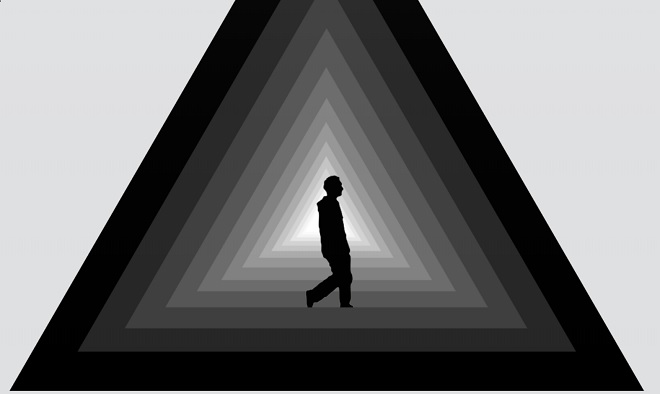
The upper left corner of the website features an image of the door from the cards, while the upper right includes a link to the Mysterious Nashville Instagram account. Dominating the screen, an animated image of concentric triangles collapse and expand, growing whiter as they fade into the background. Once the triangles fully expand, the silhouette of a man casually strides across the triangles, before repeating the loop once more. A message in small text next to the Instagram link instructs visitors to “look below the triangle”. Doing so reveals the message “Odd things are happening in Nashville”, along with a signup form for updates on future events.







 welcome home
 simulacra
 masquerade nyc
 generation loss
 meow wolf
 undertone