Tag: escape rooms

Return of the Duck Cult: A Doors of Divergence ARG?

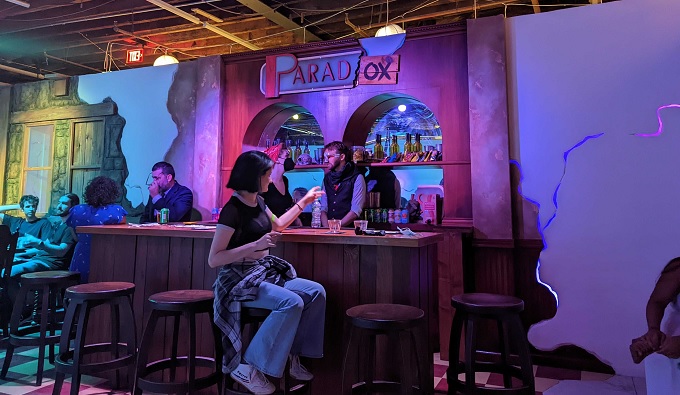
The Paradox Bar: Doors of Divergence’s in-universe lobby (that also doubles as a functioning bar)

On my first visit to the Paradox Bar I received a free drink ticket from myself, welcoming me back to the timeless venue. A handful of colorful characters slipped out of time, and found themselves at an old bar from the 1950’s. As another version of me explained in a letter, “it’s kind of a watering hole for those of us trying to repair reality – a place to meet, talk about our efforts, and compare notes while we try to find the right set of choices that will fix this rift once and for all.”

A free drink ticket, from myself – not your typical pub experience

The Paradox Bar acts as in-universe lobby for a trilogy of escape rooms collectively referred to as The Paradox Cycle, although players often referred to the games by the company’s name: Doors of Divergence. The rooms had a relatively short run in New York City: the game’s first chapter, Heresy 1897 opened in June 2022. This was quickly followed by the release of its second chapter, Madness 1917, in September. Just over a year later, Doors of Divergence closed its doors with an in-universe farewell party in October 2023.

During those 16 months, I took seven trips through the rifts at the Paradox Bar, because the team designed an experience that meant every single visit was a completely different one, leading me through different puzzles and even rooms, despite nominally playing the same game multiple times. Luckily, an online alternate reality game seems to be implying that Doors of Divergence has found a new home, giving me an excuse to talk about what remains my favorite escape room due to the depth of its experience and the vaguely terrifying scope of its ambition.

The stage at the Paradox Bar.

Into the Rift: Beyond Choose Your Own Adventure
The Doors of Divergence experience starts at the Paradox Bar, where a welcoming bartender introduces teams to the space between times they have fallen into, and introduces a few of the colorful characters who have fallen into the rift with them. One might come across an engineer, an astronaut, or even a scout leader milling about the bar. Idle conversation might even trigger a special request for the pending journey through time: bring back a couple of gears to help fix a clock, perhaps.

My first night, the Paradox Bar even had some special programming planned, and the surprisingly spacious room’s stage was used for a variety show, complete with aerialist performance. Once it’s your group’s time to proceed into the rift, a member of the staff would pull you and your group to the side, and introduce the mission. But instead of dryly reading off a list of rules and regulations, players would be encouraged to pull a series of tarot cards, offering divinations of events to come (and the corresponding rules to help navigate those situations).

As players’ first interaction with the Rift, Heresy 1897 leads players into the past as they enter Edmond Cavanaugh’s study, where they encounter the game’s Proctor. Teams are challenged with a question that determines which of two completely different escape rooms to play, within that space.

One of the puzzles from Heresy 1897, that is only seen by half the teams navigating the escape room

That means that Heresy 1897 is technically two completely different escape rooms, that just so happens to occupy the same space. There’s an entire room of Heresy that is unique to that initial binary choice, and there’s nothing about the in-game experience that would even hint at that secret. Teams are also presented with a moral quandary at the end of every room, meaning Heresy 1897 has four different endings, even if teams complete the room.

To help players track these choices, post-game debriefs include handing out a series of cards to commemorate key decisions and actions from the escape room. Entering those codes into an online portal tracks your progress and choices through the game – not just for those key moments at the beginning and end of the experience, but for some of the smaller choices, rewarding players who push the edges of the experience. Did you get sticky fingers at an opportune time, or linger for a moment longer than you should have?

Madness 1917 is where you start to really see the impact of those choices, with at least four different narrative and puzzle experiences: every escape room team enters an insane asylum during the Great War, but the reason for being there is changed, and interactions with the sequel experience’s two actors starts taking a much more theatrical turn, although it is still an escape room experience at its core.

Continue reading

Giving Escape Room Stories Room to Breathe through Theater

Madame Daphne’s Tarot Reading Room and Séance Parlor is hard to find without assistance, hidden away in a Houston artist’s studio. An invitation from Madame Daphne herself provides instructions through the former rice packaging plant’s stark white interior to the medium’s lair, its lavish decor making it feel like a room out of place. Stepping over the threshold begins a 90 minute experience that tells a tale of deception, magic, and love spanning almost a century.

Strange Bird Immersive’s production The Man From Beyond thrusts 4-8 players into a supernatural adventure that combines a masterfully crafted escape room themed around Harry Houdini with an immersive theater performance to frame the experience, set within the walls of Madame Daphne’s parlor.

An Immersive Theater Sandwich
The Man From Beyond‘s fictional narrative starts the minute players step into the room, as Madame Daphne greets her guests with a dramatic flourish. All the standard onboarding activities of an escape room are wrapped up into the context of the room, with a flair for the dramatic. The requisite waivers are still signed, but are done through the narrative conceit of the séance. Players are presented with the rules for the experience through a series of photographs in the hallway leading to the séance parlor, illuminated by candlelight. The seance itself sets the stage for the escape room portion, setting the narrative context for players when they take over the story’s agency.

Once the room’s clock starts ticking, the room transforms from séance parlor into a standard escape room. In a room surrounded by Houdini’s tools of the trade, players must tackle a century-old mystery on a deadline. At key milestones in the experience, micro-moments of theatrical exposition serve as narrative cut scenes, serving the dual purpose of rewarding player’s progress through the puzzle portion and reminding players of their broader purpose in the room. Solving a major puzzle might unlock information about Houdini’s wife Bess’ previous efforts to speak to her dead husband.

Most room escape games leave little room for telling a narrative that exists outside the room’s theming. A room based around an archaeological dig might hide some of its puzzles in a dig site and draw upon those themes to inform its puzzles, but a certain amount of suspension of disbelief is required to tackle the room’s challenges. Even rooms that try to adhere to their own internal narrative consistency stick to a bare-bones plot due to the realities of room design. Players must often split themselves up into continually shifting groups to divide and conquer in the most efficient way possible. While this tactic is highly effective at uncovering a room’s secrets, it forces players to experience the room’s narrative in a disjointed fashion. Players might all be aware they’re escaping from a jail cell, but the specifics of their escape route might only be known to a few participants, on a need-to-know basis. This challenge is exacerbated in the final minutes of a room, as teams scramble to put together the final pieces needed to escape. Often, escape room operators’ explanations at the end of the room are as necessary to explain the accomplishments of teammates as they are to highlight overlooked puzzles and clues.

The Man From Beyond addresses that problem by explicitly carving out time outside the escape room’s unforgiving countdown to allow players time to take in the story. Every player is aware of what they’re doing because they experienced the introduction together, before the clock started ticking. Every player knows the main narrative beats because the information is broadcast to the group at key moments. And the grand finale can be fully experienced since it takes place after escaping the room, removing any time pressures that might otherwise cause players to gloss over the story.

Because Strange Bird Immersive created space for players to breathe and take in the narrative, it stopped the puzzles from overwhelming the game’s powerful narrative themes. During my team’s playthrough, we made it through the puzzles at a steady clip, but were so moved by the bittersweet tale that few of us made it out through the full experience without shedding a few tears along the way. It wasn’t just that the story was pulling on our heartstrings. It was knowing everything that happened was because of our actions.

Continue reading

The Puzzling Rise of the Escape Room Game

the-tomb-boston

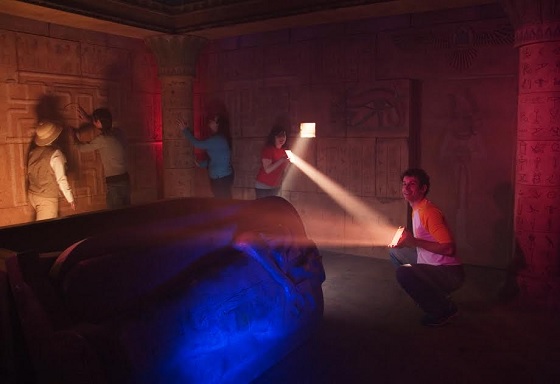
Image of Tomb’s sarcophagus illumination puzzle. ©2015, 5 Wits Productions, Inc.  Used by permission.

The first time I visited Boston, I met up with a group of friends and broke into an ancient Egyptian burial chamber. The tomb’s resident pharaoh was not exceptionally happy about our flagrant act of trespass, and forced our group of amateur archaeologists to solve a series of puzzles before barely escaping with our lives.

The rooms in the tomb were designed with a family-friendly audience in mind, and our guide throughout the experience embraced his role with an exuberant gusto I had only seen before from a skipper on Disney’s Jungle Cruise. The experience managed to make even familiar puzzles feel extraordinary: no matter how many times you’ve solved Tower of Hanoi puzzles in the comfort of your own home, it’s a completely different experience when you’re passing oversized pieces across the room while the ceiling is slowly crashing down overhead.

When 5 Wits‘ puzzle adventure Tomb set up shop in Boston in 2004, it was something of a rarity. The interactive exhibit mixed theatrics with physical puzzles to make its guests feel like swashbuckling adventurers narrowly escaping danger thanks to their collective intelligence. And the design was flexible enough to reward that success, allowing for multiple endings based on groups’  performance. While the original location is now closed, the 5-Wits moved Tomb to Tennessee, launching additional puzzle experiences in Washington DC, Massachusetts, and New York covering themes ranging from undersea exploration to espionage. Over the past decade, this type of immersive puzzle experience has expanded exponentially, with hundreds of locations putting down roots across the globe. For many, visiting the nearest real-life escape room is a day-trip away.

Continue reading