Month: October 2007 (Page 2 of 3)

Part Three – PICNIC ’07 – Three days of cross-media madness in Amsterdam

Editor’s Note: Daniel is an administrator at the Unfiction forums and was part of the team that created the Project MU Archive Book. He was on the scene at PICNIC ’07 as a representative of the ARG community and was kind enough to submit a report on his experiences. This is part three of the report. We thank Daniel for his support of ARGNet and his wonderful report and pictures.
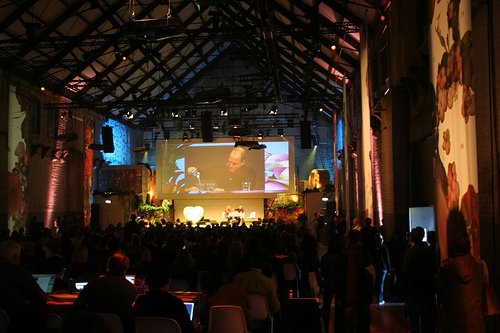
main_conference_hall.jpgOn to the Friday then, which, like last year, was divided into three separate ‘tracks’: Feel, Make and Play. Being on a mission to report on PICNIC for ARGNet, and not having encountered a lot of ARG-related topics yet, I naturally chose the Play track. It kicked off with a keynote address by Katie Salen, who is, among other things, executive director of the Gamelab Institute of Play. If you listened to episode 37 of the ARG Netcast series, you might have heard that the panelists were all especially looking forward to this presentation. Maybe this raised the bar a little too high, because I was fairly disappointed in Salen’s talk, but I think this had a lot to do with its length: it was only 30 minutes, which was just enough time to put forward some interesting notions, but not nearly enough to give an in-depth look at them. However, here are a couple of the things that stuck with me:

  • When designing a game, keep asking yourself, “What does the game want?” i.e. what does it desire or require from the player? Sometimes a game might surprise you in this area. Just as poker is a game that requires lying (bluffing), other games require collaboration. Keep in mind what you want your game to require and make sure that what you add to the game fits with how you expect the players to behave.
  • There’s the aspect of lusory (playful) attitude. If a game encourages players to take on an active attitude, you do not necessarily need to design or create as much yourself, as players will bring a lot to the game already. It is important, however, to keep in mind that this works best when there’s a transactional relationship between the game and its players: the players give to the game, but it they should also receive something back from the game in exchange for their input.

Salen ended her presentation with a nice example that demonstrated all the theoretical points she addressed: Karaoke Ice. It’s a project she did in the past which features a person in a giant squirrel suit driving around in an ice-cream truck which doubles as a karaoke bar. At first, onlookers were given free popsicles, but then they were invited to get into the back of the truck to do some karaoke. Against the expectations of most, people turned out to be more than willing to perform a few songs. One of Salen’s conclusions was that players of a game are generally willing to go along with, say, an alternate reality, if they understand that the point is that they are part of an experience.

This example was followed by some closing remarks regarding interactivity in play — interactivity only works when it’s meaningful, core interaction must be fun and audience/player expertise should be rewarded. I think these are some excellent points that easily apply to the ARG universe. Interaction for the sake of interaction is meaningless and therefore completely uninteresting. Interaction only enhances play if it’s actually fun and serves a purpose!

Continue reading

Changing the game

cruk_logo.gifGiven $2600 and the resources of a major charity dedicated to cancer research, could you come up with an alternate reality game to help raise funds for a worthy cause? That’s what Six to Start and Cancer Research UK would like to find out. Adrian Hon, formerly with Mind Candy, announced the unusual contest on Unfiction last month.

Let’s Change the Game is a competition for aspiring ARG designers, with the challenge of coming up with the best game to raise money for Cancer Research UK and awareness of cancer in general. The first step for potential puppetmasters (after putting together a team with a minimum of three people) is to submit a 500-word design summary to the competition website by November 16th. The best summaries will be shortlisted and asked to submit full proposals. Complete details along with rules can be found on the Let’s Change the Game website. Judges include ARG illuminaries Sean Stewart, Rhianna Pratchett and ARGNet’s own Jonathan Waite.

And the Emmy® Goes to…

EmmyAward.gif

We offer our belated but no less heartfelt congratulations to the team at Xenophile Media, who along with co-creator Matt Wolf were winners of a Primetime Emmy® award for Outstanding Creative Achievement in Interactive Television, presented at last month’s ceremony in Los Angeles. The team got the nod for “The Ocular Effect,” the alternate reality game tied in to the ABC Family television movie, Fallen. Xenophile previously won an International Emmy® for the ReGenesis Extended Reality Game.

The Ocular Effect told the story of Faith Arella, a girl searching for her roots in a
transglobal hunt for clues that started with a mysterious sphere called the Oculus. Players at Unfiction and elsewhere helped Faith find the secret of the Oculus and deciphered other puzzles along the way to help her on her journey.

We are also bursting our buttons with pride here at ARGNet, because our very own Jonathan Waite was a part of the Ocular Effect team. Congrats Jon, and rest of the crew
at Xenophile. We look forward to your future projects with great anticipation!

Stage6 wants to help you find Hope

Hope.jpgAlternate reality games that use kidnapping as a theme have been subject to varying amounts of controversy over the years. In November 2006, the adult-themed game The Human Pet was temporarily banned from YouTube for its fictional videos about a sadistic kidnapper. Last June, the CourtTV campaign “Save My Husband” faced a similar backlash after encouraging visitors from Cute Overload to help solve a kidnapping case. Now, a new ARG launched on Stage6 (part of the DivX network) is facing its own share of controversy.

San Francisco resident Hope Wilcott is missing. At least, that’s what visitors to Stage6 thought when a mysterious video appeared on the streaming video network’s front page on October 3rd. Posted by Richard Chambers, a user claiming to be Hope’s fiance, the two videos currently available follow Hope’s quest to find out what is wrong with her mother, and document her subsequent disappearance. The story continues to unfold at Richard’s Blogspot page at HopeIsMissing.Blogspot.com. According to Matt Staggs of Skullring.org, this campaign is run by Lance Weiler as a “Horror 2.0 ARG” serving to promote the DVD release of his film “Head Trauma”. The Head Trauma website notes the campaign will encompass “myspace, xbox, twitter, eyespot, stage 6 and opera” leading up to “live cinema games” in 10 cities on October 20th.[

Following a rather heated debate that took place within the video comments on Stage6, the producers edited the video tags to include “cinematic game” and “arg”. In addition, the header on Richard’s blog now prominently labels the project “an alternate reality game”. However, some video viewers continue to raise concerns that this makes light of real Missing Persons cases and the people affected by it. In a response to similar concerns regarding the Save My Husband campaign, Rachel at Behind the Buzz addresses this reaction as an issue of framing, noting “anyone with the slightest acquaintance with any entertainment, books, TV, films, plays etc know that dramatic situations like this are often used for entertainment. Looking at the top TV shows in the US, such as CSI or Law and Order, they use murder, kidnapping and worse as the premise for their entertainment.”

As long as the team behind “Hope is Missing” can find an acceptable compromise to viewer concerns, the game has the potential to be both successful and engaging if the videos are any indication of what to expect. Indeed, the changes that have already been implemented are likely sufficient to help Studio6 and the game producers weather any criticism sent their way.

So, while you keep your eyes peeled for Hope, remember to think twice before calling the police. After all, if Lonelygirl15 has taught us anything about the line between reality and fiction, it’s that the troubled girl in the weird video may very well be an actress from new Zealand looking to make a name for herself.

Click here for the discussion at UnFiction.
Click here to read more ARGNet coverage on the Head Trauma film.

Part Two – PICNIC ’07 – Three days of cross-media madness in Amsterdam

Editor’s Note: Daniel is an administrator at the Unfiction forums and was part of the team that created the Project MU Archive Book. He was on the scene at PICNIC ’07 as a representative of the ARG community and was kind enough to submit a report on his experiences. This is part two of the report. We thank Daniel for his support of ARGNet and his wonderful report and pictures.

main_conference_hall_exterior.jpgThe next day started out with a discussion between two people who are both known as quite visionaries when it comes to the Internet. The first was David Weinberger, who holds a Ph.D. in philosophy, is a prominent commentator on internet marketing strategies, and is the author of the book Everything is Miscellaneous. The second was Andrew Keen, a digital pioneer, author of the book Cult of the Amateur and a leading contemporary critic of recent developments regarding the Internet.

This set up a really interesting debate, between a Web 2.0 fanatic and one of its most prominent critics. Weinberger gave a compelling presentation of his views on the Internet, that it was made for one purpose — to organize messiness. Hyperlinking as a concept was invented so that content could be offered in multiple places, just by linking to it. Having user generated content, with Wikipedia as the main example, creates more content and complexity in that content than could otherwise have been achieved, which is A Good Thing.

Keen, however, fundamentally disagrees with this view, condensing his own take on this as “complexity bad, simplicity good” and stating that the media and the Internet should try and reflect the world, rather than trivialize it. Nowadays, the Internet ‘complexifies’ the world and a lot of the information that is being offered is wrong or corrupt. He kept arguing that Weinberger’s approach was much too philosophical and that he needed to be more practical. One of his better examples was the Wikipedia entry for ‘truthiness’, a term coined by Stephen Colbert. Its word count is almost exactly the same as the entry for truth, demonstrating that Wikipedia has no context and that there’s nothing there to tell us what’s important and not.

Weinberger countered this by arguing that incidents like the ‘truthiness’ entry will automatically be dealt with by the community, which is an argument I also tend to rely on a lot. Overall, I thought Keen was coming off as being rather sour and negative, while Weinberger seems to be more of a visionary and has much more of a pioneering spirit. I know one thing for sure — I will definitely go and read Weinberger’s book. Oh, and here’s a funny little fact — Amazon lists Keen’s book as a ‘Perfect Partner’ for Weinberger’s. 🙂

Continue reading

Part One – PICNIC ’07 – Three days of cross-media madness in Amsterdam

Editor’s Note: Daniël is an administrator at the Unfiction forums and was part of the team that created the Project MU Archive Book. He was on the scene at PICNIC ’07 as a representative of the ARG community and was kind enough to submit a report on his experiences, which we will release in parts over the course of the next few days. We thank Daniel for his support of ARGNet and his wonderful report and pictures.

picnic_club.jpgFor the second year in a row, I was able to attend PICNIC, the Crossmediaweek Foundation’s conference on media, internet, technology and creativity in Amsterdam. Once again, I went courtesy of ARGNet, and like last year, it was a blast! The past few days really flew by… I’ve been to my share of conferences, and the thing with PICNIC is, the moment you walk onto the Westergasfabriek site, where the conference is held, the atmosphere just grabs you.

The site is a rather peculiar place, or at the very least not the typical conference environment. The area consists of about fifteen small and large brick buildings, originally part of a natural gas processing plant, but now built to suit anything from dance parties to exhibitions and conferences. The first thing you notice when walking around is the high production value of the whole event — every area and room features a patch of grass, paths laid out with wood chips, plants and flowers everywhere, wooden picnic tables and of course the obligatory red and white checkered tablecloths.

There is also the PICNIC Club, the main lounging area where demos are being held, at which several sponsors have set up their booths, including artists showcasing their creations and a lot of other interactive stuff. Then there’s the Extraction Hall, the main conference hall, where the stage is actually a garden, complete with flower beds and 50-foot high banners hanging down from the ceiling, lighted in such a way it looks like see ants and other bugs are crawling around, to give you the real outdoorsy feeling. Very impressive.

For those of you not quite familiar with PICNIC, this is the second time the Dutch Crossmediaweek Foundation has organized a massive conference on cross-media and everything related to it. A lot of very interesting people attend, including many pioneers in media, technology, the Internet, and also (pervasive) gaming. This year, in addition to the three-day conference, there were many affiliated events planned as well. Take for example PICNIC JR, an attempt to get younger people interested in media and creativity, or the PICNIC Academy, a mini-conference intended for students. There was also the first Dutch edition of Come Out And Play festival, which turned the city of Amsterdam into a giant interactive playground. For more details about PICNIC and all these partner events, head over to the PICNIC website (http://www.picnicnetwork.org/).

Continue reading

« Older posts Newer posts »