Author: Daniël van Gool (Page 4 of 4)

PICNIC ’08, part three: Social network fatigue and visual asset collections

argnetpicnic2008.jpgEditor’s Note: Daniël van Gool, an administrator at the Unfiction forums, was on the scene at PICNIC ’08 on behalf of ARGNet. We were impressed with Daniël’s work covering PICNIC ’07 and, as media partners of the annual cross-media festival, were invited to a number of special events in addition to the speaker sessions. This is the third part of Daniël’s comprehensive look at this year’s event, still focused on the first day of conference speakers (the first part is here and the second part here). All pictures are courtesy of Daniël as well.

Next up on the first day’s schedule was Stefan Agamanolis, formerly of MIT, now working at Distance Lab, devising creative ways to deal with distance, giving a talk called Duelling the Distance. His rather bizarre but interesting address concerned itself with the communication analogy of fast-food versus slow-food: it’s efficiency versus quality, generic versus personalized, and so on. A mobile phone has the same ‘design mentality’ as fast food, meaning it facilitates ‘anywhere, anytime’ versus specific communication, it’s generic, and it’s the same device for any type of situation.

So Stefan and his colleagues had been thinking about what ‘slow communication’ would be like and tried to build a system based on those design principles. It would have to be free of distractions, like the concept of a phone booth pushed to an extreme.

What they ended up with were two people, submerged in two different swimming pools, each one’s head encased in a helmet that completely blocked their vision, taste and smell, while the water they floated in diminished their sense of touch. At the same time, their helmet, fitted with ultra-high-quality speakers and a microphone so the two test-subjects could communicate, was attached to three flotation devices so that they wouldn’t have to put effort into staying afloat. They called this concept the iso-phone. The experiment resulted in a lot of gestures under water by people who completely lost track of time.

This is a rather non-practical concept, of course, but it does provide insight into different aspects of the fast vs. slow analogy. We use the same communication device to call our lover as we do to talk to our lawyer or the pizza delivery guy, and this brings up the topic of intimacy. Another setup devised by Distance Lab tried to tackle this topic: a subject wears a ring on their finger that is detected by an overhead camera, which makes you able to draw in the air. The drawings are then communicated through projections of colored light onto someone else, creating an intimate way of communicating. Check out more about this project, dubbed Mutsogoto, on Distance Lab’s website.

Another few less intriguing objects were discussed before Agamanolis finished with a project called Remote Impact, which was described as a ‘boxing interface’ that lets you hit a mattress that’s mounted on a wall, where a silhouette of your opponent (potentially across the world) is projected. This setup proved especially popular on several games-related conferences over the past few months.
Continue reading

PICNIC ’08, part two: Aaron Koblin and the importance of data visualization

argnetpicnic2008.jpgEditor’s Note: Daniël van Gool, an administrator at the Unfiction forums, was on the scene at PICNIC ’08 on behalf of ARGNet. We were impressed with Daniël’s work covering PICNIC ’07 and, as media partners of the annual cross-media festival, were invited to a number of special events in addition to the speaker sessions. This is the second part of Daniël’s comprehensive look at this year’s event, still focused on the first day of conference speakers (the first part is here). All pictures are courtesy of Daniël as well.

Next up was Aaron Koblin, a software developer and artist who works for Google’s Creative Labs and whose work is internationally renowned. He specializes in data visualization, which was another recurring theme through PICNIC’08.

There’s a revolution going on in data visualization, departing from pie-charts and graphs and taking on quite a different, creative route. It took a while for me to figure out why this topic, while interesting, was featured so prominently at a conference like PICNIC, but the theme became apparent after several speakers made it clear that one of the biggest trends on the internet nowadays is the connection between the digital and the physical worlds. Manipulating “virtual objects” online is a thing of the past: interacting with real objects and real data and input from the real world is what’s becoming big. And this is why data visualization is rapidly becoming a hot topic.

Koblin showed us several examples of interesting ways to portray data, including a display of oil production in the form of oil blobs crawling on a map and a very cool graphical representation which illustrated which portions of New York City were communicating via email with recipients around the world. I could write about these demonstrations for a long time, but I realize that, apart from hardly being interesting, they do Koblin’s work no justice, so if you’re interested, visit his website and check out some of his work.

Continue reading

PICNIC ’08, part one: A healthy dose of cross-media inspiration

ARGNet @ PICNIC 08 LogoEditor’s Note: Daniël van Gool, an administrator at the Unfiction forums, was on the scene at PICNIC ’08 on behalf of ARGNet. We were impressed with Daniël’s work covering PICNIC ’07 and, as media partners of the annual cross-media festival, were invited to a number of special events in addition to the speaker sessions. This is the first part of Daniël’s comprehensive look at this year’s event. All pictures are courtesy of Daniël as well.

The morning of the 24th of September marked the third year I walked up to the intriguing Westergasfabriek area in the West of Amsterdam to attend PICNIC on behalf of ARGNet. In my report on PICNIC ’07 I tried to describe why this area is perfect for a conference that is all about creativity, innovation and inspiration: the Westergasfabriek area just breathes all those things. If you want to try and get an idea how PICNIC looked and felt in 2008, check out the set of rather nice 360-degree pictures made by C360.

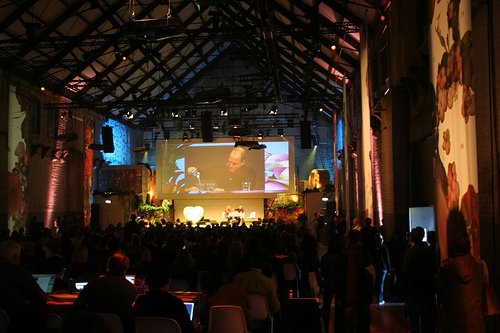
PICNIC’s ambition is still growing, and they have taken things another step further this year, welcoming an even larger audience in attendance and hosting even more events before, during and after the main conference in comparison to the previous two years. The PICNIC Club, the central lounging and networking area, was moved to the Gashouder building this year. Previously a huge silo used to store natural gas, during PICNIC it was fitted with large patches of grass, rows of picnic tables, a stage with some impressive lightning, a couple of huge displays of hundreds of images of sheep (I will come to this later) and various booths and domes where demonstrations were held and books and picnic-baskets were sold.

Around 1:00pm. Bas Verhart and Marleen Stikker, founders of the Crossmedia Foundation and PICNIC, opened the event and announced that over 5000 people had registered this year for the main conference and all the partner events. The main theme of this year’s conference was Collaborative Creativity, a subject that has a couple of interesting parallels with the world of ARGs.

Continue reading

Part Three – PICNIC ’07 – Three days of cross-media madness in Amsterdam

Editor’s Note: Daniel is an administrator at the Unfiction forums and was part of the team that created the Project MU Archive Book. He was on the scene at PICNIC ’07 as a representative of the ARG community and was kind enough to submit a report on his experiences. This is part three of the report. We thank Daniel for his support of ARGNet and his wonderful report and pictures.

main_conference_hall.jpgOn to the Friday then, which, like last year, was divided into three separate ‘tracks’: Feel, Make and Play. Being on a mission to report on PICNIC for ARGNet, and not having encountered a lot of ARG-related topics yet, I naturally chose the Play track. It kicked off with a keynote address by Katie Salen, who is, among other things, executive director of the Gamelab Institute of Play. If you listened to episode 37 of the ARG Netcast series, you might have heard that the panelists were all especially looking forward to this presentation. Maybe this raised the bar a little too high, because I was fairly disappointed in Salen’s talk, but I think this had a lot to do with its length: it was only 30 minutes, which was just enough time to put forward some interesting notions, but not nearly enough to give an in-depth look at them. However, here are a couple of the things that stuck with me:

  • When designing a game, keep asking yourself, “What does the game want?” i.e. what does it desire or require from the player? Sometimes a game might surprise you in this area. Just as poker is a game that requires lying (bluffing), other games require collaboration. Keep in mind what you want your game to require and make sure that what you add to the game fits with how you expect the players to behave.
  • There’s the aspect of lusory (playful) attitude. If a game encourages players to take on an active attitude, you do not necessarily need to design or create as much yourself, as players will bring a lot to the game already. It is important, however, to keep in mind that this works best when there’s a transactional relationship between the game and its players: the players give to the game, but it they should also receive something back from the game in exchange for their input.

Salen ended her presentation with a nice example that demonstrated all the theoretical points she addressed: Karaoke Ice. It’s a project she did in the past which features a person in a giant squirrel suit driving around in an ice-cream truck which doubles as a karaoke bar. At first, onlookers were given free popsicles, but then they were invited to get into the back of the truck to do some karaoke. Against the expectations of most, people turned out to be more than willing to perform a few songs. One of Salen’s conclusions was that players of a game are generally willing to go along with, say, an alternate reality, if they understand that the point is that they are part of an experience.

This example was followed by some closing remarks regarding interactivity in play — interactivity only works when it’s meaningful, core interaction must be fun and audience/player expertise should be rewarded. I think these are some excellent points that easily apply to the ARG universe. Interaction for the sake of interaction is meaningless and therefore completely uninteresting. Interaction only enhances play if it’s actually fun and serves a purpose!

Continue reading

Part Two – PICNIC ’07 – Three days of cross-media madness in Amsterdam

Editor’s Note: Daniel is an administrator at the Unfiction forums and was part of the team that created the Project MU Archive Book. He was on the scene at PICNIC ’07 as a representative of the ARG community and was kind enough to submit a report on his experiences. This is part two of the report. We thank Daniel for his support of ARGNet and his wonderful report and pictures.

main_conference_hall_exterior.jpgThe next day started out with a discussion between two people who are both known as quite visionaries when it comes to the Internet. The first was David Weinberger, who holds a Ph.D. in philosophy, is a prominent commentator on internet marketing strategies, and is the author of the book Everything is Miscellaneous. The second was Andrew Keen, a digital pioneer, author of the book Cult of the Amateur and a leading contemporary critic of recent developments regarding the Internet.

This set up a really interesting debate, between a Web 2.0 fanatic and one of its most prominent critics. Weinberger gave a compelling presentation of his views on the Internet, that it was made for one purpose — to organize messiness. Hyperlinking as a concept was invented so that content could be offered in multiple places, just by linking to it. Having user generated content, with Wikipedia as the main example, creates more content and complexity in that content than could otherwise have been achieved, which is A Good Thing.

Keen, however, fundamentally disagrees with this view, condensing his own take on this as “complexity bad, simplicity good” and stating that the media and the Internet should try and reflect the world, rather than trivialize it. Nowadays, the Internet ‘complexifies’ the world and a lot of the information that is being offered is wrong or corrupt. He kept arguing that Weinberger’s approach was much too philosophical and that he needed to be more practical. One of his better examples was the Wikipedia entry for ‘truthiness’, a term coined by Stephen Colbert. Its word count is almost exactly the same as the entry for truth, demonstrating that Wikipedia has no context and that there’s nothing there to tell us what’s important and not.

Weinberger countered this by arguing that incidents like the ‘truthiness’ entry will automatically be dealt with by the community, which is an argument I also tend to rely on a lot. Overall, I thought Keen was coming off as being rather sour and negative, while Weinberger seems to be more of a visionary and has much more of a pioneering spirit. I know one thing for sure — I will definitely go and read Weinberger’s book. Oh, and here’s a funny little fact — Amazon lists Keen’s book as a ‘Perfect Partner’ for Weinberger’s. 🙂

Continue reading

Part One – PICNIC ’07 – Three days of cross-media madness in Amsterdam

Editor’s Note: Daniël is an administrator at the Unfiction forums and was part of the team that created the Project MU Archive Book. He was on the scene at PICNIC ’07 as a representative of the ARG community and was kind enough to submit a report on his experiences, which we will release in parts over the course of the next few days. We thank Daniel for his support of ARGNet and his wonderful report and pictures.

picnic_club.jpgFor the second year in a row, I was able to attend PICNIC, the Crossmediaweek Foundation’s conference on media, internet, technology and creativity in Amsterdam. Once again, I went courtesy of ARGNet, and like last year, it was a blast! The past few days really flew by… I’ve been to my share of conferences, and the thing with PICNIC is, the moment you walk onto the Westergasfabriek site, where the conference is held, the atmosphere just grabs you.

The site is a rather peculiar place, or at the very least not the typical conference environment. The area consists of about fifteen small and large brick buildings, originally part of a natural gas processing plant, but now built to suit anything from dance parties to exhibitions and conferences. The first thing you notice when walking around is the high production value of the whole event — every area and room features a patch of grass, paths laid out with wood chips, plants and flowers everywhere, wooden picnic tables and of course the obligatory red and white checkered tablecloths.

There is also the PICNIC Club, the main lounging area where demos are being held, at which several sponsors have set up their booths, including artists showcasing their creations and a lot of other interactive stuff. Then there’s the Extraction Hall, the main conference hall, where the stage is actually a garden, complete with flower beds and 50-foot high banners hanging down from the ceiling, lighted in such a way it looks like see ants and other bugs are crawling around, to give you the real outdoorsy feeling. Very impressive.

For those of you not quite familiar with PICNIC, this is the second time the Dutch Crossmediaweek Foundation has organized a massive conference on cross-media and everything related to it. A lot of very interesting people attend, including many pioneers in media, technology, the Internet, and also (pervasive) gaming. This year, in addition to the three-day conference, there were many affiliated events planned as well. Take for example PICNIC JR, an attempt to get younger people interested in media and creativity, or the PICNIC Academy, a mini-conference intended for students. There was also the first Dutch edition of Come Out And Play festival, which turned the city of Amsterdam into a giant interactive playground. For more details about PICNIC and all these partner events, head over to the PICNIC website (http://www.picnicnetwork.org/).

Continue reading

Newer posts »