Category: Features (Page 27 of 37)

ARGFest 2008 in Review: Serious and Independent Games (Move Over, MoveOn)

ARGNet Writers pose at ARGFest 2008

This article is the second in a series, providing summaries of the panel presentations at ARGFest-o-Con 2008 in Boston.

The second panel discussion featured Ken Eklund of World Without Oil as moderator, Brian Clark (GMD Studios), Alice Leung (BBN Technologies), and Dave Szulborski. The panel discussed a little of everything, from projects born from passion to penny-pinching PMs and politics.

Dave Szulborski noted that independent games are the mainstay of the genre, and kept it alive when marketing executives were questioning its effectiveness. He noted that successful games of any type tend to inspire new developers to try their hand in development. Independent ARGs also encourage developers to innovate in new and surprising ways. As Brian Clark noted, “the riskiest things we do are those we do for ourselves,” and grassroots games are the ideal testing grounds for aspiring developers, as long as the project doesn’t serve as a resume of technical development skills that avoids the critical “fun” factor necessary for independent and serious games alike.

Continue reading

ARGFest 2008 in Review: Extended Media Experiences (The Mustache Strikes Back)

ARGNet Writers pose at ARGFest 2008

This article is the first in a series, providing summaries of the panel presentations at ARGFest-o-Con 2008 in Boston.

The first panel discussion featured Evan Jones of Stitch Media as the moderator, Yomi Ayeni (Expanding Universe), Elan Lee (Fourth Wall Studios), Lance Weiler (Seize the Media), and Blair Erickson (Millions of Us). The panel explored the challenges and advantages that arise from cross-media productions.

Blair Erickson started the discussion with a description of an early project, an alternate reality game promoting World Wrestling Entertainment. Recognizing that a major draw of wrestling is the love of a fight, Erickson moved the rivalry between two wrestlers onto virtual worlds, with a game that played out over more than 100,000 threads, with players contributing in support of their favored athlete. The game culminated in Summer Slam, a pay-per-view match between the wrestlers. More recently, Millions of Us developed an ARG for the Sarah Connor Chronicles, which delved deep into the franchise’s mythology.

Yomi Ayeni discussed his work with Violette’s Dream, an ARG running as part of the upcoming video game, Velvet Assassin. The video game is based on the true story of a female soldier in World War II. The alternate reality portion of the game operates under the assumption that the game’s protagonist repurposed Nazi gold to help undercover agents in need. The aim was to make the game as real to life as possible: the first gold bar was found by former ARGNet writer Dee Cook in Fredericksburg, Texas, a town with deep historical ties to Germany. Ayeni described the project as a “fingerprintless” project that runs parallel to the video game.

Continue reading

A-Mazing Event in San Francisco

P4200259.JPGWhen in danger or in doubt, run in circles, scream and shout. –R.A.H.

Over fifty people gathered at Sutro Heights Park in San Francisco this past Sunday to practice the ancient sport of “Labyrinth Running” which, according to the recently-launched Alternate Reality Game, “Find the Lost Ring,” was lost in 393 A.D. when Theodoseus banned the Olympic Games. Find the Lost Ring is an ARG designed to promote the upcoming Olympic Summer Games in Beijing, China in August, and is sponsored by the McDonald’s Corporation. It officially launched on March 3, 2008, shortly after trailhead clue packages were received by various ARGonauts and media sites.

The ARG is conducted in several languages and has gained popularity all over the planet. It was reported that at least two other training events were taking place that day in other parts of the world, including in Brazil, which country holds one of the largest interested groups of players of this game that isn’t a game. It is scheduled to run through to the closing ceremonies of the Olympics on August 24, 2008.

Labyrinth organizers Tom and LenoreAlthough the event was organized by two players, Tom Bullock (aka Ariock) and Lenore Henry (aka hmrpita), it was also acknowledged by the game, and an in-game character named Kai announced early that he would attend the practice run. Lead designer and avant-gamer Jane McGonigal also appeared at the event and offered to help organize and referee the training.

Continue reading

Video Games and ARGs – What Can they Learn from Each Other?

Note: This article covers two SXSW Interactive 2008 events: Cross-Media Cross-Pollination: Mashing Up Video Games and ARGs (Saturday, March 8th, 3:30-4:30 p.m.), and its follow-up, Core Conversation: What Can the Video Games Industry Learn From Alternate Reality Games? (Monday, March 10th, 3:30-4:30 p.m.).

A last-minute change in programming on Saturday, March 8th, at SXSW Interactive 2008 brought together familiar faces from the Alternate Reality Games development community: Dan Hon of Six to Start, Tony Walsh of Phantom Compass, and Dee Cook, a freelance writer and designer who has written and developed content for games such as “The 4400” Extended Reality, World Without Oil, Unnatural Selection, and many others. Hon, Walsh, and Cook presented the panel “Cross-Media Pollination: What Video Games can Learn from ARGs”. The follow-up conversation on Monday afternoon with Steve Peters from 42 Entertainment, and input from Jane McGonigal, Ken Eklund, Hazel Grian, and others, rounded out Saturday’s panel.

Currently one of the most popular past-times world-wide, video games have an audience both extensive and diverse. Gamers are consistently asking for more from game designers – better AI, more content, more interaction, more story and narrative, more immersion. What can Alternate Reality Game designers learn from video game design and the needs of video game players (many of whom also play ARGs), and what elements of ARGs might video game designers consider when making games for gamers in a world of rapidly-evolving technology and techno-culture?

The panel opened with the question: what elements of ARGs might interest and engage video gamers? “I Love Bees”, a well-known ARG, tapped into the fan base of Bungie’s Halo video game by providing a glimpse into Halo’s (and its predecessor, Marathon’s) detailed backstory. Many Halo players enjoyed ILB because of the opportunity to explore more of that game’s mythology. The puppetmasters presented a Halo story that the players could interact with in a different way, affecting the game not by moving the controller but by problem-solving with other players, answering payphones, emailing the Sleeping Princess, and convincing an AI that they were, in fact, human, and one of her crew.

Perhaps, Steve Peters pointed out in Monday’s follow-up conversation, cross-media is one answer to a demand for more interaction and individualized response. A player’s progress through a game could be tracked, with content delivered not only through the console but also through SMS, phone calls, or even the post office! Similarly, Tony Walsh raised the idea that ubiquitous computing, the imperceptible integration of computing systems and functions into every day life, might indeed be the next game platform, heralding the end of the “couch-potato” gamer.

Continue reading

Launching Into ’08: New Games and New Beginnings

newyear.jpgAs our planet careens into yet another lap around the Sun, puppetmasters are waiting gleefully in their lairs, cackling behind their respective curtains, fingers poised to hit the big red LAUNCH button at the stroke of midnight on January 1, 2008. All around the world, ARG players will be clinging to their F5 buttons or obsessively checking their email for the new year’s first hint of activity in the world of chaotic fiction. January’s schedule is crowded with launches, relaunches, and continuations of new and ongoing games and experiences.  We’d like to give you a quick peek at what’s in store for you in 2008.
The Lost Experience – Relaunching 12/31/07
A press release on the ABC media website declared that on December 31, Oceanic Airlines would be resuming flights service to several cities. Contact your travel agent now!

What is this Game? – Launching 1/1/08
What is this Game?, an ARG and contest promoting What is this Movie? by Staff of the Magi Productions, begins on 1-1-2008 at midnight. Players may register here to participate (must be 18 or older by January 1, 2008). According to Magi’s press release, “What is this Game requires player interaction, quick thinking, puzzle solving skills, countless hours of dedication, and in the end a journey to the Grand Prize.”

QU13E
Last Halloween, QU13E rose from the grave. A few members of unFiction began exchanging emails and receiving clues from QU13E’s shadowy inhabitants. After solving a puzzle in the source code of the QU13E website, players noted that 1/1/08 was set to be the launch day of this mysterious game.

The Dark Knight
Who knows what the Joker’s next prank will be? This time, it might be PIE! The next phase of The Dark Knight kicks off early in the new year, so keep your eyes peeled and your forks at the ready.

Cloverfield
ZOMG! 1-18-08 is less than three weeks away! Avid followers of Cloverfield’s viral marketing will finally get to experience the Cloverfield monster on the big screen.

Eldritch Errors: Book 3
What lies ahead for the Sentries and the Dreamers in a post-Scream world? No exact date has been hinted at for the opening of Book 3, but players speculate that new activity on Eldritch Errors will begin sometime in the new year.

Continue reading

Part Three – PICNIC ’07 – Three days of cross-media madness in Amsterdam

Editor’s Note: Daniel is an administrator at the Unfiction forums and was part of the team that created the Project MU Archive Book. He was on the scene at PICNIC ’07 as a representative of the ARG community and was kind enough to submit a report on his experiences. This is part three of the report. We thank Daniel for his support of ARGNet and his wonderful report and pictures.

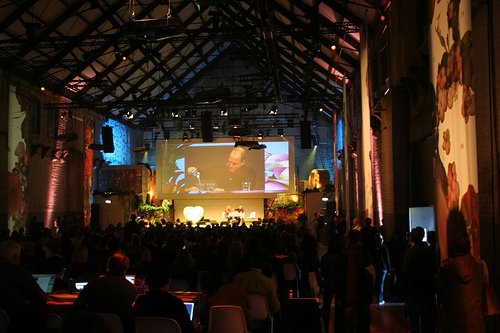
main_conference_hall.jpgOn to the Friday then, which, like last year, was divided into three separate ‘tracks’: Feel, Make and Play. Being on a mission to report on PICNIC for ARGNet, and not having encountered a lot of ARG-related topics yet, I naturally chose the Play track. It kicked off with a keynote address by Katie Salen, who is, among other things, executive director of the Gamelab Institute of Play. If you listened to episode 37 of the ARG Netcast series, you might have heard that the panelists were all especially looking forward to this presentation. Maybe this raised the bar a little too high, because I was fairly disappointed in Salen’s talk, but I think this had a lot to do with its length: it was only 30 minutes, which was just enough time to put forward some interesting notions, but not nearly enough to give an in-depth look at them. However, here are a couple of the things that stuck with me:

  • When designing a game, keep asking yourself, “What does the game want?” i.e. what does it desire or require from the player? Sometimes a game might surprise you in this area. Just as poker is a game that requires lying (bluffing), other games require collaboration. Keep in mind what you want your game to require and make sure that what you add to the game fits with how you expect the players to behave.
  • There’s the aspect of lusory (playful) attitude. If a game encourages players to take on an active attitude, you do not necessarily need to design or create as much yourself, as players will bring a lot to the game already. It is important, however, to keep in mind that this works best when there’s a transactional relationship between the game and its players: the players give to the game, but it they should also receive something back from the game in exchange for their input.

Salen ended her presentation with a nice example that demonstrated all the theoretical points she addressed: Karaoke Ice. It’s a project she did in the past which features a person in a giant squirrel suit driving around in an ice-cream truck which doubles as a karaoke bar. At first, onlookers were given free popsicles, but then they were invited to get into the back of the truck to do some karaoke. Against the expectations of most, people turned out to be more than willing to perform a few songs. One of Salen’s conclusions was that players of a game are generally willing to go along with, say, an alternate reality, if they understand that the point is that they are part of an experience.

This example was followed by some closing remarks regarding interactivity in play — interactivity only works when it’s meaningful, core interaction must be fun and audience/player expertise should be rewarded. I think these are some excellent points that easily apply to the ARG universe. Interaction for the sake of interaction is meaningless and therefore completely uninteresting. Interaction only enhances play if it’s actually fun and serves a purpose!

Continue reading

« Older posts Newer posts »