A seemingly ordinary delivery truck used as part of Great Gotham Challenge’s 2024 puzzle hunt
“I…think one of us needs to crawl into the delivery truck?”
A few minutes earlier, the four of us received a message on our phones from GGC headquarters: go down a particular street, and be on the lookout for a delivery truck. Once there, we should be prepared to open up a cardboard box. The delivery truck was parked on the street corner as expected, packed floor to ceiling with packages. But there was no package waiting for us to grab. Instead, the bottom left corner of the truck featured what almost looked like a tunnel, just big enough to crawl through.
So, we sent a volunteer through the hole, into the unknown. When they emerged on the other side, a man handed over a UPS envelope, and told them the password to unlock the next set of instructions. It provided descriptions of a series of five individuals we’d need to encounter in order to proceed further. Assuming the UPS envelope might contain further instructions, we opened it up.
A rotating wheel of colorful characters that popped up out of our very special UPS delivery
Upon unsealing the envelope, a three-dimensional papercraft contraption popped out of the envelope thanks to the tension releasing on a series of cleverly concealed rubber bands inside the puzzle. This time, we had to solve a logic puzzle to figure out the code word to unlock the next step in our journey.
This sequence of events took place as part of GGC:MMXXIV, an outdoor puzzle hunt that serves as Great Gotham Challenge’s flagship event of the year. Over the course of 4-5 hours, the game leads teams of up to four players through a neighborhood in NYC in order to complete a series of puzzles that take full advantage of the city and its history. Great Gotham Challenge is somewhat unique in the puzzling landscape for its focus on creating a spectacle out of its puzzles while also making the solving process feel just a bit more transgressive than it actually is.
Because this type of adventure isn’t just about solving a papercraft logic puzzle: it’s about walking down the street and realizing that even that truck on the side of the road might be part of the game…and then receiving enough validation to feel safe crawling inside.
Over sixty years ago the filmmaker William Castle released Mr. Sardonicus in theaters, telling the tale of a horrid wretch of a man whose face was frozen in a rictus grin. Over the course of the movie, audiences learn about the macabre sins that led to his initial disfiguration, and the heartless experiments he inflicted on others in an attempt to cure himself.
As the film concludes, William Castle himself shows up on screen and cheerfully informs the audience that they have the opportunity to decide if Mr. Sardonicus has suffered enough, or if he deserves worse. Audience members are instructed to hold up glow-in-the-dark cards to vote, and Castle makes a show of tallying the votes, before the chosen ending plays. No audience ever voted to save Mr. Sardonicus. And while Castle insisted that two endings were filmed, the general assumption is that he didn’t bother since no audience would make that choice, after seeing the film. Because of this unique feature, Mr. Sardonicus was advertised as “the only picture with [a] ‘Punishment Poll'”.
Alternate reality games are in large part defined by the agency they grant to players, promising participants a collective role in the events to follow. Your decisions will shape what’s to come. However, that agency doesn’t always have to be real – the illusion of agency is often enough to leave audiences empowered enough to feel responsible for the game’s progress, and culpable for their missteps.
Last year, the Twitch streamer Ranboofilmed a three part interactive horror series called Generation Loss: The Social Experiments that delivered a particularly compelling exploration of the nature of agency. In the process, it might just have unseated Mr. Sardonicus‘ claim as “the only picture with [a] ‘Punishment Poll'”. And while asking you to watch overfourhours of livestreamed footage might be a bit much, Ranboo just released The Social Experiments: The Founders Cut as a slightly more condensed, cinematic retelling of events.
If you’d prefer to watch Generation Loss relatively unspoiled, now would be a good time to watch The Founders Cut, which provides the best streamlined entry point to the series currently available. However, a bit of context will likely help make the viewing process a bit easier, as the series takes some fairly dramatic tonal shifts that makes the first half hour in particular a misleading indicator of the full experience.
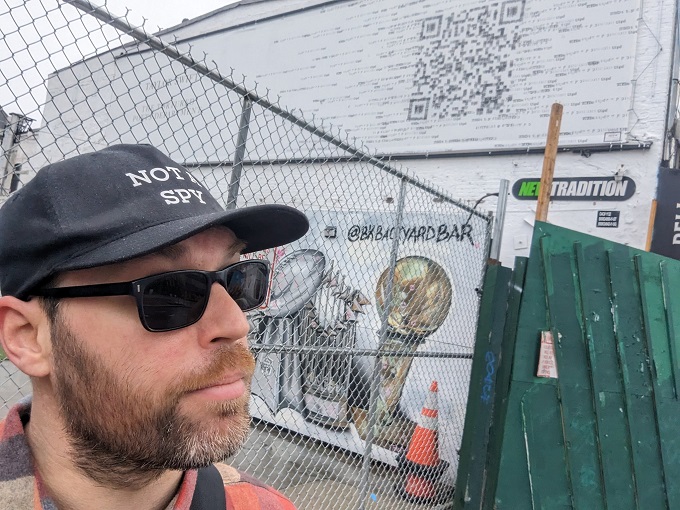
The author, visiting a secret puzzle piece for The Tortured Poets Department release in Brooklyn
Back in the late 1960s, rumors started to circulate among Beatles fans that Paul McCartney died in 1966, and was replaced by a lookalike. While official sources refuted the rumors, fans poring through the Beatles’ discography started picking up on clues that seemed to support those theories, ranging from backmasked audio hidden in songs to secret messages inserted into the album covers for Sgt Pepper’s Lonely Hearts Club Band and Abbey Road.
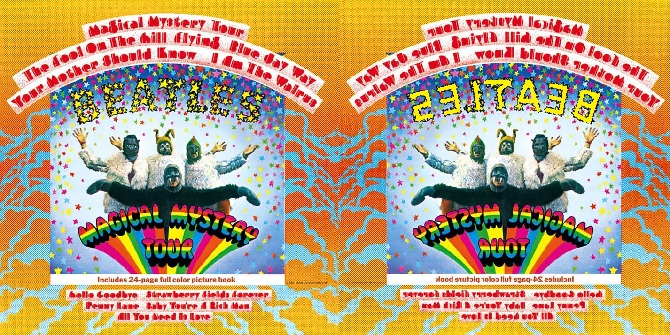
Fans even managed to find a secret phone number written in the stars, if you held the Magical Mystery Tour album up in front of a mirror. According to some rumors, calling that number would trigger the cryptic message, “you’re getting closer…” The theory came to be known as Paul is Dead.
The Magical Mystery tour in its original form, and mirrored (with an emphasis on the “phone number”
Of course, Paul McCartney was (and still is, at the time of this article) very much alive. And there is minimal evidence to even support thePaul is Dead 2.0 theory, arguing that even though Paul was alive, the band intentionally sprinkled clues alluding to his death. The connections were likely a series of apophenic coincidence – with fans creating meaning out of nothing.
Paul is Dead may not have been a “solvable” game, but it still plays a formative role in the creation of alternate reality games. According to an interview with The Beast‘s lead writer Sean Stewart, The Beast‘s creative director Jordan Weisman was heavily influenced by Paul is Dead as he constructed what came to be credited as the first alternate reality game:
Jordan from the time he was very young had been obsessed with, among other things, the Beatles mystery…if you looked at the cover of Sgt Peppers there were clues on it that indicated that Paul McCartney was actually dead….Almost certainly none of that was true, but it was a very powerful urban myth and with the advent of the internet he was thinking, “I think we could do this now…but for real.”
Alternate reality games would return to musical themes a number of times over the years, most notably with the release of Nine Inch Nails’ concept album Year Zero, which started with “leaked” USB drives left in the bathrooms of concerts and culminating in a secret concert raided by a (fictional) SWAT team. But one of the more impressive answers to the question “what if Paul is Dead was real” comes from outside the alternate reality gaming arena. Instead, it comes from the musical career of Taylor Alison Swift.
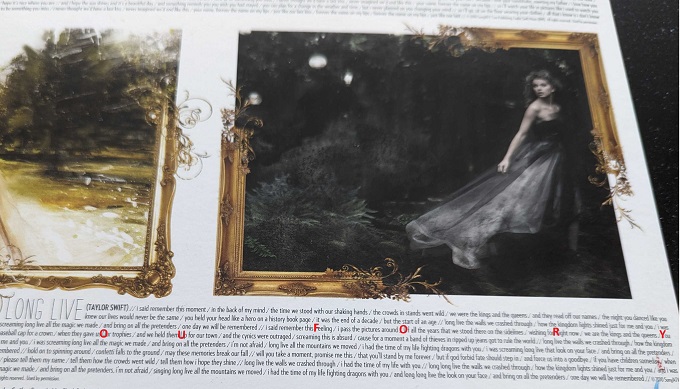
Taylor Swift Learns to Play the Puzzling Long Game Taylor Swift’s lyrical puzzles started out relatively simple: for her first five albums, the song lyrics featured in her liner notes were all presented in lower case. The only exception to that rule? A handful of capitalized letters that spelled out secret messages. For instance, the message spelled out in the lyrics of Long Live spells out the phrase “for you”, drawing attention to the song’s role as a love letter to her fellow band-mates, and to her emerging fandom.
Speak Now liner notes, with capitalized letters (highlighted in red) for Long Live spelling out “FOR YOU”
Taylor Swift may have started with hidden messages in liner notes, but things quickly spiraled into deeper “easter eggs” hidden throughout her works. In an interview with Jimmy Fallon, Swift explains:
That’s when it started [with the liner notes]…but when it got out of control was when I started to realize that it wasn’t just me that had fun with it, that they had fun with it too, and I should never have learned that. Because then I couldn’t stop, and all I started thinking of was how do I hint at things? How far is too far in advance? Can I hint at something three years in advance? Can I even plan things that far…
…and look. I think that it is perfectly reasonable for people to be normal music fans and to have a normal relationship to music. But…if you want to go down a rabbit hole with us, come along.
The Tonight Show with Jimmy Fallon
Under that guidance, the puzzles started getting more considerably more varied and expansive. The music video for Me! wasn’t just filled with easter eggs when it dropped in April 2019…it also snuck in the title of her next studio album, which wouldn’t be formally announced until two months later.
Swift even started dabbling in more traditional puzzles through a series of “Vault Puzzles” in support of her album rereleases. Solve a puzzle, and unlock information about the coming release. For Fearless (Taylor’s Version), the vault puzzle was a relatively straightforward anagram. Red (Taylor’s Version) continued the tradition of anagrammed puzzles, but this time rewarded players to complete it with an image overlay to celebrate their accomplishment.
One of 89 Vault Puzzles leading up to the release of 1989 (Taylor’s Version)
The Vault Puzzles for 1989 (Taylor’s Version) ramped up the complexity to a whole new level. Swift’s team partnered with Google to hide a series of 89 different anagrammed puzzles in various Google search results. Fans needed to collectively solve those puzzles 33 million times to unlock news about the new album.
But even the Vault Puzzles pale in comparison to the long road to the release of Reputation (Taylor’s Version), and the surprise announcement of The Tortured Poet’s Department. But to explain that, it’s first necessary to provide a brief primer to the Lover House.
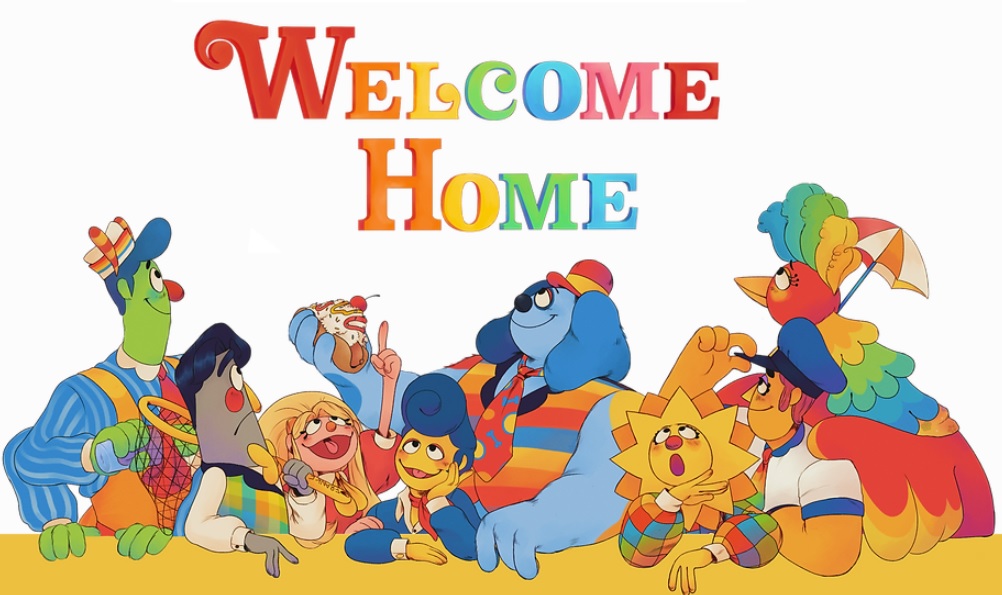
The cast of Welcome Home. From left to right: Howdy, Frank, Julie, Wally, Barnaby, Sally, Eddie, and Poppy.
Starting in 1969, the Playfellow Workshop filmed a children’s television program called Welcome Home, following the antics of eight colorful puppet neighbors who lived in a town called “Home”. After the show’s abrupt end in 1974 the production company shuttered its doors, and all show footage and ancillary materials from Welcome Home was presumed lost. And that remained true for fifty years, until the Welcome Home Restoration Project (“WHRP”, for short) stumbled across troves of documents, the paint and ink-stained documents wrapped up in brightly colored envelopes. After compiling those documents and augmenting them with fan recreations, the Welcome Home website was born.
Over the past few months, the WHRP reclaimed more and more artifacts from the show: branded children’s toys, vinyl records, advertorial standees, animation cels, and even audio from a live television interview recorded early on in the show’s run. Many of these items were shipped out to be featured as part of a public exhibition in partnership with a museum curator. Curiously, despite mounting piles of evidence, no one associated with the museum curation team had ever heard of Welcome Home prior to the WHRP team’s efforts at resurrecting the lost media.
More concerning, something seems to be amiss with anything touching on Welcome Home, if you scrape beneath the surface. Cryptic messages hidden on the website tell a much more chilling tale than the bright and cheerful kid’s show Welcome Home should have been, people who come close to the project complain about the incessant noise of phones ringing, and the Playfellow Exhibition itself seems to have been infected by some mysterious substance after the display.
The Welcome Home neighborhood, with residents added near their homes or businesses
Welcome to Welcome Home Welcome Home is an alternate reality game and experimental multi-media horror project created by an artist who goes by the pseudonym “Clown”. And while the Welcome Home page serves as the in-game entry point to the project, an out-of-game page also exists to warn fans of the game’s themes, as well as to credit the cast.
Every few months, the Welcome Home page updates with new content allowing fans to delve deeper into the Playfellow Workshop’s long-forgotten children’s show. On the surface, everything is sunshine and rainbows and players get to learn more about the show’s vibrant personalities of the show’s puppet cast. The first update focused on providing character descriptions and art, while the most recent update in July brought the characters to life with audio excerpts from archival shows and ancillary materials that celebrated their jovial interactions with each other.
Offset letters and overlapping text on the Welcome Home “About Us” page
However, elements of the website train players into how to explore more deeply into the darker side of Welcome Home. For instance, offset letters provided a hint to visitors Welcome Home fans that the website’s text might contain hidden messages in transparent text – and by signaling that messages might be hidden in that fashion, players are given a window into the WHRP team’s inner remorse and terror over their involvement with the project.
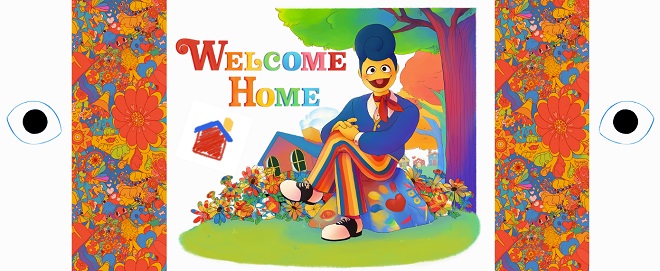
The Welcome Home homepage, zoomed out to show the site looking back at you
Similarly, the homepage for Welcome Home prominently features an interactive crayon drawing of a house that draws itself on pageload. The house (and subsequent drawings scattered across the website) direct listeners to audio messages from Wally that feel vaguely threatening, when voiced in Wally’s monotone drawl. These drawings are Wally’s window into communicating with the players, both through the audio clips themselves as well as the file names of pictures Wally drew in response to comments left on the site’s Guestbook.
Eagle-eyed visitors might also notice that a similar sketchy image can be seen just at the corner of the browser, however: zooming the browser out reveals a giant pair of eyes staring back at players.
Evidence of the Welcome Home bug infestation
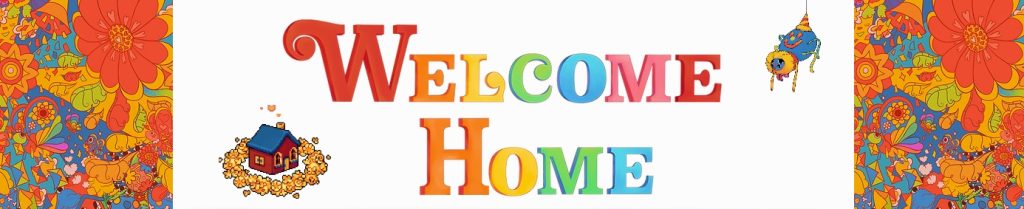
The final recurring site element left for players to discover are a series of bugs that will pop into the frame after players linger on a page for long enough: clicking on those bugs leads to a series of “behind the scenes” videos that seems to depict Wally’s silent interactions with the Welcome Home cast on a particular day, shot from his first-person perspective, with the page title of “answer”.
This puzzle structure makes Welcome Home an experience that can be explored solo, hunting across the site’s pages for secrets that might help unveil the dark secret behind the show that may not have ever even existed in the first place. By making specific instances of how to interact with the site overt, players are trained on what methods to employ to dig further and uncover the site’s more hidden gems.
BBC1 Radio’s Greg James has theories on where his fellow BBC presenters have gone in the Great DJ Hunt
When BBC1 Radio presenter Greg James went into work on Monday July 17th, thirty of his coworkers decided to play hooky, leaving him in charge of the station’s hosting duties for the foreseeable future. He was greeted by a message written in Comic Sans from a “sentient office printer” providing the following instructions written in Comic Sans:
Happy anniversary, Greg! This time last year, Radio 1 took your show away from you and you had to win it back by completing the Giant Jigsaw. You traveled the length of the country, swam with sharks, and jumped off a 10 meter diving board (sorry about that). This year, you don’t need to worry: you’ve not lost your show. But every other Radio 1 DJ has lost their show. You’re the only one left. You’re on your own until you work out where the others are.
All of Radio 1 is in your hands. You need to read every text. Play every song. Speak to every caller. This is your dream come true! Non-stop Greg…until you can find a DJ to replace you. Would you like to know how to find your fellow Radio 1 DJs? You’ll need to go and get the next piece of paper.
That next piece of paper laid out the rules of Radio 1’s Giant DJ Hunt: Greg (with more than a little help from his loyal listeners) has to track down clues to the location of his missing colleagues scattered across the internet, and confront them with a simple question: “are you a Radio 1 DJ?”
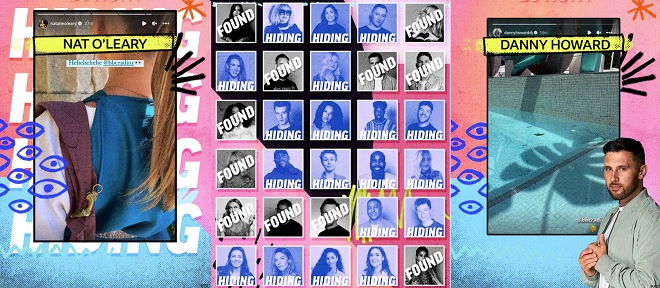
Status of the Giant Radio DJ Hunt at the end of Day 1, along with the clues that caught Danny and Nat
The Giant Radio DJ Hunt So Far: A Dash of Geoguessr, A Sprinkle of Puzzling At the time of this article, 11 out of 30 presenters have been found, with listeners tracking down clues left by presenters across their social media at a rapid clip. Charlie Hedges was the first to be found at a Tayto’s crisp factory in Northern Ireland after sharing an Instagram Story of herself outside the building’s four distinctive turrets (along with a picture of some potatoes). Meanwhile, Danny Howard and Pete Tong were tracked down because fans knew he had a DJ set in Ibiza, making it easier to track down the poolside photo he shared. Nat O’Leary and Dean McCullough had the most puzzle-heavy clue so far, with Nat’s Roman toga combining with Dean’s rugby gear directing listeners to the Caerleon Roman Fortress and Baths in Wales.
So far, the Giant Radio DJ Hunt has followed a similar flow: Radio 1 presenters (either alone or in groups) drop cryptic clues to their location in Instagram Stories, and listeners track down the clues. What makes the Giant Radio DJ Hunt so special is how leads and false starts are being documented, live on the radio.
Greg James kindly gave up his WhatsApp number, allowing fans to message with updates on the leads they’re chasing and their progress through the hunt. Accordingly, that allows the show’s producers (who have not joined their fellow presenters on the run) to follow up and facilitate live interviews about the hunt’s progress. So when a listener traveled out to the Roman bath house in Bath, they were able to report that an employee at the bath house checked out the picture and recognized it as the bath in Carleon, live on air.
Highlights from the Hunt are being syndicated on Greg James’ All Day Breakfast podcast, and vicariously experiencing tales from the hunt make for scintillating listening even if you don’t dive into the hunt yourself.
Two weeks ago, Showfall Media released a media keynote sharing the news about their exciting new horror comedy project, The Social Experiments. The live experience gives viewers at home control over aspects of the broadcast. The keynote was marred by some unexpected glitches and ominous messages about how “it got everyone…everyone but me”, but a subsequent press release from the team at Showfall Media confirmed that those rogue frequencies are completely untrue, and can be ignored. So there’s absolutely nothing to worry about when the show premieres tomorrow, May 24th at 6pm EST, on the RanbooLive Twitch channel.
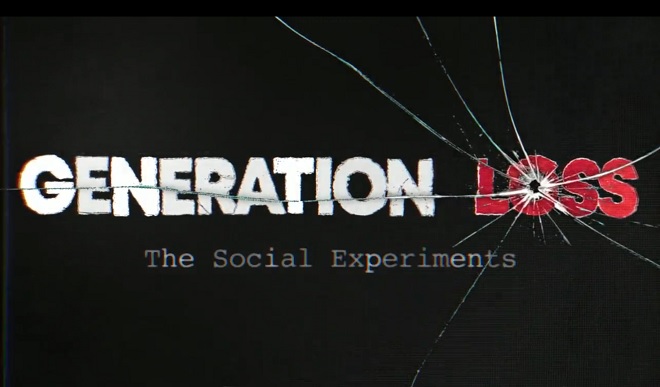
It’s worth noting that Showfall Media is a fictional company and The Social Experiments is the show-within-a-show for a new analog horror series called Generation Loss (GenLoss, for short). However, this Wednesday’s livestream is real, with the Wednesday premiere followed by additional streams on the 26th and 28th to extend the story. The series is created by Ranboo, a Twitch streamer who already has experience with semi-scripted livestreaming through his involvement as a character within the Dream SMP Minecraft server.
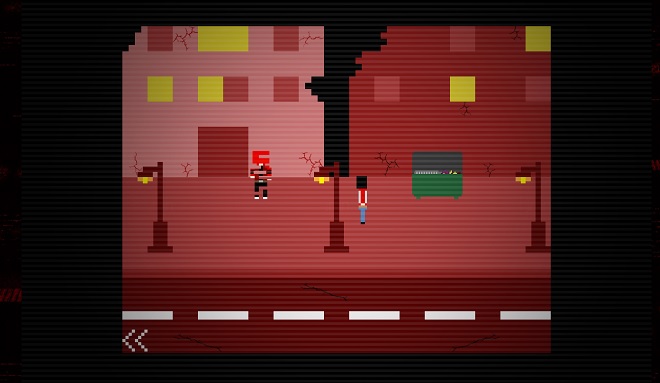
A scene from the Generation Loss teaser game
Early Glimpses at Generation Loss While the team has kept fairly tight-lipped about exactly what Generation Loss will be, there have been a number of teasers hinting at things to come. In May 2022, the series released its first teaser trailer – a 30 second video with flashing messages that inspired a 16 minute Game Theory episode theorizing about what the project might bring. In the video, MatPat notes that “generation loss” is likely a reference to the gradual degradation of quality as analog media gets copied over time.
Recent teaser content posted to the Generation Loss Twitter account supports that theming, with a video of “The Hero” switching from 16-bit avatar to photorealism, just as the audio switches from an ominous 16-bit tune to a more orchestral version. Players can even take direct control of that avatar through a game on the Generation Loss website, where players can guide the Hero to talk with three characters, before encountering a glowing orb that further degrades the 16-bit world.
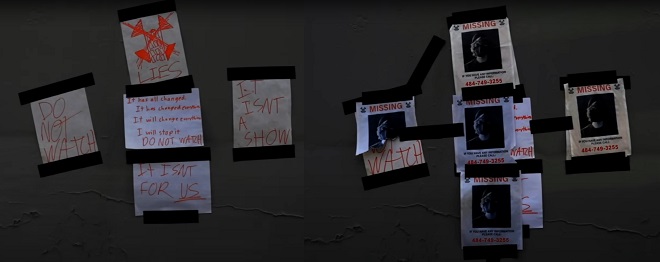
Two scenes from Connected, a video that highlights a Missing Person poster
One video in particular implies that the show is dangerous: a series of five posters warn players to ignore The Social Experiments – “It has all changed. It has changed everything. It will change everything. I will stop it.” These warnings are soon covered over with Missing Person posters. Calling the number leads to a voicemail from Showfall’s Missing Person hotline that says “we appreciate your call, but you are not able to help us”.
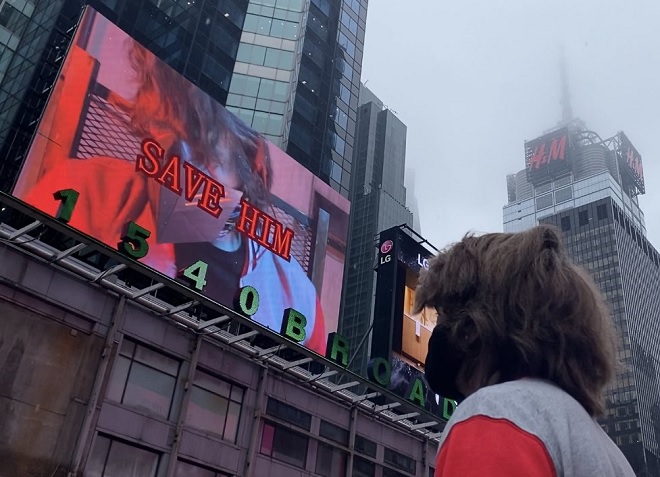
Over the weekend, Generation Loss even took out a banner on Times Square featuring the message “SAVE HIM” superimposed over the Hero’s face – Showfall Media’s press release begging their fans to pay no mind to “rogue frequencies” from an individual who wants to destroy their horror-comedy experience was in response to the outdoor advertisements as much as it was addressing the hijacked keynote.
So, the setup for Wednesday’s premiere: Showfall Media is outwardly promoting a lighthearted horror comedy series called The Social Experiments. But something has gone wrong enough that even watching the show on RanbooLive at 6pm EST on March 24th is dangerous.






 welcome home
 pendog creative
 undertone
 generation loss
 subtext game
 meow wolf