Category: Features (Page 36 of 37)

Touch Me, I’m Perplex City

pcx.jpgAs reported earlier this week, the Perplex City ARG has recently ignited a few flames of contention within the ARG community with its controversial announcement of what appeared to be a pay-for-play model based around collectible puzzle cards and, more shockingly, the possible payout of a large reward. Indeed, a prize of £100,000 (about $200,000) may be claimed by whomever locates the Receda Cube, Perplex City’s pet McGuffin Device, and returns it to its rightful owners (assuming Perplex City’s ownership of the mysterious cube is indeed rightful).

These developments have brought up plenty of questions, from whether the announced reward is real (it is), to whether players will have to buy puzzle cards in order to continue playing the ARG (they won’t), to concern about whether a large cash reward will end up factionalizing and splintering the existing community of players (maybe, but hopefully not). It certainly seems as if the recent “Group 333” launch managed to cry havoc and let loose the dogs of Meta across the forums, blogs, and news sites that populate the ARG community space. Opinions a-plenty can be found everywhere, many based on little to no concrete information, yet liberally daubed with some speculative glue to hold them together. A recent article posted to the Perplex City Sentinel helped to clarify some of the aspects of the game as related to the puzzle cards, but the best way to find out more was to secure an interview with one of the Perplex City Puppetmasters. Unfiction.com spoke at length with Adrian Hon about several issues related to some of these revelations.

Continue reading

This Is Not A Game…

…and the TINAG Philosophy

Play any Alternate Reality Game or even just read one of the many articles on the genre and you will quickly and repeatedly come across the phrase, “This Is Not A Game.” Your first reaction will most likely be to chuckle at the thought, but before long, you will notice yourself declaring those exact same words. Why? What does it mean? Where does it come from? And, for the “metaheads” out there, what the heck is TINAG?

Continue reading

Feed Me!! RSS and Alternate Reality Games

rss.jpgAlternate Reality Gamers are always looking for the best way to keep informed of what’s going on in their favorite game. Not everyone can surf the boards reading each and every post all day long (yes, some people actually have to work at work), so players are always looking for ways to stay as current as possible without having to sacrifice huge amounts of time. Historically, moderated lists or blogs that would email updates to players’ in-boxes were pretty much the standard vehicle for letting players know about game updates in a timely way.
Recently however, ARGs and their corresponding player-authored resources have begun taking advantage of RSS syndication, which is a way of pushing new content out to players, but surprisingly, this great vehicle is often going underutilized. So, we thought we’d offer a little primer for those of you who have always wondered what those little RSS buttons that show up on various websites are for.

What is RSS?

RSS stands for Real Simple Syndication, and is a standard format for publishing and distributing regular updates around the web. Using this standard, website publishers can provide updates like the latest news headlines or blog postings to consumers who use RSS reader applications (or one of a growing number of online services) to collect and monitor their favorite feeds in one place (RSS content viewed in one of these readers, is often called a “feed”).

Major news websites such as Wired and news-oriented community sites such as Slashdot and Fark offer RSS feeds, but it’s not just for news. Almost anything that can be broken down into discrete items can be syndicated via RSS: the “recent changes” page of a wiki, new items for sale on Amazon.com, even recent postings or new topics in a forum. Once information about each item is in RSS format, a feedreader program can check the feed for changes and notify you when they occur.

Continue reading

Halo 2’s “I Love Bees” Alternate Reality Game

ilbreview.jpgThe story of I Love Bees proved to be slightly confusing at times, but the gist of it is this: Beekeeper Dana had a site which was attacked by some sort of virus; a countdown was placed on the site which spawned endless hours of speculation as to what the hell “System Peril Distributed Reflex” represented. Besides looking at the odd snippet of information through corrupted pictures and jarbled text, all the players could do was wait on tenterhooks until July 27th, on which “Network Throttling would erode…”

Sure enough, come noon July 27th, ilovebees.com is updated. Someone was mad at Dana and posted pictures of her all over the site; Dana freaked out and decided to flee the country.

The next major plot advancement came August 10th, when “the medium has metastasized”. A lot of information was posted on the site- the most important being GPS Coordinates. 220 were posted in total, all of which pointed to locations the length and breadth of the United States.

On August 17th, to the dismay of some, the coordinates changed- now there were 210 in total. However, there were now specific times telling people when to be at a particular coordinate- which proved to quell a lot of confusion. The importance of being at the “axons” was further emphasized when Dana added to the excitement by implying on her blog that we really should get to them! All players could do was kill time, and many found the night of August 23 to be a sleepless one.

So what happened when the axons (pre-determined payphones in large cities) went hot?

Continue reading

Ilovebees: The Beast is Back?

danathumb.jpgWhat began as a mysterious Fedex package of honey, has become one of the most intriguing and highly anticipated (for some) events on the ‘net in quite a while. At first, when ARGN received the honey (filled with letters that spelled I LOVE BEES, leading to ilovebees.com) a little over a week ago, we thought it was a new grassroots ARG starting up, but when it was discovered that the ilovebees.com address made an appearance in the recent Halo 2 trailer, we realized this may be much bigger than originally anticipated.

We were right. Since the trailer hit the web on Friday, the entire cyberscape is abuzz, trying to figure out what’s going on. The story has been picked up on computer gaming sites such as IGN, GameSpot, and even Slashdot. Thousands of posts on innumerable boards are clamoring to figure out what is going on.

What is confounding some is exciting others who recognize this as a new Alternate Reality Game. Those in the know are even proclaiming this to be the followup to the ARG that started it all: The Beast, which was a promotional game for Spielberg’s film A.I. back in 2001. The Beast spawned Cloudmakers, an online smart mob of over 7000 who rabidly followed, solved, and obsessed over who killed Evan Chan. The Beast was a viral promotion like no other, and was an amazing event for those who were involved.

So, what is going on here with ilovebees.com? How does it relate to the Halo 2 universe?? Well, ilovebees.com is an amateurish website for Margaret’s Honey that’s being hacked by someone…..or something. Margaret’s niece, Dana, is the webmaster, and the site points to her blog, where she is asking for help dealing with the virus or whatever it is that is screwing up her aunt’s site. Players have emailed her, and Dana has actually replied to some players personally, thanking them for their advice. Upon closer examination, it was discovered that the various images on the site were corrupted with text phrases, which when assembled correctly formed a rather bizarre narrative about a Queen and a Widow.

On July 27th, one of the mysterious countdowns on the site expired, resulting in an update with more hacking goodness, and scaring the crap out of Dana. It seems whatever is taking over her aunt’s site is now actually threatening her.

So, what does Halo 2 have to do with all of this? Well, a great Story So Far explains things pretty well, even though it is a lot of speculation at this point. [EDIT: The Guide is also a great place to start, as it’s a chronological narrative of what’s been going on, and is kept very up to date.]

The ARG community has done an absolutely amazing job so far, organizing information and using tools that were unavailable just a few years ago to create an information and dissemination system the likes of which have never been seen before. If they’re right, this is just the beginning of what is sure to be an amazing ride. Stay tuned.

Here are some links to get you on your way:

QuickStart
I Love Bees Guide
I Love Bees Wiki Guide
I Love Bees Trail
Bee Quicklinks
Moderated Blog

Here are some forums discussing I Love Bees:
Unfiction
TeamXBox
Bungie.net

IRC Chat:
#ilovebees

This Is Not An ARG: A Labyrinth Tutorial

Recently, many players were alerted to a series of puzzles that were hidden in plain sight – puzzles that ultimately revealed a shiny new tool called Labyrinth. This tidy, no-nonsense program is maintained, designed, and implemented by the Karetao group.

Although the Labyrinth tool itself is straightforward and organizationally versatile, we thought we’d provide a couple of short tutorials for you. It seemed only natural to approach the Labyrinth launch puzzle itself, and use it as a means to display some of the basic features of the program.

Let’s get started, shall we?

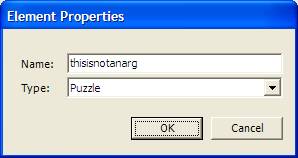
We have a trailhead, found in a known puppetmaster’s personal website. The indication here, in a comment code, turns out to be a pointer to a sub-directory on the site named ‘thisisnotanarg.’ So, we’ll call it that!

We open the Labyrinth application, and use the project properties to set the name of our mini-puzzle: ‘This Is Not An ARG’.

labtutorial001.jpg

Since this does not appear to be a story-based game, our plot elements aren’t going to be characters and locations; they’re going to be the individual pages we come across. Later on, it becomes apparent to us that the pages lead to one another, so for purposes of clarity with this tutorial, we’ll use the term ‘stage.’ We create a new element for the first stage.

labtutorial002.jpg

The element is created and opened for us automatically.

But wait, there’s more!

Continue reading

« Older posts Newer posts »