
 Greetings from sunny Los Angeles! This year’s E3 is proving to be a landmark occasion in the world of Alternate Reality Gaming. Not only is there a veritable ARG Development Team (Puppetmaster) Summit going on, with representatives from five different teams in attendance, but this whole ARG thing is creating quite a stir, especially on the exhibition floor.
Category: Info (Page 16 of 16)
 Well, it’s that time of year! The 2005 Electronic Entertainment Expo in Los Angeles opened its doors this morning. This is where game developers, console manufacturers and anyone related to the electronic entertainment industry have a chance to showcase their newest and coolest products for all the world to see for the very first time. Next-gen consoles are definitely what everyone’s buzzing about this year, with new offerings by Xbox, Nintendo and Playstation at the forefront of virtually every conversation.
 A new book is scheduled to hit the shelves that will really have a big impact on Alternate Reality Gaming. This Is Not A Game: A Guide to Alternate Reality Gaming by Dave Szulborski will be available in e-book and print-on-demand format in mid-January 2005 and in a traditional print version in February 2005. An MP3 book “on tape” will also be available. For a limited time, the first 2 chapters of this book are available to download for free!
Dave is the creator of several successful and critically acclaimed Alternate Reality Games including Chasing The Wish and Urban Hunt. From the book’s website:
Some of the founders and leading lights of the newest and hottest trend in entertainment announced today that they have joined forces to produce the first ever how-to book on the subject. Titled This is Not a Game, the new book promises to be a how-to resource for the casual game developer and media strategists alike who wish to explore the genre of Alternate Reality Gaming also called immersive gaming….
…While Alternate Reality Gaming has been around for several years, the recent phenomenal success of the online game “I Love Bees“, produced by Microsoft and Bungie to promote the release of the much anticipated video game Halo 2, has brought thousands of new participants into the genre and launched Immersive Gaming into the mainstream consciousness once and for all. ARG/immersive gaming has been featured in media venues such as CNN, Trendcentral, BBC, New York Times and countless other sources as of late.
This is Not a Game provides a concise and easy-to-understand explanation of the alternate reality game and why so many major marketing and entertainment companies are now turning to immersive gaming and marketing efforts to promote their biggest product releases. Tracing the roots of the genre back to the earliest days of online interactive fiction up through the most recent alternate reality games, This is Not a Game allows anyone, regardless of their level of knowledge and experience with the Internet or online gaming, to jump right in and become fully immersed in this exciting and engaging new form of entertainment.
The new book will also contain contributions from author and media theorist Joseph Matheny, ARGN founder Steve Peters, professional stage illusionist Ben Mack with website and cover design by cutting edge gaming artist Denny Unger of Worldworks Games.
Keep an eye on immersivegaming.com for future announcements and details as they become available.
Recently, many players were alerted to a series of puzzles that were hidden in plain sight – puzzles that ultimately revealed a shiny new tool called Labyrinth. This tidy, no-nonsense program is maintained, designed, and implemented by the Karetao group.
Although the Labyrinth tool itself is straightforward and organizationally versatile, we thought we’d provide a couple of short tutorials for you. It seemed only natural to approach the Labyrinth launch puzzle itself, and use it as a means to display some of the basic features of the program.
Let’s get started, shall we?
We have a trailhead, found in a known puppetmaster’s personal website. The indication here, in a comment code, turns out to be a pointer to a sub-directory on the site named ‘thisisnotanarg.’ So, we’ll call it that!
We open the Labyrinth application, and use the project properties to set the name of our mini-puzzle: ‘This Is Not An ARG’.

Since this does not appear to be a story-based game, our plot elements aren’t going to be characters and locations; they’re going to be the individual pages we come across. Later on, it becomes apparent to us that the pages lead to one another, so for purposes of clarity with this tutorial, we’ll use the term ‘stage.’ We create a new element for the first stage.
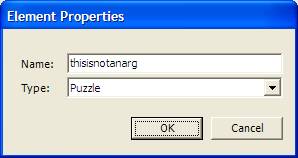
The element is created and opened for us automatically.
But wait, there’s more!
 welcome home
 black watchmen
 escape rooms
 undertone
 giggleland
 curators request