Category: Features (Page 21 of 37)

Accomplice Hollywood: Oh Nikki, You’re So Fine!

accomplice-hollywoodSteve Peters is a guest writer for ARGNet and founder of No Mimes Media.

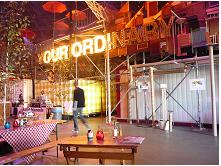
A few weeks back, I was able to head to Hollywood to take part in Accomplice: Hollywood, a new interactive experience produced by Neil Patrick Harris, Tom Salamon and Betsy Salamon-Sufott, that takes place entirely on foot throughout Hollywood Boulevard and its neighboring streets. While the website bills the experience as a “luscious blend” of one part Scavenger Hunt, one part Interactive Theater, and one part Walking Tour, (with all the good parts left intact and all of the bad parts sifted out), I’d add one part Alternate Reality Game into the recipe, for sure (c’mon Neil, get with the lingo). What was it like? I’ll do my best to explain without spoiling the fun. Was it any good? Read on and see.

After reading a blurb about Accomplice: Hollywood on some vanity blog, I said to myself, “Hey! I live near Hollywood!” and promptly bought tickets for the missus and myself, along with cajoling a couple more friends to come along for the fun. We booked 2pm on Sunday, September 27th, and were told that we’d be contacted the day before the event to be given instructions, including where to meet. In the meantime, we were told to visit NikkiDesmond.com to find out more. Go there now and watch the video (which is pretty funny, I must say). I’ll wait…
Continue reading

Not Your Ordinary PICNIC: Exploding Media, Part II

PICNIC 06This article resumes our PICNIC coverage on day two of the conference, which focused on the theme of “Exploding Media.” The second half of PICNIC’s Exploding Media coverage explores branding campaigns, location-based entertainment, and the development of special effects. 
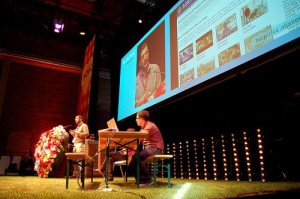
Jessica Greenwood, deputy editor of trendwatching magazine Contagious, took the audience on a tour of innovative branding and marketing campaigns that are all on the frontlines of the changing media landscape. One of the quotes she used in her introduction was one of Douglas Adams: “Anything invented before you were 18 has been there forever, anything that turns up before you’re 30 is new and exciting, and anything after that is a threat to the world and must be destroyed.” Adams’ quote raises an interesting notion, indicative of how innovations are often received. Greenwood elaborated on several innovations in the marketing field that did receive favorable receptions, and, probably more importantly, were also quite successful in reaching their goals.

The first case was Virgin Mobile’s Australian campaign Right Music Wrongs, which kicked off with a video of musician Vanilla Ice apologizing for his music, asking the public to vote on whether he was guilty or innocent of ‘music wrongs.’ The project had an initial budget of only $150k, launching an engaging campaign around the musician and the concert he was going to give in Sydney in March ’09. It ended up reaching 22 million people and getting hundreds of thousands of people engaged in several online activities.

Continue reading

Not Your Ordinary PICNIC: Exploding Media

PICNIC 04It’s time for day two of PICNIC, and a new day means a new theme: Exploding Media. The theme brought with it an exciting schedule, filled with more on social media, but this time focusing on trying to find parallels between social media and brands and marketing strategies, as well as on games and interactivity.

The first speaker was movie director Chris Burke, who is also the creator of This Spartan Life, the world’s first and only “talkshow in game space”. I hadn’t previously heard of This Spartan Life and thus wasn’t familiar with the show’s format, where a host (Burke)  interviews a guest (in this case, Gerri Sinclair, CEO of the Center for Digital Media), while playing Halo.

Apparently,  This Spartan Life has been a big  hit since 2004 and has gathered quite a bit of praise for its innovative presentation. I can see how the concept might work well with smoothly edited episodes showing Halo game play supplemented by added voiceovers. However, as a live concept, I thought it came off as a forced way of trying something new. The Halo backdrop compounded by the clumsiness of Sinclair trying to master the controls of the game were so distracting that I hardly followed the actual interview.

Sinclair, hailed by Burke as a “gaming professor who actually knows what she’s talking about” has a great track record when it comes digital media and narrative . Most of the times when the interview took an interesting turn, though, the conversation got interrupted by shrieks of “Oh no! I fell of a ledge!” and “someone is shooting at me!” or with Burke trying to keep track of where his interviewee went in the Halo level. It’s a shame, because I would have loved to hear more of what Sinclair had to say on gaming and the changing ways of delivering narratives.

Continue reading

After Purity Towers: Confessions of a Double-Crosser

Purity Towers LogoSometimes, the most interesting games are also the most controversial. They push the limits of expectations and possibilities, presenting new challenges and opportunities for participatory play. Purity Towers, the latest campaign from Funnel Productions, operated on two levels of controversy. First, the producers created a competitive game environment between two divergent camps: the hegemonic Proscript Party, and the representatives of the underclass, the Grotian Underground. Secondly, the game’s content, while often presented in a light and humorous way, touched upon real social and political issues, including illegal detention and torture, revolutionary change, and political oppression.

The Grotians and the Proscripts were once two antagonistic kingdoms forced to cooperate because of frequent dragon attacks. When the dragons were finally defeated by Edward Jameson, a mythical hero and ancestor of the last Proscript President, the Grotians were in worse shape than the Proscripts. According to the mythos, the Grotians agreed to become the servant underclass of the Proscripts, and for several generations the People’s Proscript Party (PPP) ruled over the “Proscription Zone.”

One day, the Grotian Underground (GU) started recruiting players. A luxurious Party-owned residence, Purity Towers, was about to open its doors, becoming a landmark in “The Proscription Zone.” The GU defaced the Purity Towers website, and a high-ranking Party member encouraged players to create their own GU cadre, resulting in a ning network, an underground newspaper, and the blogs of two symbolic leaders, Levi Waltershield and Rosa Wells. To complicate matters, two recurring Funnel Productions characters, Earl de Rosa and Randy Porknut got a contract to sell Sticky Itchers Shower Scrub to Purity Towers. Randy recently recovered from a bout of undeath from a previous game while Earl, in his drunken grief, got married in Las Vegas and misplaced his new bride. Inspired by this, a GU player starred as Earl’s lost wife, Bertha Marie Effenberger. Making some heartfelt videos, Bertha’s mission was to get Earl to sympathize with the Grotian side and infiltrate Purity Towers while delivering Sticky Itchers Shower Scrub.

Continue reading

Not Your Ordinary PICNIC: Turning Points, Part 2

PICNIC 02Onwards to part two of the first day of the PICNIC conference schedule–this section of three consecutive panels and presentations was all about the shifts in demographics: the role that race and ethnic background play in producing theatre on Broadway and in emerging online communities, and the role of a changing audience and the way that audience divides its attention on “traditional” media.

First off was a presentation by renowned producer David Binder, who talked us through his experience bringing Lorraine Hansberry’s 1959 play A Raisin in the Sun back to Broadway for a modern day revival. As  A Raisin in the Sun is a classic African-American play, Binder wanted to honor its roots, which to him meant that he had to find an African-American director. Broadway isn’t exactly brimming with diversity (of the 40 directors active on Broadway last season, 36 were men and only one person of color), so Binder had his work cut out for him.

What followed was a mildly interesting relay of his quest for a director (he ended up working with the then relatively unknown Kenny Leon) and cast (he managed to snag Sean Combs aka P Diddy for the lead role). I think my appreciation of Binder’s excited monologue was slightly hampered by the fact that my knowledge of all things Broadway is virtually nonexistent and the fact that as a European, I’m a lot less used to such a heavy emphasis being placed on race, so some of his points sounded (literally) rather foreign to me.

On a personal note, Binder gets a lot of credit from me for having the creative guts to bring The New Island Festival to New York City. The festival is based on two important Dutch theater festivals, Oerol and De Parade. From what I gathered from his talk, reviving a play like Raisin in the Sun took a lot more guts than that.

Continue reading

Not Your Ordinary PICNIC: Turning Points

PICNIC 01Not your ordinary PICNIC:  that’s the tagline I found plastered all over the Westergasfabriek terrain during PINIC ’09. And PICNIC indeed is something quite out of the ordinary. 

I arrived Wednesday around 11:00am, a few hours before the official opening of the conference part of PICNIC, which meant that I could take some time to explore the impressive central area of the festival, the PICNIC club. A place to meet, to eat, to tweet (there was a Twitter tree set up in the main area, with UTP cables hanging down its branches) and to look at all the interesting stuff that PICNIC’s official partners, including UPC and Microsoft, were showing off.

The area was brimming with activity. During the morning, several sessions of PICNIC Young had already started, which is a collection of workshops and seminars for teachers and students, exploring technology and creativity and their possible adaptation to school programs. PICNIC Young is only one of many “tracks” running alongside the main conference schedule of PICNIC, and if you wanted to cover all of it, you would need at least 5 or 6 people on the ground.

Other interesting events were also already going on at the various PICNIC Labs that were scattered among the conference area, like the Digital City Special, or the Augmented City Lab, exploring present and near-future adaptation of various mobile augmented reality technologies. I did not attend any of these sessions, but if you’re interested in what augmented reality can do today, check out the iPhone 3GS app that the folks at Layar have launched at PICNIC.

The main conference has a different theme for each of its three days. The first day’s theme was “Turning Points”, focusing on social changes that have their impact on society and social media, and kicked off with a familiar face: Israeli conductor Itay Talgam. I had heard Talgam speak at PICNIC last year and his ideas on leadership really stuck with me. The one-liner he kicked his talk off with this year: “In these times of insecurity and crisis, people are sick of leaders. It’s about communities now.”

Continue reading

« Older posts Newer posts »