Category: Previews (Page 9 of 19)

PICNIC ’09: Not Your Ordinary Picnic

PICNIC 2009Question: What do you get when you combine interesting speakers, special events, hands-on labs, two contests, networking opportunities, an Ignite event, and dinner? Answer: The PICNIC event in Amsterdam, which kicks off its fourth annual festival in just under three weeks!

Once again, ARGNet is proud to be a Network Sponsor of the event, which has been an annual must-see for those interested in the fields of cross-media, transmedia and social networking for the past three years. This year’s festival is the biggest yet, and it’s going to be a test of endurance for our man-on-the-scene Daniel van Gool, who will be at the conference again.

The line-up for the week is formidable and wonderful, starting with keynote speeches from such people as Peter Molyneaux (Lionhead Studios), Niklas Zennström (Skype) and Ed Ulbrich (Digital Domain). Of the other speakers and presenters, Daniel will be paying close attention to Alice Taylor (Channel4), Dan Hon (Six to Start), Kevin Slavin (Area/Code), Matt Adams (Blast Theory) and Kati London (Area/Code) as they convene for the panel “Games That People Play” on September 24th. Daniel may also want to check out some of the special events scheduled for the festival — “Reality Continuum” is a really cool and interesting title which sounds like it could be fun to take in. Or maybe he’ll make his way over to the PICNIC ’09 Labs for some hands-on experiences at the Augmented City Lab. Any way you slice it, PICNIC ’09 is going to be magical and unforgettable, and we know Daniel is already counting down the days until it starts.

Of course, some of you out there are probably thinking of attending PICNIC ’09, and if you haven’t gotten your tickets yet, we’ve got great news for you. As sponsors of the event we have a special discount code for our readers, which we will tell you…. after the jump.

Continue reading

Six to Start Puts Up “Smokescreen” for Online Privacy

smokescreengame.com

In 2008, Facebook chief executive Mark Zuckerberg proposed a social networking analog to Moore’s Law, which states that the number of transistors on a chip doubles every two years. “Next year,” Zuckerman posited, “people will share twice as much information as they share this year . . . [t]hat means that people are using Facebook, and the applications and ecosystem, more and more.” Recent studies suggest that individuals are willing to trade privacy in exchange for small rewards and convenience. As the online marketplace is embracing social networking and the “free” economy, people are increasingly faced with limited bargaining power and ignorance about what information they are offering in exchange for services. In order to address many of these issues, the British public-service broadcasting network Channel 4 has paired with veteran alternate reality game designers at Six to Start to create “Smokescreen,” a 13-part online adventure designed to educate youth in the UK about issues of online privacy, identity and trust.  The online game will be released in September.

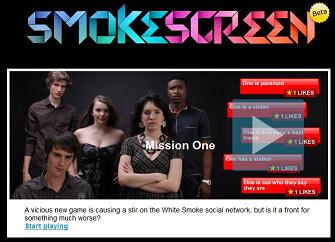
“Smokescreen” is about a vicious new game called “The Rumor Mill” sweeping its way across the fictional social network called “White Smoke.” The network’s owner, Max, is concerned the game might be a front for something else. According to Channel 4, the game, targeted towards 14-19 year olds in the UK, will allow players to network, collaborate and challenge each other using their identity as a weapon, and privacy as armor. Six to Start’s Chief Creative Officer Adrian Hon explains that “Smokescreen is a game about life online. Every time you hear about a teenager being hauled up at school because of their Facebook profile, or someone being conned out of their password on Twitter – that’s what Smokescreen aims to explore. And because our game puts players in a simulated situation, we can give them an experience that is far more powerful and immersive than any other media.” Six to Start’s CEO Dan Hon adds that “[i]t’s about the implications of what sharing information means to daily life, beyond just stealing identities or credit cards . . . [t]his could simply be one character asking you to find out information about another character, leaving you to decide whether you tell them or use it to your advantage.”

Channel 4 Education is embracing the cross-media entertainment model, with game budgets Routes, an alternate reality game addressing the implications of genomic research. Alice Taylor, Channel 4’s Commissioning Editor, told Escapist Magazine that Channel 4 aims to get “more teens and more impact for our investment. We still do television projects – but now they’re native to the internet, and sometimes they act like games, too.”

Providing information about yourself on the internet is not in and of itself a bad thing. However, disclosing information should be an informed choice. And “Smokescreen” is a step in the right direction towards fostering media literacy.

Coral Cross: Pandemic Preparedness from the Hawaii Department of Health

coralcrossDystopic literature often turns to the threat of pandemics for inspiration. From Albert Camus’ La Peste to Stephen King’s The Stand, authors create global pandemics in their stories to confront issues raised by a threat to human survival that strikes at the very fabric of our society. In order to open a dialogue about Hawaii’s pandemic preparedness and allocation priorities, the U.S. Centers for Disease Control and Prevention is funding an alternate reality game starting in mid-May at CoralCross.org.

As part of a larger public engagement initiative that includes community meetings and a live TV panel, the Hawaii State Department of Heath has contracted with the Hawaii Research Center for Future Studies to produce Coral Cross, a “playable scenario” on the island of Oahu. According to Judy Kern at the Communications Office of the Hawaii State Department of Health, the goal of the ARG is to “help encourage public dialogue and elicit input for decision-makers on Hawaii’s pandemic priorities.”

The game is scheduled to launch during the second half of May, with each day representing one month of game time. While anyone can play, the game’s core audience will be located in Hawaii, particularly the island of Oahu. As Stuart Candy, researcher at the Hawaii Research Center for Futures Studies, explains,

First, we can make use of the limited geography — a captive audience, if you like — by using more real-life elements to augment the storytelling. Second, as a member of our design team observed, the fact that we’re tackling a global topic, pandemic flu, with a local tilt, not only gives it an interesting flavour, but it also helps the scenario. Instead of trying to evoke every last thing about how the world could transform as a result of a deadly disease sweeping across it, the island acts as a sort of microcosm in which, no matter where they’re from, people will be able to see what’s at stake more clearly and concretely, in particular how lives and communities are affected.

By restricting the geographic field of gameplay to a limited area, Coral Cross will hopefully be able to address the impact pandemics will have on local communities and social structures while providing a truly immersive experience for the participants.

For a number of years, the Hawaii Research Center for Futures Studies has been facilitating public discussions of future scenarios through “experiential futures.” And as a former Game Master for the Institute For the Future’s forecasting game Superstruct, Stuart Candy received first-hand exposure to the potential of the genre for community forecasting. With serious games like World Without Oil, Superstruct, After Shock, Ruby’s Bequest, and Coral Cross engaging the community in meaningful dialogue, Jane McGonigal’s dream of seeing a game designer win the Nobel Peace Prize is becoming increasingly likely.

Anyone interested in Coral Cross can submit their email address to CoralCross.org in order to receive notification when the game begins in May.

ARG Lab: UT Dallas Class Offers Practicum in ARG Design

albrackinLast fall, veteran alternate reality game designer Adam Brackin taught a class on alternate reality gaming at the University of Texas at Dallas’ Emerging Media and Communications program. The course required graduate students interested in the developing field to read a series of academic works on the subject, learn about the history of the genre, and follow a currently running game. This semester, Brackin is offering students the opportunity to put their theoretical knowledge to the test with the ARG Lab, a class where students will design their own six-week long alternate reality game, scheduled to launch in early April.

Brackin’s graduate students seem eager to trade their tuition dollars for the opportunity to experiment with game development through the practicum. Candace Barnhill, one of the ARG Lab students, explains that “we learned so much about the history of ARGs and player experiences last semester that I coudn’t resist a peek behind the curtain. I had no idea PMs did so much to prepare for what often appears to be player developed.”

Continue reading

Mir-12: Viral Marketing for Singularity?

mir-12

Once again, YouTube has led to a rabbit hole that seems to go deeper and deeper with each day. A video was uploaded to the site, supposedly a Russian news clip reporting on an assassination attempt on a scientist, as well as the the subsequent shooting of the would-be killer. The newscast points viewers towards an organization named Mir-12, which is believed to be behind the attack. Upon visiting the Mir-12 website, players discovered a blog documenting the actions of Mir-12, a “global community” attempting to uncover a Russian conspiracy concerning an island where Soviet weapons testing took place during the height of World War II.

Mir-12’s founder, an American student, roundly denied any knowledge of the scientist prior to January 16th, the date of the incident documented in the video, and states that the assassin, Natasha Norvikov, was nothing more than a friend helping to uncover the truth behind the mysterious island and the Russian government cover-up. Researching Natasha, players have found more information on the active young woman who had accounts on Flickr and Facebook. Mir-12’s most recent update includes a link to Natasha’s photography work, also discovered and submitted to the site by players.

So, what does it all mean? As one intrepid blogger has already uncovered, Mir-12 seems to be a viral marketing campaign for the upcoming Activision video game Singularity. Some research into Mir-12’s Twitter account shows that certain followers of the Mir-12 Twitter-feed were employees of the DDB Ad Agency, and DDB has worked with Activision in the past. This discovery, coupled with the Singularity trailers, make the coincidences in plot seem much less… coincidental.
Continue reading

Skynet Research Wants You!

terminator_salvation

A recent trailhead discovery could prove very exciting for Terminator fans as it appears to be the beginning of a viral marketing campaign for the upcoming Terminator: Salvation film. Skynet Research has little more than a message claiming that “Skynet Research is Coming,” and registration for e-mail updates but the legitimacy of the site as more than a fan creation is helped by the privacy policy, which links to the website of non other than Warner Bros., the production company behind the Terminator films. There are still three months before Terminator: Salvation hits the big screen on May 22nd, which is plenty of time to give fans a chance to take part in John Connor’s resistance.

Hopefully, more comes of this web site, and when it does, ARGNet will provide updates, so keep watching this site for details.

« Older posts Newer posts »