
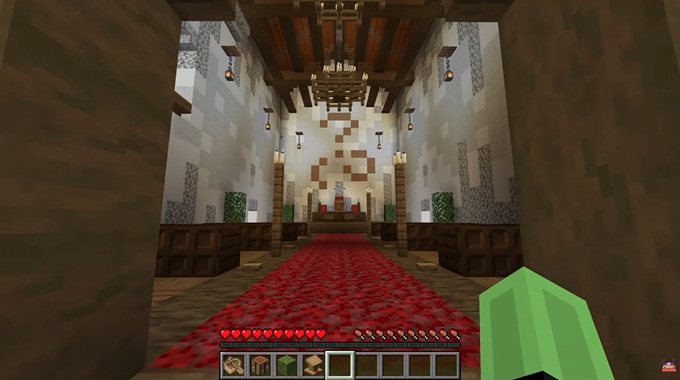
Back in November, ARGNet covered Searching for a World That Doesn’t Exist, a modern reinterpretation of Robert Chambers’ The King in Yellow through the lens of a Minecraft Let’s Play video. This reframing of the classic horror story is particularly fitting, as the titular King in Yellow isn’t a typical eldritch horror. Instead, it’s a play capable of driving those exposed to it mad, serving as an early instance of cognitohazards.
Searching for a World That Doesn’t Exist ended with the protagonist Derek (playing under the handle d3rlord3) encountering the King in Yellow offscreen, and offering one final warning to protect Avery (TheMostMayo) from repeating his mistakes. And for a few months, that was where the series creator Wifies left things. But earlier this month, Wifies released the second part of his duology, Destroying A World That Doesn’t Exist.
As with the prior installation, Wifies’ two hour long video offered a summary of a considerably longer source material – this time, a fifteen hour long upload to Avery’s YouTube channel. But while the prior video was primarily told through Derek’s perspective, the first half of Destroying A World That Doesn’t Exist is told from a considerably more naive perspective.
Avery’s Perspective: Following in D3rlord3’s Footsteps
The first installment of Wifies’ King in Yellow reimagining starts with the warning, “whatever you do, at the crossroads, don’t turn left.” And as we finally begin to see Avery’s exploration of the world, he ignores these instructions and attempts to follow in D3rlord3’s footsteps. But when Avery crosses the threshold of the giant golden door, instead of being confronted with unseen horrors, he’s confronted by a single gold block…until turning around and finding himself in a room filled with doors.
Behind each door, Avery finds himself thrust into a different world, littered with signs of D3rlord3’s prior passage – items from his inventory appear like a trail of breadcrumbs, guiding Avery through puzzles he doesn’t quite understand. The first world he stumble across, for example, is a series of precarious mountain spires connected by wooden bridges. Upon crossing each bridge, mountains appear and disappear with no explanation. On one occasion, the only thing saving Avery from falling to his virtual death is a series of blocks previously placed by D3rlord3.
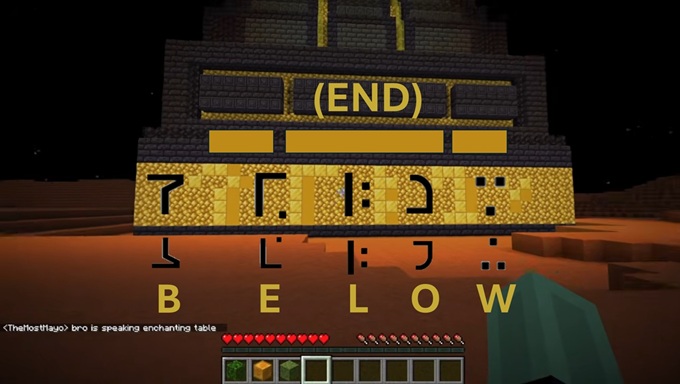
That is not to say that Avery isn’t engaging with his environment: in one world, he comes across a towering obelisk, with strange glyphs written on it, and recognizes the puzzle in place: “bro is speaking enchanting table”. And he’s right – the bricks spell out a message in Minecraft’s Galactic Alphabet, which often appears alongside the game’s enchantment table. The upper portion of the obelisk starts with – — – , the pattern used in the Galactic Alphabet for “end of sentence”. This provides a hint that the cigils need to be flipped upside down and reversed to be legible, resulting in the message “BELOW”.
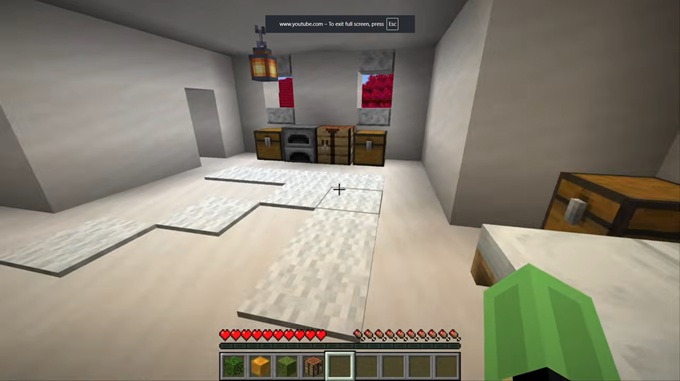
Avery proceeds through many of these elaborately designed worlds and eventually finds the doorway leading to the next, guided by a trail of items. Sometimes, viewers can intuit the way forward themselves. In a world blanketed by a sea of red rolling hills, the landscape is broken up by a series of white houses. Avery focuses on the items inside the houses, missing the giant tiled arrows placed on the floor of each house, directing him where to go. Eventually it’s a crafting table in the distance that leads Avery to his next location. Only this table couldn’t have been placed by D3rlord3, since it appeared out of nowhere. There’s something else leaving a path of breadcrumbs for Avery to follow.
One particularly insidious world almost halts Avery’s journey entirely. Slightly over 2 hours into the raw footage, after navigating a series of underground canals, Avery stumbles across a cozy world occupied by a single church. A Yellow Sign often serving as harbinger of the King in Yellow hangs above the pew, and a book at the altar reassures Avery he’s safe here. And for the next twelve hours, Avery silently tends to the church. It’s only until he reads a sign left by D3rlord3 that he is broken from his reverie and proceeds onward.
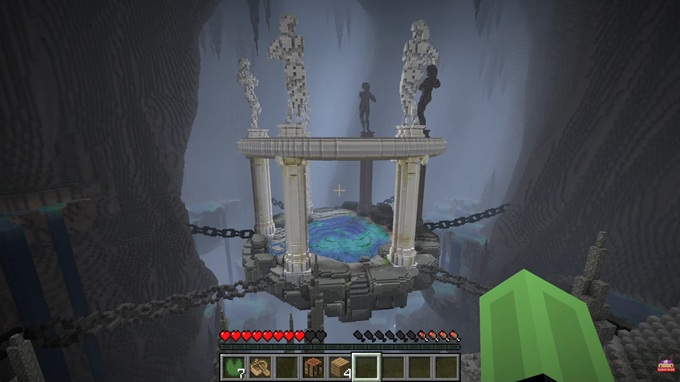
That is not to say that Avery has no personal agency in progressing forward: one particularly intricate puzzle appears in the center of a lake in between six statues. Avery “solves” the puzzle by spending four minutes breaking through the netherite block that acts as the lock, before typing “stupid puzzle” into chat. Finally, around halfway through the video, Avery encounters D3rlord3. And during that conversation, he’s provided a link to the events leading up to their encounter, from Derek’s perspective, although the video has since been “deleted”.
Continue reading






 the wedding party
 postcurious
 subtext game
 pendog creative
 simulacra
 generation loss