
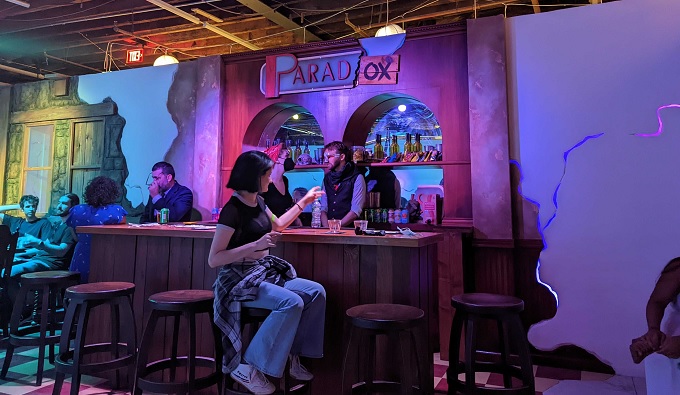
On my first visit to the Paradox Bar I received a free drink ticket from myself, welcoming me back to the timeless venue. A handful of colorful characters slipped out of time, and found themselves at an old bar from the 1950’s. As another version of me explained in a letter, “it’s kind of a watering hole for those of us trying to repair reality – a place to meet, talk about our efforts, and compare notes while we try to find the right set of choices that will fix this rift once and for all.”

The Paradox Bar acts as in-universe lobby for a trilogy of escape rooms collectively referred to as The Paradox Cycle, although players often referred to the games by the company’s name: Doors of Divergence. The rooms had a relatively short run in New York City: the game’s first chapter, Heresy 1897 opened in June 2022. This was quickly followed by the release of its second chapter, Madness 1917, in September. Just over a year later, Doors of Divergence closed its doors with an in-universe farewell party in October 2023.
During those 16 months, I took seven trips through the rifts at the Paradox Bar, because the team designed an experience that meant every single visit was a completely different one, leading me through different puzzles and even rooms, despite nominally playing the same game multiple times. Luckily, an online alternate reality game seems to be implying that Doors of Divergence has found a new home, giving me an excuse to talk about what remains my favorite escape room due to the depth of its experience and the vaguely terrifying scope of its ambition.

Into the Rift: Beyond Choose Your Own Adventure
The Doors of Divergence experience starts at the Paradox Bar, where a welcoming bartender introduces teams to the space between times they have fallen into, and introduces a few of the colorful characters who have fallen into the rift with them. One might come across an engineer, an astronaut, or even a scout leader milling about the bar. Idle conversation might even trigger a special request for the pending journey through time: bring back a couple of gears to help fix a clock, perhaps.
My first night, the Paradox Bar even had some special programming planned, and the surprisingly spacious room’s stage was used for a variety show, complete with aerialist performance. Once it’s your group’s time to proceed into the rift, a member of the staff would pull you and your group to the side, and introduce the mission. But instead of dryly reading off a list of rules and regulations, players would be encouraged to pull a series of tarot cards, offering divinations of events to come (and the corresponding rules to help navigate those situations).
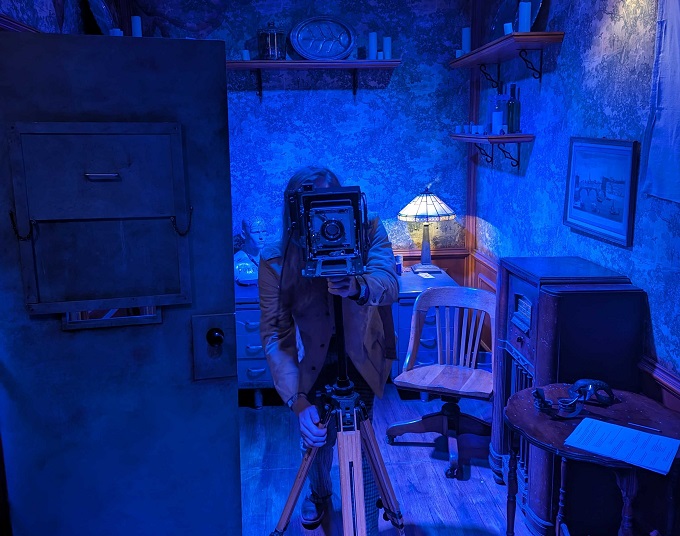
As players’ first interaction with the Rift, Heresy 1897 leads players into the past as they enter Edmond Cavanaugh’s study, where they encounter the game’s Proctor. Teams are challenged with a question that determines which of two completely different escape rooms to play, within that space.

That means that Heresy 1897 is technically two completely different escape rooms, that just so happens to occupy the same space. There’s an entire room of Heresy that is unique to that initial binary choice, and there’s nothing about the in-game experience that would even hint at that secret. Teams are also presented with a moral quandary at the end of every room, meaning Heresy 1897 has four different endings, even if teams complete the room.
To help players track these choices, post-game debriefs include handing out a series of cards to commemorate key decisions and actions from the escape room. Entering those codes into an online portal tracks your progress and choices through the game – not just for those key moments at the beginning and end of the experience, but for some of the smaller choices, rewarding players who push the edges of the experience. Did you get sticky fingers at an opportune time, or linger for a moment longer than you should have?
Madness 1917 is where you start to really see the impact of those choices, with at least four different narrative and puzzle experiences: every escape room team enters an insane asylum during the Great War, but the reason for being there is changed, and interactions with the sequel experience’s two actors starts taking a much more theatrical turn, although it is still an escape room experience at its core.
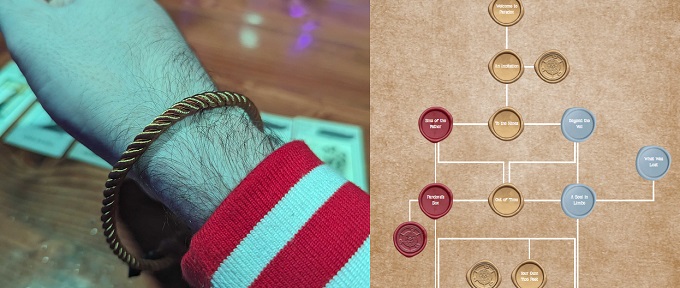
Reducing Doors of Divergence‘s narrative flexibility to a series of binary choices diminishes what they actually accomplished, however. For one of the puzzle paths in Heresy 1897, rotely doing as you’re told through a series of puzzles has serious implications to the Proctor monitoring your investigation. Narrative cues scattered throughout the rooms helps provide context behind the true implications of that choice, but it is perfectly reasonable to complete the room by making that final decision by the flip of a coin. But if you go out of your way to figure out those implications and explain your choice to the Proctor, the bartender might gift you with a pin from a secret order at the end of the experience, along with the cards.
And if you wear that pin on subsequent visits to Doors of Divergence, characters will make note of its presence: both inside the Rift, and in the Paradox Bar lobby. Things can get even more personalized than that: when I first played Heresy 1897 with No Proscenium’s Blake Weil, he tried to bluff his way through a scenario by making up a somewhat scandalous affair. When we returned for Madness 1917 a few months later, he was slipped a letter referring back to that moment – you can even find a picture of that letter here. But the most extravagant example of player customization can be found with the duck cult.

That’s Right, I Joined A Duck Cult – And I’d Do It Again
While constructing Doors of Divergence, the team filmed a series of behind the scenes videos, including one video highlighting Creative Director Christian Vernon’s reliance on “rubber duck debugging” to navigate particularly thorny technical challenges. That same duck makes a number of appearances in the behind the scenes videos, and seems to have become something of a mascot for the team. So, it’s no surprise that the duck, now named “Chester”, was given a prominent perch behind the Paradox Bar to oversee his domain.
But then, I started hearing rumors in the escape room community: Chester has a cult, and if you ask about it at the Paradox Bar, it unlocks a secret optional puzzle track. So when I went back to Doors of Divergence with a few out-of-town guests, I figured I’d give it a shot. And yes, asking about Chester triggered a challenge: while escaping the rooms, our job was to locate a golden cord of rope and Chester himself. After locating both objects, we went through a suitably ridiculous ceremony whose details I cannot disclose, and were inducted into the Order of the Flying V. That cult membership would become relevant again at the Farewell Party the team threw in October 2023.
The Goodbye Party I Wish More Immersive Experiences Got to Throw
On October 28th 2023, Doors of Divergence opened its doors one last time to the public with an event that allowed fans to visit the Paradox Bar one final time. There was a scavenger hunt to locate a series of objects hidden throughout the venue…a social deduction party game…and even a chance to tackle puzzles in the Heresy and Madness rooms we might not have played before, culminating in a heartfelt ritual to bring the night to a close.
They even had a lottery for attendees offering Doors of Divergence merch: I ended up winning one of three failed Philosopher’s Stones, with the promise that bringing one to the third chapter of Doors of Divergence would cause…something to happen.
It’s so rare to get to say goodbye to a beloved experience. I did attend Sleep No More‘s Apparitions festivities (a three night series of parties that helped bring narrative closure to the looping story), but Life and Trust ended more abruptly. And I’d love to say that the heartfelt closing remarks were my favorite part of the night.
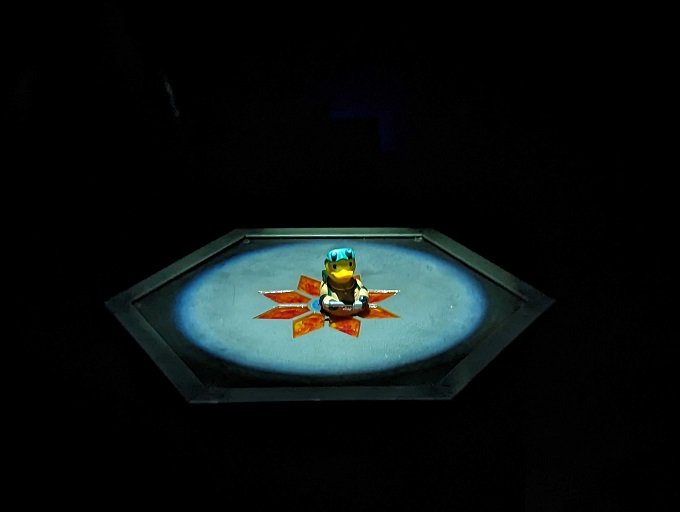
But the Duck Cult held its first and final conclave, and I can’t stop thinking about it. Picture this, if you will: a line of acolytes are led into the lobby that is typically the home to Heresy 1897. It is pitch dark. All of a sudden a spotlight appears, highlighting Chester, resting on a dias. A haunting “quacking” sound echoes, and a screen lights up.
“Greetings, my flock. It is good to finally speak to you directly. We have much to discuss, you and I. You have helped me lay the foundation of a grand endeavor. But this is only the beginning. There are larger plans soon to be hatched. Before we can discuss, I must give you one final…Inducktion.”
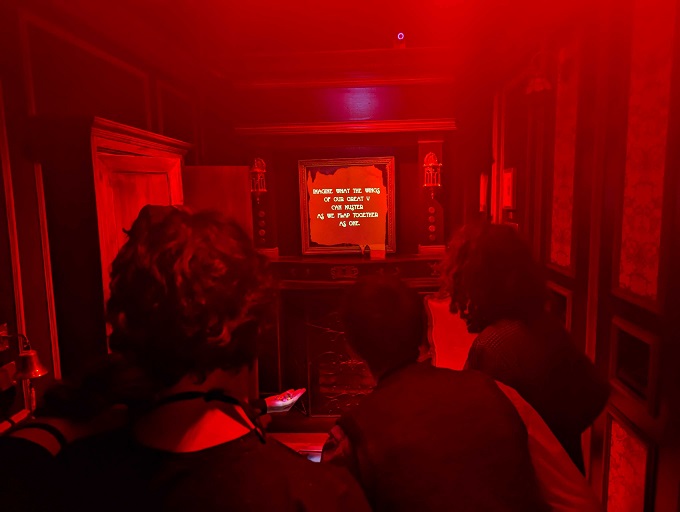
Vows exchanged, the room is bathed in red and a secret panel pops open: the dias is filled with tiny plastic ducks, and we are charged with spreading them wherever we go. And that was the end of Doors of Divergence. At least, for a time.
Teasing a Return to the Paradox Bar with an ARG
Starting on June 20th, the Doors of Divergence Instagram account returned from over a year of silence to post a series of nine images that combine to show Doors of Divergence owners Christian Vernon and Zac MacKrell breaking ground at a new location.
Curiously, each of those posts also contained a series of nine different rulesets for nonograms. Compiling each grid created a 25×25 QR code, scanning to a Google Drive containing a message:
If you’re seeing this, it means you found my thread. It means you had reason to pull on it.
It means you KNOW what’s coming back.
We have to be ready. You have to prepare. Time is going to break again, and worse. Nobody remembers the last time. Save for me. And you.
I don’t have much information yet, but I’m working on it. When I find more, I’ll put it here.
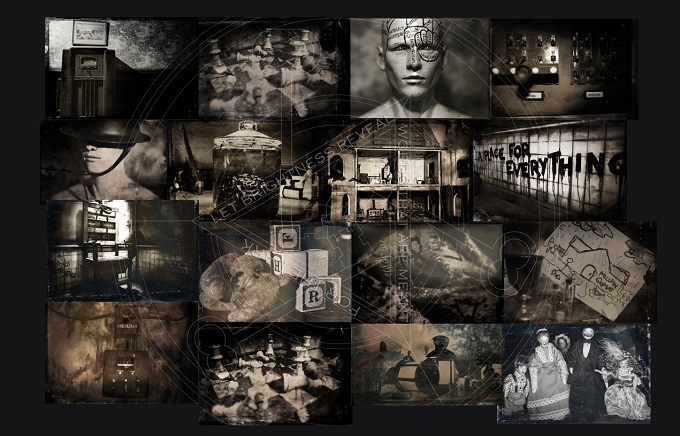
The PDF also contained a hidden email address, putting players in touch with “A Friend” who prefers to go by Pendulum. And Pendulum is coming out swinging with some devious puzzles hidden across Christian and Zac’s social accounts. One particularly satisfying puzzle shown above features a series of 16 photos Christian posted to his portfolio on LinkedIn, featuring shots of some of the props from puzzles in the Madness insane asylum.
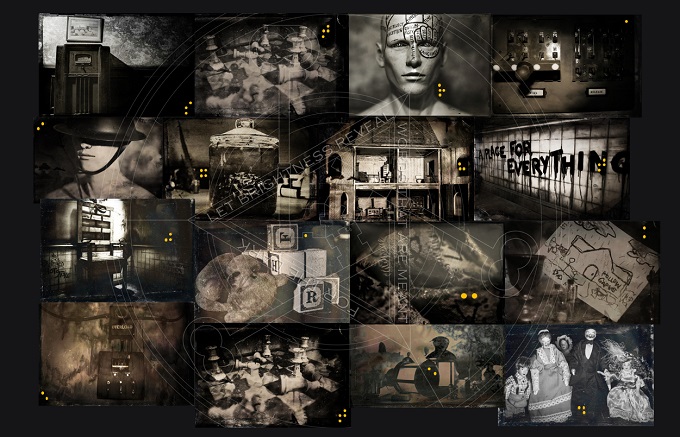
Assembling them based on the patterns lightly etched into the background reveals the message, “Let Brightness Reveal Words That Are Meant For the Dark”. Turning up the brightness reveals a series of braille characters spelling out “straightjacketed” – a key to unraveling a cipher on another social platform.
On the Importance of Feeling Seen in Immersive
Over the weekend, Richard Burns published an article on the Room Escape Artist blog about the importance of feeling seen in escape rooms. In it, he argues that games can create more meaningful moments by presenting players with the chance to bring something more than binary choices to the table, to make players feel like the story requires more than just a warm body to move forward.
And while Doors of Divergence does an incredible job at creating an elaborate decision tree to transform a series of three escape rooms into dozens of completely different experiences, that’s not why I’m so fascinated by what they’ve built, and what I hope they are bringing back.
It’s those smaller moments of interactions with the cast: how asking the right question can lead to joining a duck cult, or secure membership into a more serious secret society. Or developing parasocial relationships with a disembodied hand in the window that’s helping you through a puzzle that’s quite the handful. It’s about using the game’s hint line to banter with a character rather than advance the plot. And it’s about using a key you received from a character months ago to barter for information about future events.
And hopefully, it’s about the return of an in-universe bar that’s an immersive attraction in its own right.
Thanks to the RECON Discord for their efforts in untangling the ARG so far. This article will be updated once an official location and/or opening day has been announced for Doors of Divergence’s return. In the meantime: poke around, and see what you can uncover from the alternate reality game. Click Here for a full walkthrough of the ARG’s progress so far.
 scp afterworld
 the wedding party
 undertone
 black watchmen
 giggleland
 curators request
This is not the end. It never ends, not truly. Find me, before they break everything and everywhen.