Category: Features (Page 10 of 37)

Giving Voice to Novel eBook Experience, The Silent History

The silent epidemic began in the year 2011. Children around the world were born without the ability to learn language. They didn’t babble as babies. They didn’t speak as they grew older. They couldn’t understand what their parents were saying. They seemed to show no interest in using language at all. Parents became frustrated, trying every obscure teaching method and advertised miracle cure. Scientists were baffled. There was no virus, no environmental toxin they could pinpoint as the cause of the disorder. As years went by, hope for a cure dwindled, but it became obvious that there was something more to the silents, something everyone had failed to notice.

This is the premise of a new, serialized digital novel, The Silent History, by Kevin Moffett, Matthew Derby, Russell Quinn and Eli Horowitz. Fans of puzzle hunt books might recognize Horowitz as one of the authors of The Clock Without a Face, a children’s book filled with hidden clues that led to real-world buried treasures.

While The Silent History doesn’t have cryptic clues or buried jewels, it does encourage readers to explore the story in several new and exciting ways. The creators, who designed and released The Silent History as an iOS app, are calling it “a new kind of novel”. Initially, the app offers video and text that introduce the reader to the story world. There are then two different experiences a reader can choose to explore: the time-released Testimonials, or the location-based Field Reports.

Continue reading

Television and Gaming Merge in Defiance for Transmedia War Zone

Over the years, Rockne S. O’Bannon has transformed more than a few science fiction projects into cult classics: O’Bannon helped shape the futuristic worlds depicted in properties including Alien Nation, SeaQuest DSV, and Farscape. With his newest project, Defiance, O’Bannon explores a future, post-apocalyptic Earth where aliens and humans are forced to cooperate in constantly-warring factions to survive.

While humans and aliens are entering a tentative alliance in the Defiance narrative, television and video games are entering into a novel alliance to tell the story. While a Syfy television show will play out in a refugee camp located in the former city of St Louis, a massively multiplayer online first-person shooter (MMOFPS) developed by Trion Worlds (makers of the popular MMORPG Rift) will follow events in San Francisco, with crossover events from both storylines impacting the developing narrative. The Defiance television show does not debut until April, with the video game version preceding the television premiere by one week. However, the stage is already being set for the launch through a website for Von Bach Industries, a company within the transmedia narrative’s universe.

Continue reading

2012 Year in Review: We’re Still Here

argnet

Over the years, more than a few alternate reality games, transmedia storytelling projects, and advertising campaigns have warned that December 2012 would mark the end of the world. That shouldn’t come as much of a surprise: you can’t get much higher stakes than saving the world, and fighting against an ancient prophecy with its own pre-existing mythos (however misinformed) can add mystique to a narrative.

In 2009, the alternate reality game The Institute for Human Continuity reportedly sparked hundreds of letters to NASA’s Astrobiology Institute from people earnestly worried about the coming Apocalypse. Closer to the date in question, Funcom’s The Secret World offered a series of six missions intended to forestall the End of Days both inside and outside the game. Even Old Spice got in on the harbinger of doom act, using points from six increasingly ridiculous flash games to power a laser cutter that slowly etched additional time onto the Mayan calendar for their absurdist campaign, Old Spice Saves the World.

Proclamations of impending disaster weren’t limited to global catastrophe this year, with Fourth Wall Studios’ Elan Lee adding his voice to the chorus claiming that ARGs are dead at the StoryWorld Conference in Los Angeles. And yet, 2012 was in many ways a renaissance for alternate reality games and transmedia storytelling, as new sources of funding arise for a thriving community of developers. What follows is a closer look at some of the major events in alternate reality gaming for the year.

Continue reading

Google’s Niantic Project Hints at Smartphone-Fueled Portals

Comic-Con has served as the launch platform for more than a few alternate reality games in the past. At the San Diego convention, Why So Serious held its first live event promoting The Dark Knight at the convention in San Diego, using attendees as the Joker’s patsies by getting them to don the criminal’s signature clown make-up and stage minor crimes. Showtime kicked off its Dexter-themed ARG with a scavenger hunt leading to a grisly kill room, while Disney’s Flynn Lives campaign transformed a nearby warehouse into the End of Line Club from Tron: Legacy. While most of these affairs have been major events centered around entertainment properties, Google appears to have shaken up that trend by slipping their Comic-Con launch of the Niantic Project under the radar, only to have it resurface in force this month.

On July 12th, self-proclaimed “ghost comic book artist” Tycho started working the crowds at San Diego Comic-Con near Artist’s Alley, handing out flyers inspired by his inexplicable visions, dominated by scenes of global landmarks and enigmatic encrypted messages about parasitic “Shapers.” As crazy as Tycho seems, the folks at Niantic seem interested in his ramblings.

These visions drove Tycho to confront Flint Dille about hidden messages regarding extra-dimensional portals implanted for decades in Buck Rogers stories, before security threw him out of the convention. A few weeks later, a university professor teaching his students about visualizing portals with cell phone cameras was escorted away from his inattentive audience, but that was largely the end…until earlier this month, when mystery blogger P.A. Chapeau started updating his virtual conspiracy theory corkboard at NianticProject.com.

Continue reading

TV Tropes’ Echo Chamber Turns Self-Referential Attention to ARGs

TV Tropes is an intimidating website. Over the past eight years, the community wiki has displayed frightening tenacity in indexing, codifying, and analyzing the tricks of the storytelling trade in an often irreverent manner. Remember the pilot episode of Community? The TV Tropes community flagged those 25 minutes of television for using over 46 different tropes ranging from Worthless Foreign Degree to The Dulcinea Effect. And the community doesn’t limit itself to documenting tropes that appear on television: everything from fan fiction and webcomics to alternate reality games are fair game.

Here’s where things start getting complicated. Starting in 2011, the TV Tropes homepage was taken over by Echo Chamber, an episodic web series dedicated to illustrating tropes through the lens of an increasingly eccentric cast of characters. For two seasons, Dana Shaw and her collaborators Tom Pike and Zack Wallnau played characters in a “Trope of the Week” Show Within a Show that paralleled events in their fictional lives, under the direction of Zack’s father Mark, Director of Transmedia for “The Other Wiki” (TV Tropes’ tongue-in-cheek nickname for Wikipedia) and the inscruitable Mr. Administrator. Season two ended with a Mind Screw, as Mr. Administrator explains that the entire show is part of a diabolical plot to understand the true nature of fiction and reality in order to inject tropes into the fabric of reality. And that’s where the alternate reality game, named The Wall Will Fall by its players, begins.

Continue reading

Byzantine Tests Add a Touch of Magic to “Hunted” Campaign

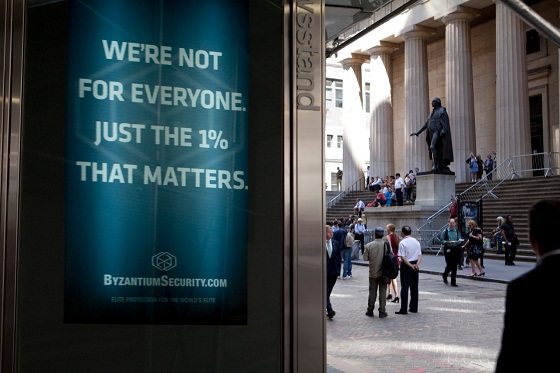
“We’re not for everyone. Just the 1% that matters.”

Byzantium Security International’s slogan embracing the financial elite’s privileged role serves as an uncomfortably poetic accompaniment to the one-year anniversary of the Occupy Wall Street movement. And with an out-of-home advertisement proudly flaunting a company’s exclusivity mere steps from Federal Hall in Wall Street, it’s no wonder the image has been repurposed to support the movement.

There’s more to Byzantium Security than an arresting hexagonal logo and a general disinterest in 99% of the country. The fictional company features prominently in Cinemax’s upcoming drama Hunted, and the Wall Street advertisements are merely one of a number of rabbit holes into the company’s inner workings. The series, premiering October 19th, revolves around Byzantium Security operative Samantha Hunt (Melissa George) as she seeks to unravel the mystery behind an attempt on her life. Fans can get a glimpse into the world of a Byzantium operative by completing a five-part examination liberally dosed with more than a few twists. Not everything is as it seems at Byzantium Security, which appears to be a recurring theme throughout the series’ interactive campaign, created by Campfire with the help of Jam3, the development team that worked on the interactive documentary Bear 71.

Yesterday, I received a puzzle box in the mail that serves as an alternate entry point to the Hunted transmedia experience. The hexagonal wooden box slid apart with relative ease, revealing a secret compartment carved into one of the pieces containing a miniature USB drive engraved with Byzantium Security’s overlapping hexagons. The drive contained a single password-protected file named “UNLOCK_ME.” Luckily, each of the three puzzle pieces had three letters etched onto their sides, spelling out “LOR / AGH / SSU.” Unscrambling the letters spelled out “Hourglass,” which unlocked a video driving to the Byzantium Security application page at ByzantiumTests.com.

Continue reading

« Older posts Newer posts »