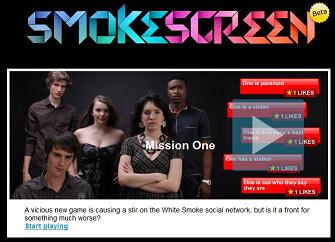
In 2008, Facebook chief executive Mark Zuckerberg proposed a social networking analog to Moore’s Law, which states that the number of transistors on a chip doubles every two years. “Next year,” Zuckerman posited, “people will share twice as much information as they share this year . . . [t]hat means that people are using Facebook, and the applications and ecosystem, more and more.” Recent studies suggest that individuals are willing to trade privacy in exchange for small rewards and convenience. As the online marketplace is embracing social networking and the “free” economy, people are increasingly faced with limited bargaining power and ignorance about what information they are offering in exchange for services. In order to address many of these issues, the British public-service broadcasting network Channel 4 has paired with veteran alternate reality game designers at Six to Start to create “Smokescreen,” a 13-part online adventure designed to educate youth in the UK about issues of online privacy, identity and trust. The online game will be released in September.
“Smokescreen” is about a vicious new game called “The Rumor Mill” sweeping its way across the fictional social network called “White Smoke.” The network’s owner, Max, is concerned the game might be a front for something else. According to Channel 4, the game, targeted towards 14-19 year olds in the UK, will allow players to network, collaborate and challenge each other using their identity as a weapon, and privacy as armor. Six to Start’s Chief Creative Officer Adrian Hon explains that “Smokescreen is a game about life online. Every time you hear about a teenager being hauled up at school because of their Facebook profile, or someone being conned out of their password on Twitter – that’s what Smokescreen aims to explore. And because our game puts players in a simulated situation, we can give them an experience that is far more powerful and immersive than any other media.” Six to Start’s CEO Dan Hon adds that “[i]t’s about the implications of what sharing information means to daily life, beyond just stealing identities or credit cards . . . [t]his could simply be one character asking you to find out information about another character, leaving you to decide whether you tell them or use it to your advantage.”
Channel 4 Education is embracing the cross-media entertainment model, with game budgets Routes, an alternate reality game addressing the implications of genomic research. Alice Taylor, Channel 4’s Commissioning Editor, told Escapist Magazine that Channel 4 aims to get “more teens and more impact for our investment. We still do television projects – but now they’re native to the internet, and sometimes they act like games, too.”
Providing information about yourself on the internet is not in and of itself a bad thing. However, disclosing information should be an informed choice. And “Smokescreen” is a step in the right direction towards fostering media literacy.

 You know when you get that feeling that you should have done something last week but you forget what it was? Today was one of those days for me, but luckily a little birdie reminded me about The Institute for Human Continuity, an ARG that launched (gasp!) in November 2008 in connection with the movie 2012. While this campaign has been going for ten months now, activity has been ramping up in recent weeks, with a letter making its way into ARGFest-o-Con 2009 swag bags, as detailed on the Unfiction forums by our own Celina Beach.
  Earlier this year, the Xi alternate reality game invaded the Playstation Home community-based service with cryptic clues scattered across the virtual playspace that Home provides. The game was billed as the first console-based ARG, and put nDreams (the company behind the game) into the spotlight. Recently, the company
  It’s been a while since the end of the ARGFest-O-ComicCon Hardcore Summer Tour, and I think I’m finally recovered enough to start recapping some of the crazy events that occurred! For this, the first in a series of Comic-Con 2009 recaps, here is the recap of the live event for the Disney movie, Tron: Legacy – otherwise known as “Flynn Lives!”.
 Well folks, here comes the day I know I’m going to look back on and think, “Wow, I wish I had written something much more insightful and interesting.” Starting September 1, 2009, I will no longer be the senior editor and owner of ARGNet. This is a decision I’ve reached after a great deal of thinking and soul-searching, and I know I’m walking away from a great group of people that work behind the scenes here. What I’ve come to realize is that with a new job starting in September and with two kids that are active in extracurricular activities, I don’t have the time necessary to put into this site anymore. So, rather than try to muddle through at a sub-par pace, I’ve asked Michael Andersen to take the reins, and thankfully, Michael has accepted the job.
 welcome home
 black watchmen
 masquerade nyc
 meow wolf
 generation loss
 undertone
