

It’s late on a Friday night, and our team of investigators have tracked down a lead while investigating the theft of the Shadow Diamond. We’re instructed to send a core group of aspiring detectives to the gala to try and track down the thief. Once our group assembles at the gala event, a helpful bartender tunes our radio to the proper channel, and set us off on a narrative scavenger hunt that weaved across over a dozen buildings on the MIT campus, tracking down the locations of eleven blue paw prints. The twist: since this was a noir detective adventure, our audio helper only saw things in black and white, so many of the colorful signposts along the way were described in shades of gray – fifty, to be exact.
Eventually, our team realized that the film noir world of MITropolis we traced layered perfectly over a map of the MIT campus itself, and that cross-referencing the clues we discovered along the way paired with the locations of those Blue Clues spelled out the identity of the thief.

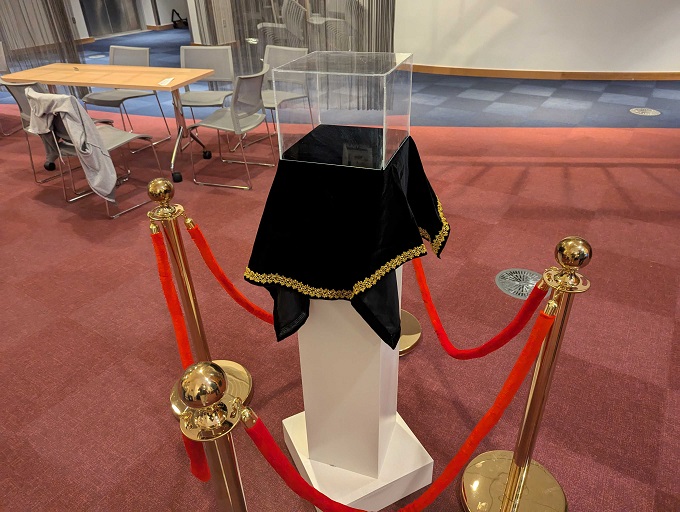
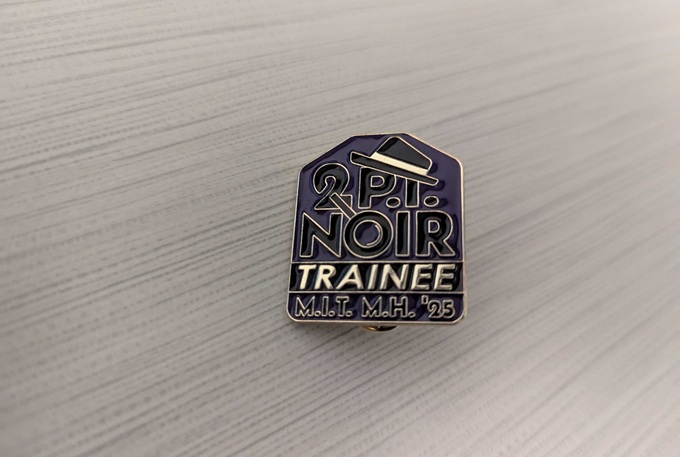
Armed with a name, our full team went up to the gala to confront the thief…only to discover that the culprit was murdered, and the diamond near the body was a fake, covered in scuff marks. Luckily, we were recognized for our efforts and upgraded to trainee detective status.
The MIT Mystery Hunt Means Something Different Every Year
At this point, the MIT Mystery Hunt might be the most covered immersive experience on ARGNet, with articles discussing the hunts in 2011, 2012, 2016, 2018, 2021, 2022, and 2023. And while the site skipped coverage of the annual event in 2024, that was because I was part of the team running that year’s hunt.
Some things have been constant about the MIT Mystery Hunt over that time. Hundreds of extremely smart puzzlers gather at MIT (either in person or virtually) over MLK Day weekend to push the boundaries of what a puzzle can be – both as puzzle constructors, and as solvers. There’s a narrative tying that experience together, structured around “feeder” puzzles, and meta-puzzles that use the answers of those feeder puzzles as inputs into a broader puzzle challenge. Teams have a long weekend in January to make it through the puzzles. And the reward for finishing the hunt first is a coin-like object, paired with the responsibility for running the next year’s Mystery Hunt.
Beyond that, the Mystery Hunt becomes an aspirational exercise in what the event can be, presented by teams that are excited about the event for very different reasons. And one of the most compelling questions asked by Death & Mayhem with their 2025 Mystery Hunt The Case of the Shadow Diamond was what it means to be a puzzle hunt community, in the first place.
Hunt as Film Noir: Two-PI Noir Detective Agency
The 2025 Mystery Hunt was structured as a detective noir investigation. During kickoff, teams learned that the Shadow Diamond has gone missing, stolen away from its display at a gala event honoring the engagement of Gladys Finster and Ferdinand Carter. To get to the bottom of the heist, Billie O’Ryan and the Two-P.I. Noir Detective Agency was hired on to investigate, and Mystery Hunt teams were enlisted to assist.
The first round of the hunt centered around investigating the alibis of each of the main suspects for the theft, with interactive text adventure interrogations of key witnesses after each meta-puzzle was solved. After piecing events together, detectives were sent on the radio-driven runaround across campus, only to learn the jewel heist was also a murder mystery.
Subsequent puzzle rounds focused on following up on leads from the first half of the hunt to uncover the suspects’ sordid pasts. Background Check guided players through Ferdinand Carter’s past crimes through a series of newspaper clippings rooted in a particularly intricate series of layered meta-puzzles, while The Illegal Search designed a round structured as a good old fashioned virtual escape room themed around tearing apart Papa Finster’s study for clues. Finally, the murder investigation itself took the form of an even more puzzley Cain’s Jawbone homage where players contextually reassembled the night’s events from six different perspectives.
This narrative framework was laid out on a website structured to mimic a conspiracy board, with new connections opening up after every new meta-puzzle solved.
Spam Your Friends: The Copypasta Puzzle
One of the earliest puzzles to unlock for most teams was a “copypasta” puzzle that encouraged puzzlers to spam their friends on other teams. Upon opening the puzzle page, teams would receive one of nine different emoji-laden spam messages. For our team (“Team That is Now Named Later”, or TTINNL, for short), we received the following Rickroll:
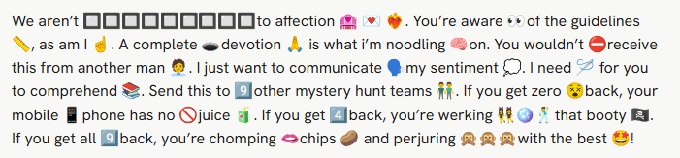
Within minutes, I started receiving direct messages from friends on other teams with their own blocks of copypastas. Teams came knocking on our headquarters door looking to trade spam messages, and even random passerby in campus halls got stopped, with questions like “did you get number three yet” echoing the halls. Eventually, I set up a database to manage outreach, tracking which teams we had copypastas from and who reached out to which connections on other teams to help complete the full set.
Structurally, the puzzle was relatively simple: the first portion of the text referenced a specific word from a famous copypasta, the middle portion provided guidance on how to index into that word (as well as how many different versions could be found), and the final part hinted at which copypasta went next in the cycle. The real puzzle here was an excuse to renew friendships with people on other teams, and maybe even have an excuse to make a few new ones.
The MIT Mystery Hunt is one of the only large scale puzzle hunts tied to a physical location, and teams are traditionally warned not to talk about puzzles or their solutions in the halls, to avoid spoiling the experience for other teams. The unfortunate side effect of this structure is that although the MIT Mystery Hunt is a puzzle event that lures around 2,000 puzzlers on campus every year, in practice most socializing happens within your own team while the hunt is live.
Solving Copypasta set the tone for the rest of the weekend: interactions with other teams wouldn’t be limited to the hunt’s four scheduled events which typically serve as the primary outlet for cross-team interactions. One of the more impressive examples of this in action involved the Hunt’s custom built radio. During the puzzle Songs on the Radio, teams unlocked the ability to use their radios as musical instruments. As a follow-up puzzle called The Comeback: It Takes Two, teams were tasked with using that knowledge in collaboration with another team who unlocked that functionality to perform a radio duet.
The Gala as Community Hub: Bringing the MIT Mystery Hunt to Life
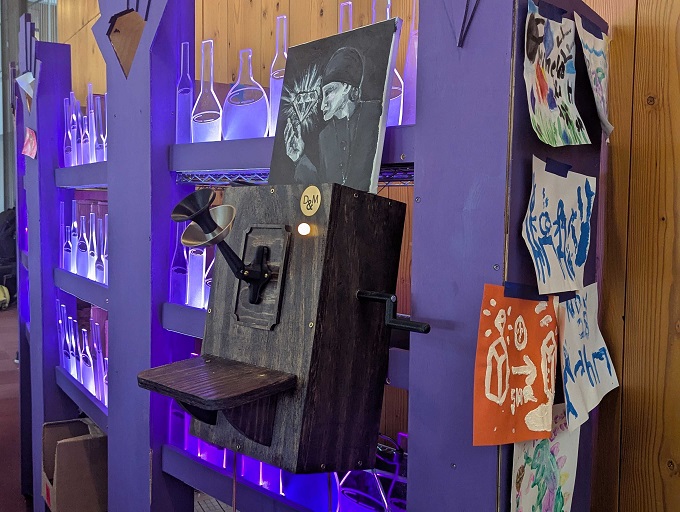
The narrative of the 2025 MIT Mystery Hunt revolved around a heist at a gala event. And Death & Mayhem transformed the fourth floor of the Stata Center into an actual gala event to serve as both command center and experiential hub for the weekend. Bartenders would print out receipts and hand over physical puzzles to teams that unlocked the right passphrase over the course of the hunt, and even offer challenges to proceed to the next step.
One particularly memorable example of this happened to me on Saturday morning. When I walked into my team’s on campus headquarters half-awake, Joe DeVincentis (who runs the Mystery Hunt Puzzle Index) turned to me and said, “Michael, I saved this for you – I need you to go to the gala and hit on a bartender.” The interim solution to a pickup line themed puzzle called A Recipe For Success instructed teams to get a little flirtatious to unlock the final answer.
After making a proper fool of myself, the extremely gracious bartender “slipped me his number”…a printed receipt with the final answer to the puzzle. While I was there, I picked up another puzzle for our team from the bar: a cereal box of Mystery O’s, covered in hidden puzzles.
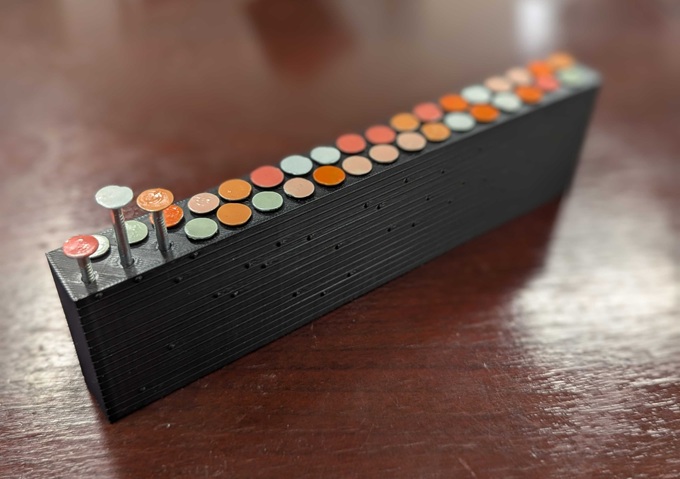
Another puzzle I worked on, the nail polish themed puzzle A Dash of Color, gave puzzlers the interim instruction to come and “get your nails done”. Fully expecting to have a manicure, bartenders instead handed our team a bag full of painted roofing nails of different lengths, along with a 3D printed plastic brick with holes drilled in the top to house the nails.
Hanging out at the gala could easily turn into its own form of entertainment, as a seemingly endless supply of teams visited the bar to put on a show for the gala’s patrons. Why did the gala’s receipt machine go haywire, printing out a series of 56 separate receipts in quick succession? What foul brews were gala attendees served in a custom packaged six-pack container advertising an alphabetical list of potential ingredients?
As the hunt went on, additional gala staffers also started offering puzzle hints, turning the bar’s many tables into a series of in-universe help desks. The hunt’s suspects would even make the occasional appearance, giving puzzlers interested in a little light Larping the opportunity to grill the suspects in an attempt to flush out a few clues.
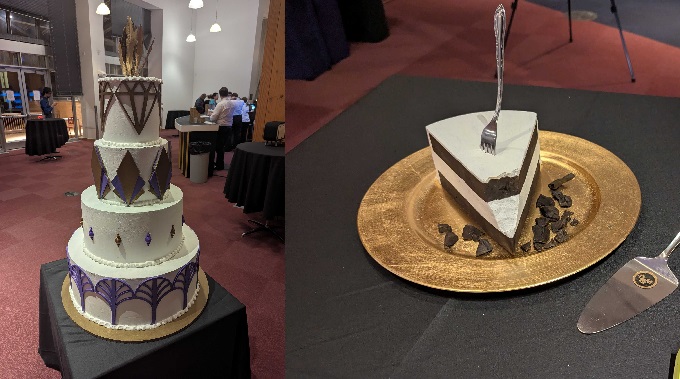
There was even environmental storytelling to give players a sense of how the hunt was progressing for other teams – finger-paint drawings from teams gradually filled up the gala bar’s walls as the weekend progressed, and as the first few teams reached the final runaround, even the giant wedding cake at the center of the gala was replaced by a slice of half-eaten cake to show that the gala was a living, breathing event.
The Hunt As Experience You Construct For Yourself
The MIT Mystery Hunt will frequently field over a hundred puzzles each year, and it’s not uncommon for a small group of solvers to spend hours trying to solve a single puzzle. Because of that fact, with few exceptions every solver is going to experience a very different hunt.
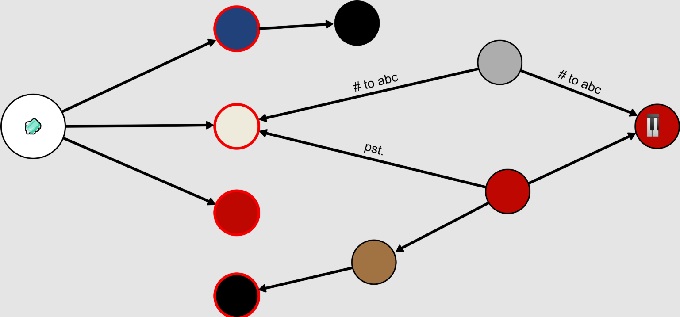
One of the things that this year’s hunt did to build anticipation around that fact was to let teams choose which puzzles to unlock for solving. This year, teams were provided with a list of puzzle titles and brief descriptions of available puzzles, but could only access it after spending virtual keys. This added a layer of strategy to the puzzle hunt and built anticipation for puzzles to come. For instance: as soon as The Eras Puzzle dropped as an option (described as “Colored node charts with pianos and guitars”), a half dozen team members immediately pinged me about the likelihood of another Taylor Swift puzzle, because I have something of a reputation. We ultimately held off on unlocking the puzzle until a crew of Swifties finished up their existing puzzles, and were ready to conduct the necessary lyrical analysis.
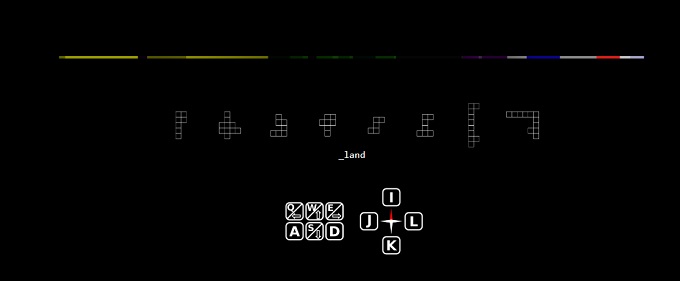
And there were a lot of powerfully thematic puzzles that unlock structure made easier to experience, by timing availability to when the people most interested in tackling it were free to experience it. Reuse and Recyclability hinted at a delightful Regency era genealogy puzzle with a twist, Synthetic Tagsonomy finally took advantage of the bread clip database for puzzling purposes, and _land managed to pull of puzzling as art by creating a navigable one-dimensional representation of two dimensional space that still breaks my brain. There were even puzzles that pushed against expectations of where puzzles could be hidden, like What Do They Call You, a puzzle that required changing your team name multiple times, and Recipe Substitutions, which parodied online recipe blog posts.
Return of the Remote Control Human Puzzle
One of the hunt highlights broke form, and managed to get most of our team collaborating on a single puzzle at the same time. Control Room started out innocuously enough, described as “an invitation to schedule an interaction.” Once it was unlocked, we were instructed to send a single teammate to another room, while everyone else on the team provided questionably helpful instructions through a web interface. Remote team members were provided with a checklist of actions that needed to be taken in order to complete the room, but could only pass on instructions by collectively voting on options of how to VERB the NOUN.
This highly comedic escape room experience was actually a spiritual successor to a series of puzzles that featured heavily in ARGNet’s coverage from Death & Mayhem’s last time running the MIT Mystery Hunt in 2018. Similarly to Control Room, 2018’s puzzle Under Control also tasked teams with sending someone to another room as tribute, with the rest of the team passing on instructions over a livestream to navigate a turn-based dance battle that only livestream viewers could see.
A New Year, A New Vision for the Hunt
Death & Mayhem’s Case of the Shadow Diamond was an exploration in the potential for a live Mystery Hunt – not just in terms of production value and physical puzzles, but what it means from an experiential standpoint to have over a hundred different teams running around the MIT campus for the weekend.
For some attendees, the highlight of Death & Mayhem’s hunt might have been seeing a fully-functioning radio filled with components that allowed it to be the center of a baffling range of puzzles. For others, it might have been the surprising opportunity to get a surprise escape room logged on their Morty account. For me, it was the chance to see new ways to get the puzzle hunt community interacting across teams outside of the shared Discord server.
Cardinality won the MIT Mystery Hunt for 2025, and in so doing took on the responsibility of running the hunt starting January 16th, 2026. And while the team has been running online hunts for a few years now, this will be their first time taking over the reins for the MIT Mystery Hunt. And I look forward to experiencing what their vision of what the hunt can be looks like.
 undertone
 giggleland
 masquerade nyc
 escape rooms
 scp afterworld
 postcurious
“The real puzzle here was an excuse to renew friendships with people on other teams, and maybe even have an excuse to make a few new ones.”
Perhaps the real puzzle was the friends we made along the way…
Great writeup, sounds like it was a ton of fun!
Guilty as charged, on both counts.