
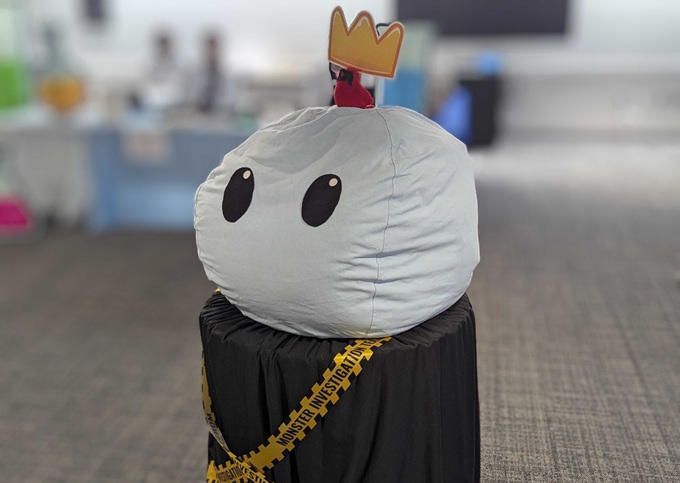
It’s January 16th, and I’m sitting in a classroom on the MIT campus. Hours earlier, I joined thousands of puzzlers attending a paranormal research conference called CRYPTIC, where an intrepid researcher named Burnham proved that cryptids do exist…but in the process, opened up a rift to another world that threatened our very existence. The only way to close the rift and save the world: befriend that world’s puzzle monsters (PuzzMon) to save the world. This is the 2026 MIT Mystery Hunt, an annual puzzle event that attracted over 5,000 puzzlers to spend a long weekend tackling a series of wildly creative puzzles.
Shortly after the conference, the PuzzMon.world website went live. By the time the evening rolled around, our team had already solved a handful of puzzles. I had just come off working on a puzzle themed around fanfiction tropes and the Omegaverse, and took a break from puzzles to explore the world of PuzzMon through a fully playable 16-bit video game world to unlock more puzzles for our team.
All of a sudden, two teammates settle down at my table and dump a box of black jigsaw puzzle pieces on the table, and start slowly matching pieces. I ask them what they’re working on: they explain it’s a puzzle called Starry Night. This is more interesting than what I was working on, so I drop everything and join them. Curious, I ask: “our team was given a set of two blacklights in our team’s welcome kit…do you think there’s secretly UV ink on the puzzle?”
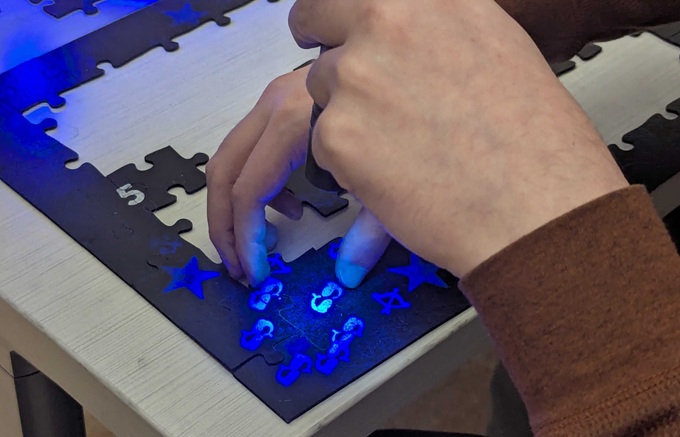
My suspicion was correct: there was secretly UV ink on the puzzle pieces, and under the right lighting the puzzle is much easier to complete. In under an hour we have a fully assembled jigsaw puzzle, covered in ultraviolet stars and astrological signs. But that’s only the first step of the puzzle, and for the next hour or so we would try and figure out how to connect the dots to transform those hidden symbols into a word or phrase that is the final solution to the puzzle.
Puzzles at the MIT Mystery Hunt can take just about any form, so over the event’s 45 year history the teams running the event have used it as a platform to push the limits of what a puzzle can be. And because the prize for a team winning the MIT Mystery Hunt is the responsibility for running the next year’s hunt, every team has a slightly different answer to what that spectacle entails. For 2026, the puzzles themselves served as center for the spectacle. But be warned, as this article will spoil puzzle mechanics of a number of puzzles for those looking to solve after the fact.
This Puzzle Has Been Here The Whole Time: The Art of the Cameo
One of the earlier puzzles in this year’s Mystery Hunt is titled This Puzzle Was Here the Whole Time, and guided players through a series of puzzles referencing episodes of Dropout’s hit variety show Game Changer. The initial phase of the puzzle featured four mini-puzzles that used mechanics referencing back to those episodes, resulting in an instruction to search for a particular phrase.
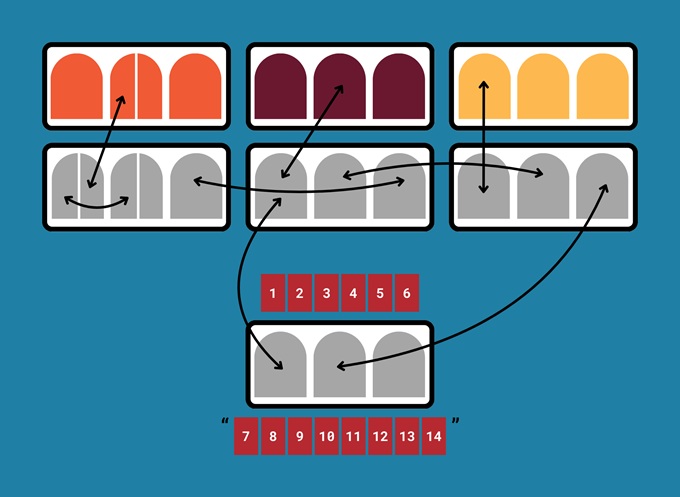
The top result for that query was a review of Escape the Greenroom (an escape room themed episode) on the blog Room Escape Artist, with three seemingly incongruous images added to the review. Overlaying those images over the prior puzzles spelled out a message, leading to a particularly fitting answer: CAMBRIDGE. Entering that word into the hunt’s answer checker didn’t solve the puzzle, however. Instead, it triggered a link to an unlisted YouTube video for teams, with a message from Dropout CEO and Game Changer host Sam Reich, himself.
Buried in Reich’s snarky response is a cryptic clue instructing solvers on the final step necessary to find the puzzle’s true solution. Amusingly, the puzzle’s solution document notes its initial design had to be scrapped because those elements were used to launch an actual Game Changer ARG, last year.
This Puzzle Was Here the Whole Time highlights two of the ways many hunt teams chase spectacle in puzzle design: enlisting nerdy celebrities to make puzzle cameos, and finding unexpected places to hide puzzles.
In making a cameo in a puzzle themed around his own show, Sam Reich has joined an impressive line of nerdy celebrities who made cameos in past Mystery Hunts. In 2022, Weird Al Yankovic congratulated puzzlers on completing a cooking-themed metapuzzle themed around his music. In 2024, Barenaked Ladies frontman Ed Robertson offered a similar congratulatory message for a puzzle based around one of their songs. Even former American National Standards Institute chairman Oliver Smoot joined in on the fun, narrating the 2020 puzzle Tall Tales as a nod to the time in college he established his own height as the unit of measurement for a campus bridge.
However, it’s not just about sneaking celebrities into puzzles: it’s also a question of where puzzles can be hidden. Room Escape Artist isn’t the only place Mystery Hunt puzzles have been hidden. Alex Rosenthal took advantage of his relationship with TED to hide secret puzzles in both TED-Ed videos as well as a TED talk he delivered on puzzle hunts, while Cards Against Humanity co-founder Josh Dillon helped print up a custom set of official game cards for a Mystery Hunt event.
Even reference sites for the MIT Mystery Hunt have been retrofitted into puzzles: in the puzzle Haddock Walk, a puzzle created a mirrored version of the MIT Mystery Hunt puzzle database with slight changes made to serve as base for a puzzle.
Lets Get Physical: The Care and Feeding of Voracious Puzzlers
The Starry Night puzzle was a particularly involved answer of how physical puzzles can be used to create spectacle. The Boxaroo team that made the puzzle published a write-up of how that puzzle came to be, from ideation to mass production. But spectacle in physical puzzles doesn’t always involve high production costs: for this year’s puzzle Da’ Bomb, spectacle centered around watching teammates make poor life choices.
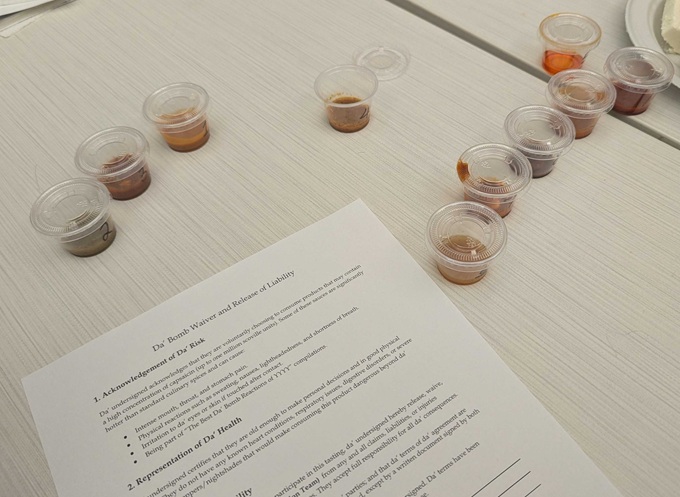
Setup for the puzzle was relatively simple: teams were provided with a series of ten numbered plastic cups with hot sauces, and charged with identifying the sauces and pairing them up with ten audio clips pulled from episodes of Hot Ones, with Sean Evans. The goal: identify the hot sauces used, look up their ingredient lists, and use the spice scale at the bottom of the puzzle page to “extract” an answer. And while a large part of the spectacle of Da’ Bomb involved watching teammates tenderly dab droplets of hot sauce on their tongues with toothpicks, even the puzzle’s liability waiver got into the fun, comedically noting that:
Da’ undersigned acknowledges that they are voluntarily choosing to consume products that may contain a high concentration of capsaicin (up to one million scoville units). Some of these sauces are significantly hotter than standard culinary spices and can cause:
- Intense mouth, throat, and stomach pain.
- Physical reactions such as sweating, nausea, lightheadedness, and shortness of breath.
- Irritation to da’ eyes or skin if touched after contact.
- Being part of “The Best Da’ Bomb Reactions of YYYY” compilations.
The physical care and feeding of teammates was mirrored with the virtual care and feeding of a Puzzmon. For the puzzle Novelty Store, teams were gifted with a virtual TaMITgochi pet, highly reminiscent of the retro Bandai toy. Proper care and feeding unlocked a series of dance moves for the pet, which spelled out a secret message.
This particular breed of spectacle at the MIT Mystery Hunt has been a popular form of oneupmanship, with build teams competing for the most impressive puzzle artifacts. Last year, much of the hunt centered around a custom radio, while the 2018 hunt’s puzzle Marked Deck produced a custom deck of playing cards featuring a layered, 3-dimensional rendering of the cover of Neal Stephenson’s Cryptonomicon when the cards are sorted in the correct order. Prior Mystery Hunts have produced everything from self-published books like The Puzzle at the End of This Book and Send Yourself Swanlumps to custom playable pinball machine with Game to Be Themed Later.
Prioritizing Puzzle Rounds As Source of Spectacle
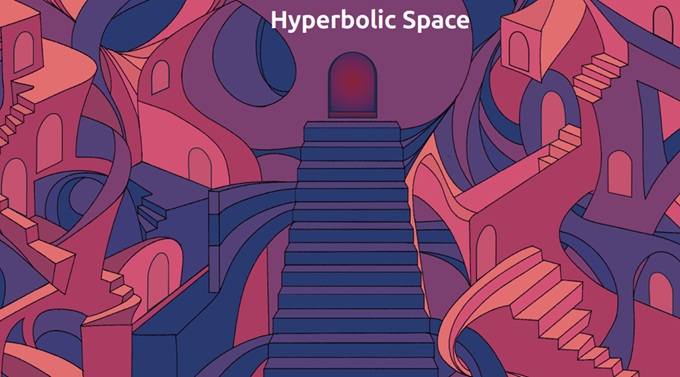
While the 2026 MIT Mystery Hunt featured spectacle of many different types, the biggest impact it will likely leave is in how heavily spectacle featured into entire puzzle rounds. Understanding what makes this so impressive requires an understanding of how puzzle hunts are typically constructed.
When designing puzzle hunts, teams will typically start by building out puzzle rounds, since restrictions built into the solving process for metapuzzles often rely on imposing restrictions against the individual puzzles that “feed” into them. Sometimes, those restrictions can even dictate other elements of round design. One example of this constraint in action can be found in the 2019 Mystery Hunt round Thanksgiving and Halloween, which required answers to include the letters A/B/O in a specific order, as a reference to blood types. To practically make that happen, an individual puzzle constructor might be instructed to write a puzzle with a solution that includes the letters BOB in that specific order. Just as likely, they might be assigned the solution SUBPROBLEM for a thematically appropriate puzzle they pitched to the puzzle editors.
Some puzzle types, however, don’t just dictate what the answer of a puzzle might resolve to, but a core structural element of the entire puzzle round. For the MIT Mystery Hunt I helped construct in 2024, my teammate Joseph DeVincentis constructed the meta A Rift in Hades to create a series of interdependent puzzles, so that each individual puzzle had six different solutions. This type of meta construction doesn’t just place restrictions on what puzzle answers look like, it adds restrictions to what the “feeder puzzles” themselves look like.
The MIT Mystery Hunt will often have a few rounds that are pressing the boundaries of what hunt structure looks like. But for the 2026 Mystery Hunt, practically every round in the second half of the hunt came with constraints that pressed the boundaries of what a puzzle round might look like, while at the same time imposing considerable restrictions on the types of puzzles that might live in that round. Below are some of the more impressive feats of puzzle meta construction.
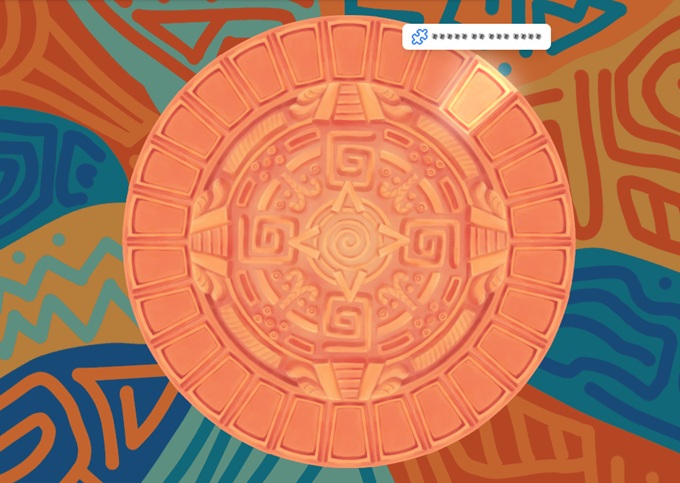
One of the first non-traditional puzzle rounds to confront solvers was The Land with No Name: a round of 26 puzzles where every puzzle corresponds with a letter in the alphabet. Even the text on puzzle pages remains obscured in a sea of question marks. The only way to unlock the missing letters across the 26 puzzle pages is to solve the corresponding puzzle. Initial entry points like an emoji-laden Celeste puzzle (which unlocks the letter “M” across all puzzles in the round after solving it) made it possible to reveal a few initial letters, but identifying which puzzles are potentially solvable at any given point are as much of the challenge of this round as anything else.
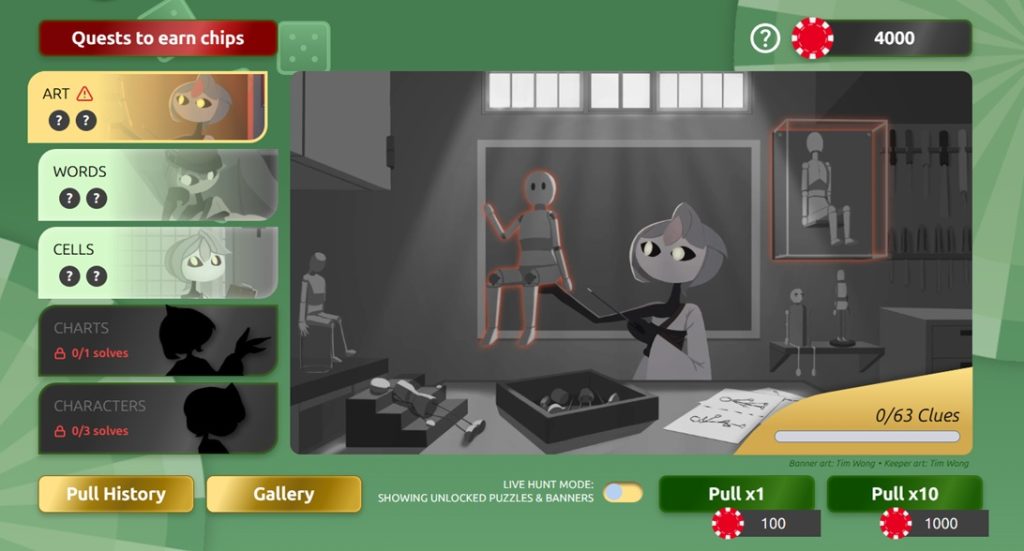
Fate’s Thread Casino round challenged teams to pull for puzzle fragments across five different categories. Pulling against the Characters banner, for instance, pulled anime trading cards associated with either the puzzle Hear Me Out, or the puzzle Goku. The first step of the puzzle involved figuring out which puzzle pieces go with which puzzle, using hints provided in the Quests section to figure out each puzzle’s mechanics.
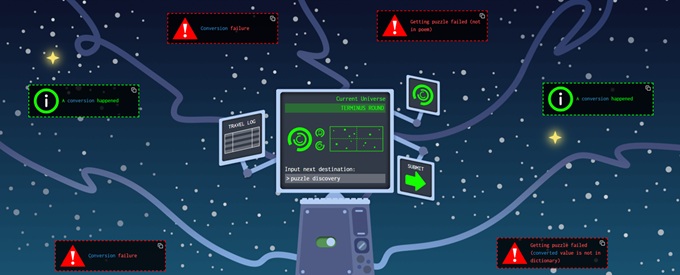
The Terminus round tasked solvers with hopping between dimensions to unlock puzzles across six different categories. Navigating to dimensions in the central terminal that met specific criteria would unlock puzzles from different dimensions offering puzzles following a highly specific theme. For instance, puzzles mapping back to the sixth dimension explored different methods of deconstructing crossword puzzles, asking “can you really call it a crossword if” there were no clues, no words, or no crosses. Offering a similar deconstruction, puzzles mapping back to the fourth dimension challenged solvers to identify popular terms based on their various trend lines, ranging from financial stock prices to Google Trends data on searches for numbers.
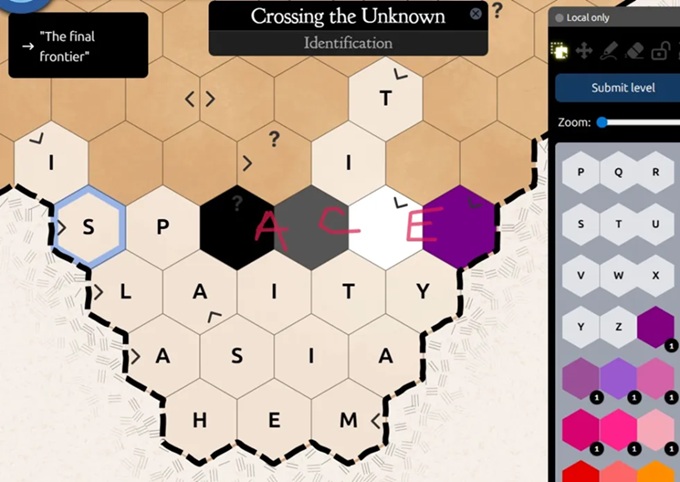
The hunt’s pièce de résistance, however (and that is a modest hint to the meta), was the Atlas of Mosaics round. The puzzle starts out simple: place lettered tiles on a hexagonal grid in response to crossword-style clues, but subsequent rounds get increasingly creative with their use of hexagonal tiles. At first, it starts simple: in addition to letters, colored tiles are added to the solving repertoire, like the section of “Identification” pictured above. Progressively, hexagonal tiles are placed by increasingly creative methods. How are popular celebrities related to each other? What’s the answer to a superhero themed murder mystery, with evidence ranging from progressive heat map scans of the scene of the crime to interrogations with four of the suspects? And how on earth do you cope with a grid that has colored dots moving across the hexagonal panels?
With over a hundred hexagonal sections organized across 12 different thematic rounds, the Atlas of Mosaics round is an in-depth exploration of the many different types of puzzles that can be fit into a hexagonal grid, with a metapuzzle reveal that justifies why teams were tasked with creating such an expansive grid. And while it’s comparatively easier to talk about how puzzle hunts can create spectacle through celebrity guest appearances or impressive technical builds, there’s something truly awe-inspiring about puzzle rounds that make you rethink the very nature of puzzles.
Whether that’s a puzzle that decides your access to the alphabet is a privilege to be earned, or one that maps out an entire world one hexagonal tile at a time.

Special Mention: Devilish Devilries
One of the innovations added to MIT Mystery Hunt structure from the 2025 hunt was the introduction of brief descriptions of feeder puzzles, since teams were given the opportunity to choose which puzzles to unlock. That tradition continued in 2026 for earlier rounds, with one notable evolution that persisted throughout the full hunt: puzzles were given iconographic indicators when they required MIT presence to solve, and “spicier” puzzles were given mature content warnings. And no puzzle earned that flag more than Devilish Devilries, which reduced my team’s MIT headquarters into fits of laughter.
As the puzzle title implies, the puzzle is comprised of a series of printer’s devilries, with a particularly spicy twist. For instance, one exchange starts out: “I am deed to see you well. / It was just a min. Omen Tim feeling better.” While the sentence as presented is somewhat incomprehensible, adding two words into the exchange makes things much clearer:
“I am de[light]ed to see you well. It was just a min.O[r ail]ment.”
The step that followed the discovery of the phrase LIGHT RAIL is what earned the puzzle its mature rating, while reducing our team to a classroom of immature middle schoolers.
Spectacle Through the Breadth and Depth of Puzzling
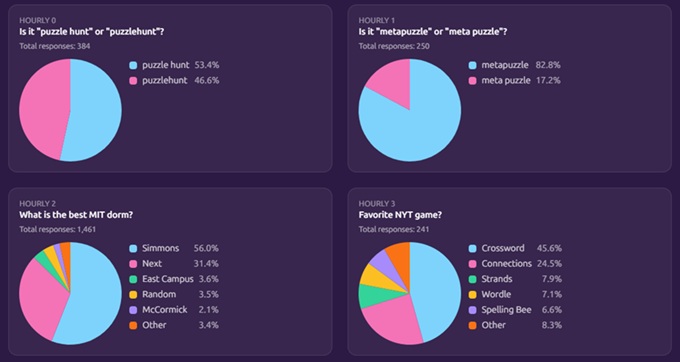
As is often the case with the MIT Mystery Hunt, even this lengthy overview only captures a small portion of the puzzles featured in the hunt. And that acts as its own form of spectacle. The hunt’s wrap-up page highlights some impressive stats, with over five thousand puzzlers tackling the hunt’s 232 puzzles while also completing almost a hundred scavenger hunt style “tasks” that this article didn’t even adequately address. Even that understates the sheer scope of the hunt, with teams placing over a quarter million hexagonal tiles over the course of the hunt.
To explore the hunt yourself, go to Puzzmon.world and explore it yourself: you don’t have to catch ’em all, but it’s definitely worth checking out a few corners of the game, whether that means an idle exploration of the underlying video game or attempting to solve the first few rounds of Atlas of the Mosaic. The Atlas of the Mosaic round in particular makes a great accessible entry into variety puzzling for the first few grid segments.
Since Providence won the 2026 MIT Mystery Hunt, they will be spending the next year creating the hunt for 2027, with their own unique view of what “spectacle” means. And I look forward to seeing what emerges.
 masquerade nyc
 subtext game
 simulacra
 escape rooms
 postcurious
 meow wolf
Thanks for the shoutouts and insightful analysis! So glad you enjoyed This Puzzle Has Been Here The Whole Time ?
The detail about the UV ink on the jigsaw pieces is such a clever twist. It really highlights how the hunt layers physical interaction with pure logic. Makes me wonder how many other puzzles had similar hidden layers we never even noticed.